
You are using an out of date browser. It may not display this or other websites correctly.
You should upgrade or use an alternative browser.
You should upgrade or use an alternative browser.
Grid-scale batteries: They’re not just lithium
- Thread starter JournalBot
- Start date
Mine that take 24V aren't rack mount, they're tower form factor (because they were cheaper and I have 120V at home...I can live with stacking on a rack-shelf) but the same idea applies. APC BR1500G+BR24BPG. Cost is a bit more looks like $243 for the main unit, $209 for the battery pack at B&H. Main unit takes 2x batteries in series, expansion unit takes 4x batteries in series-parallel. That will run everything except my home server for about 3 hours...and I have a separate UPS for my home server since Plex and home-automation is less critical than connectivity in general. I got them during the COVID pandemic because I was stuck WFH and a storm zapped my old UPS...and I really desperately needed high uptime to do my job during the pandemic. My main network (without the home server) is around 200W and varies 160-210 minutes of estimated runtime. I've let it go around 2 hours before starting a portable generator up. That powers my cable modem, starlink, cellular-backup, main router (pfsense on SFF PC), PoE 24 port managed switch, 4x APs, cellular extender, GPS NTP server, VoIP ATA, and a handful of other small things I can't recall (Pi's and such). As of May 2024 when there was a widespread outage it still held up for multiple hours runtime on the 4 year old batteries.The whole conversation was weird. @mmiller7 posted up unit characteristics that don’t appear to make sense (I can’t find any current APC UPSs that are rack mountable, take a 24V battery and are compatible with a remote battery unit; maybe that’s my overlooking something? Maybe APC no longer makes an equivalent unit? Etc).
I also couldn’t find anything less than $2k MSRP with a power curve that supported more than an hour of runtime at ~200W. Smt3000rm2u
At the same time, UPS costs vary wildly based on factors other than raw battery capacity. Offline versus line-interactive, stepped approximation of a sine versus pure sine output, monitoring/management capabilities, and more make a big difference.
If someone wanted to chase this down, we would probably want to get some clarification about the detailed specs/model is being used for a reference, and work from there.
We have bigger rack mount ones at work (where they have the budget) that takes around 220V DC worth of batteries on a sled, with optional additional sleds expanding it, and put out 208V 30A AC. I think they're the APC SRT 5000 series but they came in on a forklift they're so huge and heavy.
Last edited:
Upvote
3
(3
/
0)
Hydroelectric storage is a thing already.I'm not an expert in this area... but what about just pumping a lot of seawater up a mountain, and then slowly releasing it through a turbine generator whenever you need more electricity? There's no loss of stored energy over time like with chemical batteries.
Side benefit: if you happen to have extra energy, you can use the water pressure to push that seawater through reverse-osmosis filters and get freshwater, which is scarce in certain parts of the country, like California.
Is anyone doing something like this already?
https://en.wikipedia.org/wiki/Pumped-storage_hydroelectricity
I got to visit one near by Grandparents house when I was younger:
https://en.wikipedia.org/wiki/Smith_Mountain_Dam
Upvote
1
(1
/
0)
Australia is the second-largest zinc producer and has the largest reserves. The US is the fourth largest producer, and we could free up a lot of supply if we stopped minting useless pennies. (Modern pennies are 97.5% zinc.) We have a lot of options for getting zinc that don't rely on China. Not sure where you got the idea that Iran is a major zinc producer; they aren't even on the list here:Zinc - China produces more than four times as much as any other country, with only a couple of others being even within an order of magnitude.
https://en.wikipedia.org/wiki/Zinc_mining
Upvote
11
(12
/
-1)
Carlos Sempere
Seniorius Lurkius
Pumping water up at night and letting it down during the day is already common. Nearly all the good spots for a dam are already taken, though, and there's a limit to how much water you can move without affecting your water supply. In California, at least, reservoirs exist for water supply purposes rather than power; any power they can generate is a bonus but we're not going to compromise our supply for it.I'm not an expert in this area... but what about just pumping a lot of seawater up a mountain, and then slowly releasing it through a turbine generator whenever you need more electricity? There's no loss of stored energy over time like with chemical batteries.
Side benefit: if you happen to have extra energy, you can use the water pressure to push that seawater through reverse-osmosis filters and get freshwater, which is scarce in certain parts of the country, like California.
Is anyone doing something like this already?
I work at a small water district and we do the same with our treated water tanks and reservoirs. They're all small because treated water has to kept enclosed (these reservoirs have a roof over them), so we don't get much power out of them. But we do fill them at night when power is cheaper, and use them up during the day. The higher-elevation ones have turbines. Again, it's not much in our case.
It's also not enough pressure for reverse osmosis. The problem with that is that if you're pumping water up high, you might as well just pump it directly into those filters instead of to a higher elevation.
Upvote
4
(4
/
0)
So you don't believe that APG is an existential crisis and that we don't need to be throwing anything and everything at the problem. Good to know.APG isn't really relevant. Renewables are replacing other generation means because they are cheaper, which means they are only going to become more prevalent over time. Grid storage is a natural outgrowth because renewables benefit from time-shifting between generation and use.
Last edited:
Upvote
-11
(0
/
-11)
I only looked at that website/model a little bit. Frankly, a lot of costs and terms I don’t understand, but using 2011 weather data was a problem for me.DDopson probably wasn't running his optimization exercises on Europe, but if did he'd see hydrogen having a larger role.
Constraining the problem to Germany, and using the 2011 weather data / 2030 cost predictions, including hydrogen cuts the cost nearly in half, a larger effect that he was seeing.
I haven't done Europe as a single entity, which might see less hydrogen due to statistical averaging of wind output.
EDIT: I selected most of Europe out to Poland and Hungary (excluding the UK, Norway, Sweden, and Finland). Hydrogen still saves, although not quite that much (53.6 euro/MWh vs. 79.1 euro/MWh). This is consistent with my expectations.
The model is basically a back of the envelope calculation to give people a sense of big changes. But there are systemic things that can easily nuke any conclusions you may derive from it.
If you are using a back of the envelope model for this, using 2050 weather data is a big input that could change things. We are on track for about +6 °F global temperatures in about 80 years. Europe? Could be higher? Could be lower due to lack of AMOC? If we actually do something drastic to address global warming, might only be +3 °F.
So, a latitude shift might be the best way to use the model for 2050. Do not include any northern European countries. Include northern African countries. Maybe it will represent a more accurate number.
Like others, I’m pretty firm in the belief that all of Northern Europe will have air conditioning in the decades to come, and their energy needs for heating is going to decrease. Summer A/C may well be the biggest use of energy. That will change how much gas based storage is needed.
Heh, I’m waiting for that one special summer where the rivers get so hot that it will limit thermal plants, be it nuclear, gas, or coal, because dumping the river water used for cooling is going to kill lots and lots of flora and fauna downstream. A Kobiyashi Maru decision will then have to be made. Kill the river, or have AC.
Curtailing of one or two thermal plants has already happened here in there, but it will just take one special summer, the first of many special summers, for a wider disaster to happen.
Upvote
5
(5
/
0)
"Remote shutdown" is related to feeding the grid. There will be times when NO power can be accepted, and the facility has to be forced off-grid and the solar production (if the battery is full and the grid operator doesn't need/want the energy) throttled. Current residential solar isn't able to do that. When a good-sized battery is added, it can, for a while at least.The system I described was for a home that uses about 16.5 MWH per year. I didn't think it was an unusual number at all. It's the usage for your basic 2500 to 3500 ft2 house in Texas. That's not an average house, but 2500 to 3500 ft2 houses are pretty common. Electricity usage would be even more if the house had a pool. Those folks really have to pay for having the pleasure of a pool, $600, $700, $800 per month during the summer.
Yes, once you are generating a lot more than you use, it gets complicated. Obviously the grid will not let you make money on it. A lot of the power providers here just limit how much output power you can have. I haven't heard about remote shut down capability for a solar+storage system before though. The signaling is from cellular or WiFi I assume? What happens during a grid outage?
Upvote
1
(1
/
0)
Small scale: I grew up in and around San Francisco. Nobody had a/c in the 1950s-60s; it was way too expensive, and simply not needed when days got to around 80F perhaps 2-3 times a year. Same thing in Santa Rosa in the 1970s-80s; it got hot (90sF) during the day, but outside of a few short episodes in the fall you could depend on a cooldown in the afternoon and often morning low overcast. On those couple of hot days, if you had a car with a/c, you took a drive in the afternoon perhaps to visit a few wineries.I only looked at that website/model a little bit. Frankly, a lot of costs and terms I don’t understand, but using 2011 weather data was a problem for me.
The model is basically a back of the envelope calculation to give people a sense of big changes. But there are systemic things that can easily nuke any conclusions you may derive from it.
If you are using a back of the envelope model for this, using 2050 weather data is a big input that could change things. We are on track for about +6 °F global temperatures in about 80 years. Europe? Could be higher? Could be lower due to lack of AMOC? If we actually do something drastic to address global warming, might only be +3 °F.
So, a latitude shift might be the best way to use the model for 2050. Do not include any northern European countries. Include northern African countries. Maybe it will represent a more accurate number.
Like others, I’m pretty firm in the belief that all of Northern Europe will have air conditioning in the decades to come, and their energy needs for heating is going to decrease. Summer A/C may well be the biggest use of energy. That will change how much gas based storage is needed.
Heh, I’m waiting for that one special summer where the rivers get so hot that it will limit thermal plants, be it nuclear, gas, or coal, because dumping the river water used for cooling is going to kill lots and lots of flora and fauna downstream. A Kobiyashi Maru decision will then have to be made. Kill the river, or have AC.
Curtailing of one or two thermal plants has already happened here in there, but it will just take one special summer, the first of many special summers, for a wider disaster to happen.
That's not the way things are any more, and a/c has become standard in newer housing in the Bay Area. It's a common retrofit when somebody's spending money on HVAC (there are big rebates and credits for installing heat pumps to replace old gas furnaces, which brings a/c as a side effect). And it's needed with 90F happening several times a year in SF itself in the summer-fall (with 80s becoming fairly common away from the immediate coastline) and the relatively high humidity that comes with being surrounded by water on 3 sides.
"Normal" in the weather business is a 30-year average. That doesn't work any more. Things are changing more quickly than that.
Upvote
3
(3
/
0)

Yeah, all that makes a lot more sense. Thanks for the clarification.Mine that take 24V aren't rack mount, they're tower form factor (because they were cheaper and I have 120V at home...I can live with stacking on a rack-shelf) but the same idea applies. APC BR1500G+BR24BPG. Cost is a bit more looks like $243 for the main unit, $209 for the battery pack at B&H. Main unit takes 2x batteries in series, expansion unit takes 4x batteries in series-parallel. That will run everything except my home server for about 3 hours...and I have a separate UPS for my home server since Plex and home-automation is less critical than connectivity in general. I got them during the COVID pandemic because I was stuck WFH and a storm zapped my old UPS...and I really desperately needed high uptime to do my job during the pandemic. My main network (without the home server) is around 200W and varies 160-210 minutes of estimated runtime. I've let it go around 2 hours before starting a portable generator up. That powers my cable modem, starlink, cellular-backup, main router (pfsense on SFF PC), PoE 24 port managed switch, 4x APs, cellular extender, GPS NTP server, VoIP ATA, and a handful of other small things I can't recall (Pi's and such). As of May 2024 when there was a widespread outage it still held up for multiple hours runtime on the 4 year old batteries.
We have bigger rack mount ones at work (where they have the budget) that takes around 220V DC worth of batteries on a sled, with optional additional sleds expanding it, and put out 208V 30A AC. I think they're the APC SRT 5000 series but they came in on a forklift they're so huge and heavy.
Upvote
3
(3
/
0)
A latitude shift isn't a good proxy for changes in climate because even if Earth sees extreme climate changes, the Northern latitudes will still see a greater seasonality effect on solar generation, which is determined primarily by the Earth's axial tilt.I only looked at that website/model a little bit. Frankly, a lot of costs and terms I don’t understand, but using 2011 weather data was a problem for me.
The model is basically a back of the envelope calculation to give people a sense of big changes. But there are systemic things that can easily nuke any conclusions you may derive from it.
If you are using a back of the envelope model for this, using 2050 weather data is a big input that could change things. We are on track for about +6 °F global temperatures in about 80 years. Europe? Could be higher? Could be lower due to lack of AMOC? If we actually do something drastic to address global warming, might only be +3 °F.
So, a latitude shift might be the best way to use the model for 2050. Do not include any northern European countries. Include northern African countries. Maybe it will represent a more accurate number.
Like others, I’m pretty firm in the belief that all of Northern Europe will have air conditioning in the decades to come, and their energy needs for heating is going to decrease. Summer A/C may well be the biggest use of energy. That will change how much gas based storage is needed.
Heh, I’m waiting for that one special summer where the rivers get so hot that it will limit thermal plants, be it nuclear, gas, or coal, because dumping the river water used for cooling is going to kill lots and lots of flora and fauna downstream. A Kobiyashi Maru decision will then have to be made. Kill the river, or have AC.
Curtailing of one or two thermal plants has already happened here in there, but it will just take one special summer, the first of many special summers, for a wider disaster to happen.
Changes in climate could alter wind patterns, so there might be an effect there, but in the range of uncertainties in this modeling exercise, I don't think that's such a big deal. It will modulate the outcome a bit, but won't change the qualitative conclusions.
The real-world answer is going to experience a gravitational attraction in the direction of the modeling result, but will be complicated by many other factors, including the sunk-cost effect of existing infrastructure, and the renewables deployments being a deal-by-deal project-by-project effort, not something that scales as smoothly as the model.
Simplified models can have useful predictive power and can help develop intuitions about the system's sensitivity to various assumption changes, but ultimately, if you want the only model that has perfect fidelity, you have to wait to see how the physical world plays out. The nuance is in understanding the bounds, assumptions, and error bars on the modeling exercise.
Still, there are better models out there, used by people who have a stronger economic interest in arriving at a more precise result. One of the big improvements is to model the existing grid infrastructure with a spatial understanding of both generation and demand, and of course you need those curves on an hour-by-hour basis. I haven't figured out how to get any of those working yet, but my understanding is that their results differ only in the particulars, not in the qualitative / intuitional conclusions.
Upvote
6
(6
/
0)
I agree with everything you've written. In particular, gas turbines will continue to be our solution for managing multi-day variability until there's a major shift on either public policy or the cost assumptions.4) dunkelflaute events; It might occur that over a period of some weeks in winter, both wind and solar produce much lower than average in the entirety of Europe. This is quite rare (2 weeks out of the year), but we need to be able to cope with it nonetheless. The economics are a lot different for this type of storage: We look towards energy sources with low capital costs per stored kwh (batteries are out of the question), but we allow much bigger operating cost per kwh. Because it's used so little, we don't see this as an urgent problem to solve and are currently quite agnostic about what will turn out the be the most economical option in 2050. Natural gas is currently the perfect solution, and this will probably remain the very last thing we do with natural gas up until 2050. Cheap to store, cheap to burn. Many say this is the place where hydrogen and green molecules in general will shine. The absolutely dreadful efficiency of producing green hydrogen is less of an issue because of how little we need it. Similarly, synthetic fuels, biofuels, waste fuels might be a solution here, although we will probably need those for aviation.
The irony about it all is that so much (online) discussion happens related to point number 4, which is an absolutely tiny part of the energy transition. Even if it turns out the tech is not there in 2050 to tackle point number 4 in a carbon neutral way, it will mean very little for the climate to just have that one point be something that's solved at a later date. (well, the tech is definitely here already, but I mean rolling it out at scale in time)
All of my conclusions regarding hydrogen as energy storage are contextualized by the hypothetical consideration of a world that has at least a carbon tax, if not an outright zero-emissions requirement (equivalent to an infinite carbon tax).
I've also seen a lot of talk along the links of "dunkelflaute happens" therefor "renewables can't work", which is dumb on several levels, so it's refreshing to have a talking point for how even dunkelflaute events can be handled on a true zero-emissions grid, using present-day technology, for only a modest cost premium over the "mostly renewables" grid that we are in the process of deploying. And it was eye-opening for me to realize that hydrogen was suddenly relevant in that scenario.
Fixing the last 10% of electricity related emissions isn't any more important than fixing the equivalent quantity of emissions in the heating, transportation, chemicals, steel, and cement sectors, or anywhere else. A carbon tax would be a smart policy because it would allow the market to automatically figure out which emissions reductions are the most efficient to pursue first.
It doesn't make sense to use green hydrogen for energy storage until we've displaced most of the grey hydrogen production, although neither commodity is easily transported, so it's possible for different regions to convert at different times. Certainly, we wouldn't want to produce grey hydrogen and then burn that in a turbine, because it produces only a fraction as much energy as burning the methane directly. Which means that we should prefer to prioritize our remaining methane consumption for power production over hydrogen production. I can figure that out from first principles, or a slowly escalating carbon tax would work it out automatically.
Upvote
7
(7
/
0)
I assume APG is some weird synonym for "climate change", but I have no idea what it stands for.So you don't believe that APG is an existential crisis and that we don't need to be throwing anything and everything at the problem. Good to know.
Empirically, we aren't "throwing anything and everything" at the problem, because most of our population isn't willing to pay what I've estimated would be a 10% cost premium for true zero-emissions electricity. Nor is there political consensus to pass a basic carbon tax. We've effectively set a price of $0 on carbon pollution, willing to take lower pollution solutions ONLY when they also save us money. Plus various cosmetic greenwashing efforts to assuage anxieties over the problems we're unwilling to solve directly.
In reality, it's more like we are throwing exactly nothing at the problem, and we are damned lucky that the march of technology is making progress on the problem in our absence.
The idea that society would be willing to pay a 400% premium for electricity in order to deploy your favorite technology is ... implausible.
Upvote
13
(13
/
0)
CAISO will force you off-grid or just shutdown your PV inverter through an Internet command? If the latter, you can remain on-grid but with the PV system offline?"Remote shutdown" is related to feeding the grid. There will be times when NO power can be accepted, and the facility has to be forced off-grid and the solar production (if the battery is full and the grid operator doesn't need/want the energy) throttled. Current residential solar isn't able to do that. When a good-sized battery is added, it can, for a while at least.
Or are the smarts are in the meter? Where they will shut off power at the meter, and if so, your solar+storage will be in self-consumption mode? I have not thought about what happens if the batteries are full. If they are full, the controller box will shut down the solar PV connected to it? Just asking myself here.
Well, I will find out soon enough as 2 Powerwall 3 units are going to be installed in my house soon. Curtailment is quite unlikely in ERCOT, currently, but I have multiple multi-day blackouts in the past 4 years, so I'll have an answer about what happens to the solar PV system if the batteries are at capacity sooner or later.
Upvote
1
(1
/
0)
paulfdietz
Ars Scholae Palatinae
Certainly, we wouldn't want to produce grey hydrogen and then burn that in a turbine, because it produces only a fraction as much energy as burning the methane directly.
There is one way this could make sense: if the CO2 is sequestered. The steam methane reforming plant producing the hydrogen (and the CO2 for sequestration) could operate full time, with the hydrogen stored to be burned during those rarer times when extra power is needed. This could be cheaper than having the CO2 capture on the turbines themselves, operated at lower duty cycle and higher peak throughput.
Methane leakage would have to be very low for this to work out, though.
Upvote
-1
(1
/
-2)

How can it be cheaper than just burning the methane and sequestering the CO2 after combustion? Why waste energy and capital on making H2? Be sure to burn it in an Allam Cycle plant as well.There is one way this could make sense: if the CO2 is sequestered. The steam methane reforming plant producing the hydrogen (and the CO2 for sequestration) could operate full time, with the hydrogen stored to be burned during those rarer times when extra power is needed. This could be cheaper than having the CO2 capture on the turbines themselves, operated at lower duty cycle and higher peak throughput.
Methane leakage would have to be very low for this to work out, though.
Upvote
4
(4
/
0)
I'm not all that deep on steam reforming, but the first page that I found suggested a 36% energy efficiency, meaning that for each MWhr worth of methane, you'd produce 0.36 MWhr worth of hydrogen. If burned in a turbine, either fuel would have a similar energy efficiency. With an efficient fuel cell, you might get higher efficiency from hydrogen than from a gas turbine, but not by anywhere near enough to make up the losses in the steam reforming process.There is one way this could make sense: if the CO2 is sequestered. The steam methane reforming plant producing the hydrogen (and the CO2 for sequestration) could operate full time, with the hydrogen stored to be burned during those rarer times when extra power is needed. This could be cheaper than having the CO2 capture on the turbines themselves, operated at lower duty cycle and higher peak throughput.
Methane leakage would have to be very low for this to work out, though.
And then on top of all of that, you have to spend the energy to compress, transport, and inject carbon dioxide for long-term geological sequestration, something that usually consumes significant energy on its own. And tends to be appallingly expensive, so expensive in the model's default cost assumptions that mandating sequestration results in zero gas peakers.
Last edited:
Upvote
5
(5
/
0)
DiogenesNJ
Smack-Fu Master, in training
Why no mention of the MIT spinoff Ambri's calcium-antimony liquid metal battery? It's been under development for a decade. They went broke, filed Chapter 11, and are now owned by their former lenders and have re-capitalized. The lenders must figure it's a reasonable bet. They just got UL-1973 certification, which is a big step toward commercial acceptance, and are partnering with Xcel Energy which is also testing a 400KWh system. Their claim is a 20-year life with "minimal fade", although they don't cite a specific percentage. The raw materials are relatively inexpensive. Or were - the price of antimony has spiked recently to record levels since China has cut back on exports (antimony is also used in munitions as tracers and primers).Thank you for this. We don't usually hear much about the non-Lithium Ion battery tech currently in use.
Upvote
3
(3
/
0)
Oh dear Lord:I assume APG is some weird synonym for "climate change", but I have no idea what it stands for.
Empirically, we aren't "throwing anything and everything" at the problem, because most of our population isn't willing to pay what I've estimated would be a 10% cost premium for true zero-emissions electricity. Nor is there political consensus to pass a basic carbon tax. We've effectively set a price of $0 on carbon pollution, willing to take lower pollution solutions ONLY when they also save us money. Plus various cosmetic greenwashing efforts to assuage anxieties over the problems we're unwilling to solve directly.
In reality, it's more like we are throwing exactly nothing at the problem, and we are damned lucky that the march of technology is making progress on the problem in our absence.
The idea that society would be willing to pay a 400% premium for electricity in order to deploy your favorite technology is ... implausible.
a) I didn't say 'we', I said 'you'. Don't go off on a tangent concerning something I didn't say.
b) That 'last 10%' is the difference between surviving the winter or freezing in the dark. Don't play with other people's lives.
c) Stop declaring something is so by fiat. You still haven't shown that hydrogen storage is feasible, preferring to double down and demand other people prove that it isn't. If that's the standard you want to go by, just skip to nuclear fusion; it's demonstrated a net energy positive and so it must be feasible.
d) I don't have a 'favorite technology'.
e) I suggest you dial down the combativeness and address the points ... particularly point c). That's the one you've been ducking. The rest is just so much squid ink: 'My favorite technology'? I can't imagine why you think this advances the discussion.
Upvote
-12
(0
/
-12)

As long as we're calling people out for ducking questions, what is 'APG'?Oh dear Lord:
a) I didn't say 'we', I said 'you'. Don't go off on a tangent concerning something I didn't say.
b) That 'last 10%' is the difference between surviving the winter or freezing in the dark. Don't play with other people's lives.
c) Stop declaring something is so by fiat. You still haven't shown that hydrogen storage is feasible, preferring to double down and demand other people prove that it isn't. If that's the standard you want to go by, just skip to nuclear fusion; it's demonstrated a net energy positive and so it must be feasible.
d) I don't have a 'favorite technology'.
e) I suggest you dial down the combativeness and address the points ... particularly point c). That's the one you've been ducking. The rest is just so much squid ink: 'My favorite technology'? I can't imagine why you think this advances the discussion.
Upvote
3
(3
/
0)
Please be more specific about what you think needs to be proven WRT Hydrogen storage. We know how to store it in in tanks at room temperature and cryogenically. We have some evidence of significant reserves in ‘natural storage’:Oh dear Lord:
a) I didn't say 'we', I said 'you'. Don't go off on a tangent concerning something I didn't say.
b) That 'last 10%' is the difference between surviving the winter or freezing in the dark. Don't play with other people's lives.
c) Stop declaring something is so by fiat. You still haven't shown that hydrogen storage is feasible, preferring to double down and demand other people prove that it isn't. If that's the standard you want to go by, just skip to nuclear fusion; it's demonstrated a net energy positive and so it must be feasible.
d) I don't have a 'favorite technology'.
e) I suggest you dial down the combativeness and address the points ... particularly point c). That's the one you've been ducking. The rest is just so much squid ink: 'My favorite technology'? I can't imagine why you think this advances the discussion.
https://meincmagazine.com/science/202...ave-stumbled-upon-a-mammoth-hydrogen-deposit/
So when you say nobody’s demonstrated that Hydrogen storage is feasible, it seems like you must mean something more specific, as simply storing Hydrogen is a known thing, and the existence of significant underground deposits necessarily implies that it can remain in such deposits for periods of time greater than seasonal shifts.
Upvote
7
(7
/
0)
Thanks with providing us with a textbook example of a Straw Man argument. I discussed a priority ordering for decarbonization and then you swapped what I actually said for some crazy-pants argument about shutting off the power to people's homes during periods of dangerous cold, allowing you, the heroic virtue-signaling knight, to step in and thoroughly demolish that straw man position.b) That 'last 10%' is the difference between surviving the winter or freezing in the dark. Don't play with other people's lives.
Last edited:
Upvote
10
(10
/
0)
ALittleTeapot
Ars Scholae Palatinae
Australia is the second-largest zinc producer and has the largest reserves. The US is the fourth largest producer, and we could free up a lot of supply if we stopped minting useless pennies. (Modern pennies are 97.5% zinc.) We have a lot of options for getting zinc that don't rely on China. Not sure where you got the idea that Iran is a major zinc producer; they aren't even on the list here:
https://en.wikipedia.org/wiki/Zinc_mining
That's probably why I didn't say anything resembling Iran being a major zinc producer. Australia does not have the largest reserves, Iran does. Having "options that don't rely on China" is not relevant. We have options for pretty much everything that don't rely on China. We could do all our own manufacturing. We could mine and/or produce pretty much all our own raw materials, or at least obtain them from a variety of more friendly countries and/or those with less abusive labour practices. The simple fact is that we do not actually do so.
The article claimed that the resources used in various alternative battery chemistries are cheap and easily obtainable without many of the concerns relating to materials used in lithium batteries. Most zinc is produced in China. Most bromine is produced from the Red Sea. Exactly the same concerns clearly exist for these materials. It being hypothetically possible to change that in the future is not relevant, especially given that we demonstrably have not done so for the materials in lithium batteries which are also plentiful in many places that do not currently produce them in significant quantities.
Upvote
-3
(1
/
-4)
[Emphasis added]The trade off with flow batteries is charge/discharge rate is significantly reduced compared to cell batteries, they tend to be big, though, because they need to have 2x the volume as their electrolyte takes up, just in electrolyte tanks, mostly seasonal grid, the advantage is that they can scale up almost at cubed square and the electrolyte can be cheap.
Not true. Classic trick: You have a tank with two compartments separated by a moveable wall. The total volume of the tank is sufficient to hold all the electrolyte, but it's divided in two with exactly as much volume as needed for the charged vs. uncharged electrolyte on one side or another. (An alternative is a tank with an inflatable "balloon" inside; the two liquids are divided between "inside" and "outside" of the "balloon." Same result.)
There's obviously some significant engineering effort to make this leak-proof and long-lasting and it likely ends up somewhat larger than what the base volume of electrolyte predicts. If you configure it right, the pressure from the "growing" side of the tank can help push fluid out of the "shrinking" side letting you waste less energy in pumping.
Upvote
-1
(0
/
-1)

How does the green hydrogen scenario compare to over provisioning and using the excess for carbon fixation? Is there yet a way to account for those dollars in the model.energy calculator?You need to read my original post more carefully. It considers that option and finds that it costs 130% instead of 110% of the polluting solution's cost.
Wind+Solar+Batteries are a fantastically cost-efficient way to produce the first ~85% of electricity, and even in a world without carbon taxes or other policy incentives, the lowest cost solution produces the vast majority of all electricity from renewables. That's why renewables deployments are scaling exponentially. It's just plain cheaper.
But then you reach a point where further renewables deployments generate most of their power on days where you've already satisfied 100% of demand, leading to curtailment. And the time gap between this curtailed power and the next day on which you need it is too long for battery storage to be economical. In a world without carbon taxes, the most economical solution is to pollute by running a gas turbine.
But what if you don't want to pollute at all? Is a zero-emissions grid feasible?
For context, one of the evergreen "discussion topics" is whether renewables, with their obviously variable power output, are capable of providing a stable, reliable power grid, or whether it's all just a greenwashing scam that can't possibly scale to more than a few percent of our power and there will always be a coal power plant running under the hood. In large part, the persistence of this topic is driven by "common-sense" observations that the sun doesn't shine at night, that clouds can cover an individual solar panel, and that the wind people perceive at ground level varies wildly, with long periods of little movement punctuated by occasional gusts. People often don't realize that the wind at a turbine's height is nothing like what they experience at ground level and that cloud shading effects can be almost totally averaged away by summing across a large number of panels.
Unfortunately, renewables variability is a topic that can only be properly addressed statistically. The post that you originally responded to summarizes my conclusions from a dozen hours of data analysis using real-world weather data to estimate Wind and Solar production hour-by-hour and understand the impact that variability has on the lowest-cost solution for providing reliable electricity under various assumption-sets. I'm using a model that's simplified in several ways, including using a constant demand curve, but the conclusions it reaches are broadly consistent with much more complex grid simulations that run on finer temporal and spacial granularity including transmission modeling. It's infinitely more accurate than anyone's subjective hand-waiving about renewables variability, which is something that we get a lot of in the media, in politics, and in these discussion forums.
When you say "Solar/wind and battery storage already exist" you are effectively proposing the over-provisioning solution where we continue deploying more solar, wind, and batteries until we satisfy all demand, along with curtailing a non-trivial fraction of that extra generation capacity. That costs 130% of the cheapest solution with 15% pollution, which isn't exactly unaffordable, but it's three times the cost premium of a solution that uses some over-provisioning of solar/wind/batteries, but then addresses the last 3.3% of residual unmet demand by burning expensive green hydrogen that was (inefficiently) produced during times of excess power. When including green hydrogen as energy storage, zero-emissions is possible for only 110% the cost of the polluting solution.
The hydrogen cost assumptions aren't particularly rosy, and not only would the scenario's green hydrogen be significantly more expensive than grey hydrogen produced from methane, it would be much more expensive than burning methane in a gas turbine. But it's cheaper than building wind and solar resources that are >90% curtailed. It's cheaper than doubling the number of batteries, which the over-provisioning scenario does in addition to deploying heavily curtailed renewables. It's cheaper than carbon sequestration. It's cheaper than nuclear.
That conclusion surprised me, so I played with the model extensively to see if it was sensitive to any of the cost assumptions, and under all plausible assumption sets, including aggressively pessimizing hydrogen cost and being beyond aggressively optimistic about battery and solar prices, zero-emissions was always cheaper when the last X% of electricity was solved by burning expensive green hydrogen. Changing the assumptions just meant that X would be 1% instead of 3%.
I don't expect to see green hydrogen get deployed anytime soon for the simple reason that it's currently cheaper to pollute. Until either the policy or cost assumptions change, our grid will continue moving in the direction of the 85/15 lowest cost solution. Putting a price on pollution would be smart, and efficient, but we seem pretty far from that being politically feasible.
Upvote
3
(3
/
0)
I agree that pennies are useless, but 8B and 2.5g each only works out to around 20kt/yr, out of 750kt/yr US production.Australia is the second-largest zinc producer and has the largest reserves. The US is the fourth largest producer, and we could free up a lot of supply if we stopped minting useless pennies. (Modern pennies are 97.5% zinc.) We have a lot of options for getting zinc that don't rely on China. Not sure where you got the idea that Iran is a major zinc producer; they aren't even on the list here:
https://en.wikipedia.org/wiki/Zinc_mining
Upvote
4
(4
/
0)
paulfdietz
Ars Scholae Palatinae
How can it be cheaper than just burning the methane and sequestering the CO2 after combustion? Why waste energy and capital on making H2? Be sure to burn it in an Allam Cycle plant as well.
Because then the CO2 capture equipment is operating with low duty cycle. It has to be sized larger. For example, for the Allam cycle, you're having that air separation plant sitting there idle most of the time. By making hydrogen, the SMR plant can be operated 365/24/7.
Upvote
0
(0
/
0)
paulfdietz
Ars Scholae Palatinae
I'm not all that deep on steam reforming, but the first page that I found suggested a 36% energy efficiency, meaning that for each MWhr worth of methane, you'd produce 0.36 MWhr worth of hydrogen. If burned in a turbine, either fuel would have a similar energy efficiency. With an efficient fuel cell, you might get higher efficiency from hydrogen than from a gas turbine, but not by anywhere near enough to make up the losses in the steam reforming process.
And then on top of all of that, you have to spend the energy to compress, transport, and inject carbon dioxide for long-term geological sequestration, something that usually consumes significant energy on its own. And tends to be appallingly expensive, so expensive in the model's default cost assumptions that mandating sequestration results in zero gas peakers.
That's not what I got.
https://iopscience.iop.org/article/10.1088/1742-6596/2053/1/012007/pdf
"The most efficient hydrogen production method is the catalytic reforming of hydrocarbons. For example, the energy consumption for hydrogen production by the steam methane reforming (SMR) is 2 kWh/Nm3 of H2 at the efficiency level of 74–85% but this is not “green” hydrogen because the SMR side product is the carbon dioxide. The steam methane reforming environmental performance may be improved by the carbon dioxide capture and storage which makes the hydrogen environmentally harmless “light blue” [13]. The SMR technology cost is relatively low so it is the most popular hydrogen production technology applied for 76% of the world production. Other methods of hydrogen production by hydrocarbon reforming have lower efficiency of 60–75% for example the auto-thermal reforming [7]. "
Upvote
2
(2
/
0)
The cost for that is going to be the same 130% of the polluting solution, PLUS the cost of the fixation equipment. And to be economically efficient, you'd want to run the fixation equipment at a fairly high duty cycle (I suspect ~80%), which means you can only use a fraction of the excess power before it's more efficient to deploy additional renewables than additional fixation equipment.How does the green hydrogen scenario compare to over provisioning and using the excess for carbon fixation? Is there yet a way to account for those dollars in the model.energy calculator?
Or what you might have meant is that you could spend that sequestration on allowing an equivalent amount of gas peaker usage such that the system is net neutral on emissions. This effectively turns DAC+Peaker into an energy storage system that competes against hydrogen storage.
Here's the tool's default cost assumptions for Batteries / Hydrogen / DAC, all scaled proportional to a 1 kW "discharge rate":
Batteries:
* Charging: €0 capex per [1.04 kW_electric => 1.02 kW_battery] (capex already covered by higher discharge need)
* Storage: €160 capex per 1.02 kWhr_battery
* Discharge: €180 capex per [1.02 kW_battery => 1 kW_electric]
Hydrogen (per the model's default cost assumptions):
* Electrolyzer+Compressor: €1243 + €487 capex per [2.5+0.1 kW_electric => 1.7 kW_H2] (68% efficiency)
* Geologic Storage: €0.25 capex per 1.7 kWhr_H2 (their source: 2009 NREL report)
* OR Stainless Storage Tanks: €22 capex per 1.7 kWhr_H2
* Turbine: €916 capex per [1.7 kW_H2 => 1 kW_electric] (58% efficiency)
DAC+Peaker:
* DAC+Heat Pump: €3,312+€660 capex per [0.6 kW_electric => -0.5 kgCO2]
* CO2 Sequestration Cost: ???? per -0.5 of kgCO2
* Energy Storage: several times cheaper (to store a reserve of the CH4 you plan to burn)
* Peaker: €442 per [€50 of CH4 cost => kW_electric + 0.5 kgCO2]
Based on the cost assumptions above, DAC+Peaker wants to run with a much higher duty-cycle than Hydrogen Storage, due to the "charging" infra being 2.3X more capex intensive, but using only 1/4th as much electricity. Even though there's less electrical input, the variable cost to generate a MWhr from Peaker+DAC is actually slightly more expensive than the variable cost to purchase and burn Green Hydrogen. In these cost assumptions, DAC's primary advantage is that methane turbines are assumed to be less than half as much capex as a hydrogen turbine. Their gas peaker capex numbers might be too low, or at least they are lower than the numbers published by Lazard. If the turbine costs were equivalent, DAC+Peaker would have no role in the solution.
DAC behaves very similarly to a €100/tCO2 carbon tax by effectively doubling the "fuel" cost for a gas peaker from €50/MWhr to €100/MWhr. This is feels pretty optimistic, given that the US is currently funding DAC pilot plants that are "targeting" $160/tCO2 (with a long history of these projects failing to hit their targets) and "aspire" to eventually reach $100/tCO2 "at scale" (in their pitch decks). The difference could be explained by my lack of a number for the actual CO2 sequestration cost. I suspect that these cost numbers for DAC might only cover capturing the CO2, not storing it.
With the somewhat optimistic €100/tCO2 for DAC, the model reduces peaker usage to 1.1% of all electricity, and spends roughly as much on hydrogen infra as on peaker plants. The solution prefers burning green hydrogen over burning methane that it has to pay for with DAC, so DAC is only being used to scale discharge capacity more cheaply than purchasing additional hydrogen turbines.
If I use a more pessimistic €150/tCO2 for DAC, the model reduces peaker usage to only 0.2% of all electricity. The peakers in this scenario have an appalling 1.3% duty cycle, making their electricity €680/MWhr.
It wouldn't take much to push DAC entirely out of the solution.
Last edited:
Upvote
5
(5
/
0)
It goes both ways. Simplified models can be straight-up incorrect because this or that assumption, this or that not being modeled. The site warns you it is a toy model. So, the usual with toy models. They provide a nice sense of what could happen, but don't hold those beliefs too closely.Simplified models can have useful predictive power and can help develop intuitions about the system's sensitivity to various assumption changes, but ultimately, if you want the only model that has perfect fidelity, you have to wait to see how the physical world plays out. The nuance is in understanding the bounds, assumptions, and error bars on the modeling exercise.
Still, there are better models out there, used by people who have a stronger economic interest in arriving at a more precise result. One of the big improvements is to model the existing grid infrastructure with a spatial understanding of both generation and demand, and of course you need those curves on an hour-by-hour basis. I haven't figured out how to get any of those working yet, but my understanding is that their results differ only in the particulars, not in the qualitative / intuitional conclusions.
They have a sister site that looks to be using current weather and energy demand for Germany only. They are implementing their toy model over a running window of 10 days. Here is their default scenario:
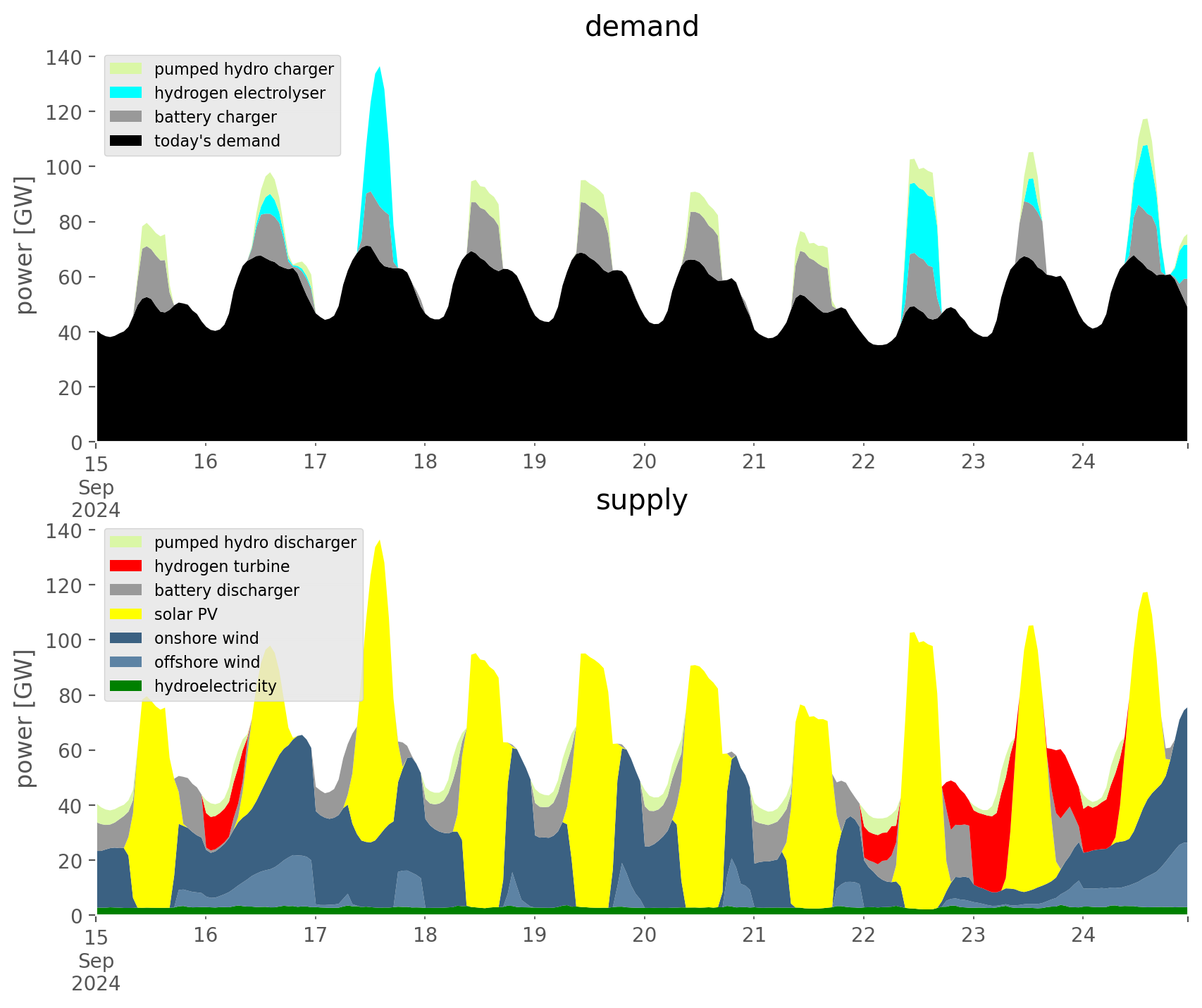
You can see the assumptions in the plots. Battery storage is lithium-ion based, or a battery system that needs to be charged daily. Solar and wind is being used to generate hydrogen and charge batteries, so there is about 2x solar and >1x wind capacity over total instantaneous demand. On days following low wind and low sun, the hydrogen plants come on.
This may say green hydrogen is required. It is all going to come down to costs per MWH for storage systems that can go for 100+ hr. That could be lithium based batteries that can last for 100+ hr, other batter chemistries that can go for 100+ hrs, or something like the flow batteries discussed in this article.
It may be the numbers will come down to hydrogen, or other synthetic fuel, being the most affordable option, especially as hydrogen has multiple markets it is needed for. There are pathways to make cheaper the whole generation to storage process. But, it's tough to bet against battery systems for EVs and electronics. If they can hold their charge for several days, there won't be much market for hydrogen.
I don't know if it is a physics issue with lithium batteries being able to hold its charge, or if not, whether it can be overcome. There is a lot of doubt on flow batteries or iron-air batteries, or other storage, to be able to compete, me included, but perhaps the market window still is open for these technologies.
The hydrogen use in the plot above is during night-time. If this electricity usage is a for heating, thermal batteries can offset that, and solar based charging of thermal batteries should be cheaper than generating hydrogen. If thermal batteries can hold their heat for weeks to months? That may change these plots above.
I'm still ruminating on the demand side in all this. There is still 30% efficiency improvements in A/C, especially in the USA. As SEER 20+ systems penetrate the market, it can decrease demand or make the difference for EV energy usage. Ground source heat pumps for cold climates should become more prevalent and reduce night-time energy usage. Architecture changes to optimize for more energy efficiency should become more prevalent.
Upvote
4
(4
/
0)
Indeed, I've started poking around in their fancier model, which includes some transmission grid modeling. In particular, I'm curious to better understand the dynamics driving their balance between onshore vs offshore wind.It goes both ways. Simplified models can be straight-up incorrect because this or that assumption, this or that not being modeled. The site warns you it is a toy model. So, the usual with toy models. They provide a nice sense of what could happen, but don't hold those beliefs too closely.
They have a sister site that looks to be using current weather and energy demand for Germany only. They are implementing their toy model over a running window of 10 days. Here is their default scenario:
You can see the assumptions in the plots. Battery storage is lithium-ion based, or a battery system that needs to be charged daily. Solar and wind is being used to generate hydrogen and charge batteries, so there is about 2x solar and >1x wind capacity over total instantaneous demand. On days following low wind and low sun, the hydrogen plants come on.
This may say green hydrogen is required. It is all going to come down to costs per MWH for storage systems that can go for 100+ hr. That could be lithium based batteries that can last for 100+ hr, other batter chemistries that can go for 100+ hrs, or something like the flow batteries discussed in this article.
It may be the numbers will come down to hydrogen, or other synthetic fuel, being the most affordable option, especially as hydrogen has multiple markets it is needed for. There are pathways to make cheaper the whole generation to storage process. But, it's tough to bet against battery systems for EVs and electronics. If they can hold their charge for several days, there won't be much market for hydrogen.
I don't know if it is a physics issue with lithium batteries being able to hold its charge, or if not, whether it can be overcome. There is a lot of doubt on flow batteries or iron-air batteries, or other storage, to be able to compete, me included, but perhaps the market window still is open for these technologies.
The hydrogen use in the plot above is during night-time. If this electricity usage is a for heating, thermal batteries can offset that, and solar based charging of thermal batteries should be cheaper than generating hydrogen. If thermal batteries can hold their heat for weeks to months? That may change these plots above.
I'm still ruminating on the demand side in all this. There is still 30% efficiency improvements in A/C, especially in the USA. As SEER 20+ systems penetrate the market, it can decrease demand or make the difference for EV energy usage. Ground source heat pumps for cold climates should become more prevalent and reduce night-time energy usage. Architecture changes to optimize for more energy efficiency should become more prevalent.
However, what you've posted is broadly consistent with the results from the toy model. The cheapest grid gets most of its power from renewables, backed by a few hours of batteries and a significant number of gas peakers that operate on a modestly low duty-cycle. As you put an increasingly higher cost on carbon emissions, the number of gas peaker hours drops, initially due to mild over-provisioning of the renewables, later due to the inclusion of hydrogen for energy storage to further reduce peaker hours towards zero.
Even on the toy model with constant demand, the plot is similar:
It's not surprising that hydrogen mostly discharges during the morning/evening net demand peaks; when a day needs a hydrogen withdrawal, might as well take it at the most useful time, subject only to the limitation that we don't want to over-spend on the discharge infrastructure (ie, there should be some days where the hydrogen discharge runs continuously, or we've paid for too many turbines). But hydrogen's core role is still in shifting power between days. There are a few days where hydrogen charges during the solar and discharges that same night, but those same-day energy transfers only explain a small fraction of the hydrogen discharge -- it happens on days where the diurnal shifting opportunity exceeds available battery capacity, and these days must be relatively rare, otherwise it would be profitable to add more batteries. Most of the hydrogen that gets consumed was put into storage much further in advance, on the order of weeks and months.
Thermal storage is promising on paper, but can be surprisingly tricky to deploy. It's a site by site problem, which makes scaling very challenging. At the margins we could get some consumer A/C units to over-cool during the afternoons, and in sufficiently well-insulated buildings that might pay out if the incentives were aligned and the coordination problems solved. But installing an actual thermal reservoir is challenging. My house has a water-based HVAC system, with a 50 gallon tank in the basement as a thermal reservoir, but that's only enough capacity to cover something like ~30 minutes. I'd need to fill a third of my basement with tankage to be able to buffer overnight. The capex for me to do that was too high (labor cost is offensively expensive) and my power company doesn't offer any time-of-use incentives under my current billing model. With a water-based HVAC, I'm a near ideal case, yet I can't get the project to make financial sense. For someone who has a more standard mini-split system, the conversion cost is prohibitive. And I wouldn't recommend my water-based system to anyone who has a choice: 200+ hours of debugging / maintenance effort and counting.
Or my office building has an industrial-scale ice-based thermal reservoir, and I strongly suspect that buying solar panels would have been a cheaper way to reduce daytime loads. Using ice's phase change instead of cooling liquid water improves the thermal capacity by almost an order-of-magnitude, but then instead of being able to reuse the same air conditioners that you still need to maintain in parallel, you also need to provision an entirely separate chiller system that can cool glycol to well below the freezing point of water, so right there, you've more than doubled your A/C plant's capex. Then the storage tanks are designed by a contract engineering firm that's known to have generous margins, and it took several iterations to fix all the leaks. This sort of thing adds up very quickly, and then you're also buying more than one kWhr at night per kWhr that you've shifted away from the daytime. Which, btw, is the opposite direction of what most grids need, but Manhattan has a lot of daytime loads, so that's what their priority was at the time this project was done (it was related to an anticipated power plant closure).
In my post right before this one (probably written in parallel), I gave their cost assumptions per kWhr of discharged electricity:
* Lithium-ion: €160
* Stainless Hydrogen Tanks: €22
* Geologic Hydrogen: €0.25
* Methane: even cheaper (eg, Germany has 255 TWhrs of storage capacity, which is more than 6 months of their electricity usage and exceeds by a large margin the entire global inventory of Lithium-ion)
Lithium-ion is certainly going to continue getting cheaper, and the model's 2030 price assumption is arguably too pessimistic for even 2024, but the gap to even the most expensive hydrogen storage option is huge and unlikely to be closed anytime soon. If we get Lithium-ion for €22/kWhr, it's all but game-over. The lowest-cost grid becomes 2/3rds solar dominated with 4% gas peakers and zero-emissions is only 106% with geologic hydrogen storage or 109% without, and all three of those prices are less than today's polluting price.
Last edited:
Upvote
6
(6
/
0)
electrolytes tend to be at least mildly acidic, movable gaskets wear out, you could use bladder tanks but bladder tanks that big are likely pointlessly complicated, besides energy density is NOT a major issue for these applications, so much as round trip efficiency and longevity. and build/maintenance costs, so being big isn't a problem[Emphasis added]
Not true. Classic trick: You have a tank with two compartments separated by a moveable wall. The total volume of the tank is sufficient to hold all the electrolyte, but it's divided in two with exactly as much volume as needed for the charged vs. uncharged electrolyte on one side or another. (An alternative is a tank with an inflatable "balloon" inside; the two liquids are divided between "inside" and "outside" of the "balloon." Same result.)
There's obviously some significant engineering effort to make this leak-proof and long-lasting and it likely ends up somewhat larger than what the base volume of electrolyte predicts. If you configure it right, the pressure from the "growing" side of the tank can help push fluid out of the "shrinking" side letting you waste less energy in pumping.
Upvote
4
(4
/
0)
From Techno-economic assessment of future vanadium flow batteries based on real device/market parameters:

UCC = Unit capital cost. The article conclusion was that VFBs need to be less than 105 €/kWH UCC to make a profit. A 3x to 8x reduction from their current cost estimate.
Now the UCC numbers for Li-ion batteries are not that correct. OEMs can get LFP batteries from CATL or BYD, or other Chinese battery OEM, for $50 to $100 per kWH in 2024. There's a reason why the USA put 100% tariffs on Chinese EV imports, so China is perhaps a special case. Even so, $200 to $300 per kWH for Li batteries is like a number from 5 years ago, fully import taxed? Anyways, lithium based batteries are under an ongoing huge state of flux. Energy density will double in a few years! A lot of entities are under-predicting how low solar PV and batteries will go imo.
I need to actually read the article for op-ex numbers, and to understand the cap-ex numbers.
Form Energy has aspirations that their iron-air batteries will hit $20/kWH, but that number is probably at least 20 years of mass production away from even coming close. Energy Dome's CO2 phase-change battery is about $200/kWH. No idea how they get to $50/kWH to be competitive.
Those self-discharge characteristics are going to be a big driving parameter for the last 10% of a grid. Hydrogen being able to use existing natural gas capital assets has a lot of political will, as it were, and tough to ignore.
UCC = Unit capital cost. The article conclusion was that VFBs need to be less than 105 €/kWH UCC to make a profit. A 3x to 8x reduction from their current cost estimate.
Now the UCC numbers for Li-ion batteries are not that correct. OEMs can get LFP batteries from CATL or BYD, or other Chinese battery OEM, for $50 to $100 per kWH in 2024. There's a reason why the USA put 100% tariffs on Chinese EV imports, so China is perhaps a special case. Even so, $200 to $300 per kWH for Li batteries is like a number from 5 years ago, fully import taxed? Anyways, lithium based batteries are under an ongoing huge state of flux. Energy density will double in a few years! A lot of entities are under-predicting how low solar PV and batteries will go imo.
I need to actually read the article for op-ex numbers, and to understand the cap-ex numbers.
Form Energy has aspirations that their iron-air batteries will hit $20/kWH, but that number is probably at least 20 years of mass production away from even coming close. Energy Dome's CO2 phase-change battery is about $200/kWH. No idea how they get to $50/kWH to be competitive.
Those self-discharge characteristics are going to be a big driving parameter for the last 10% of a grid. Hydrogen being able to use existing natural gas capital assets has a lot of political will, as it were, and tough to ignore.
Upvote
6
(6
/
0)
My my my. Histrionic little git, ain't you? Meanwhile, don't think we didn't notice your refusal to address point c), to whit, your claim that hydrogen storage is feasible. So, let's see your evidence for this assertion.Thanks with providing us with a textbook example of a Straw Man argument. I discussed a priority ordering for decarbonization and then you swapped what I actually said for some crazy-pants argument about shutting off the power to people's homes during periods of dangerous cold, allowing you, the heroic virtue-signaling knight, to step in and thoroughly demolish that straw man position.
I also want to see an apology for your very rude behaviour, or rather, I want to see you deny that you owe me one.
Last edited:
Upvote
-12
(0
/
-12)
Indeed, I've started poking around in their fancier model, which includes some transmission grid modeling. In particular, I'm curious to better understand the dynamics driving their balance between onshore vs offshore wind.
However, what you've posted is broadly consistent with the results from the toy model. The cheapest grid gets most of its power from renewables, backed by a few hours of batteries and a significant number of gas peakers that operate on a modestly low duty-cycle. As you put an increasingly higher cost on carbon emissions, the number of gas peaker hours drops, initially due to mild over-provisioning of the renewables, later due to the inclusion of hydrogen for energy storage to further reduce peaker hours towards zero.
Even on the toy model with constant demand, the plot is similar:View attachment 91147
It's not surprising that hydrogen mostly discharges during the morning/evening net demand peaks; when a day needs a hydrogen withdrawal, might as well take it at the most useful time, subject only to the limitation that we don't want to over-spend on the discharge infrastructure (ie, there should be some days where the hydrogen discharge runs continuously, or we've paid for too many turbines). But hydrogen's core role is still in shifting power between days. There are a few days where hydrogen charges during the solar and discharges that same night, but those same-day energy transfers only explain a small fraction of the hydrogen discharge -- it happens on days where the diurnal shifting opportunity exceeds available battery capacity, and these days must be relatively rare, otherwise it would be profitable to add more batteries. Most of the hydrogen that gets consumed was put into storage much further in advance, on the order of weeks and months.
Thermal storage is promising on paper, but can be surprisingly tricky to deploy. It's a site by site problem, which makes scaling very challenging. At the margins we could get some consumer A/C units to over-cool during the afternoons, and in sufficiently well-insulated buildings that might pay out if the incentives were aligned and the coordination problems solved. But installing an actual thermal reservoir is challenging. My house has a water-based HVAC system, with a 50 gallon tank in the basement as a thermal reservoir, but that's only enough capacity to cover something like ~30 minutes. I'd need to fill a third of my basement with tankage to be able to buffer overnight. The capex for me to do that was too high (labor cost is offensively expensive) and my power company doesn't offer any time-of-use incentives under my current billing model. With a water-based HVAC, I'm a near ideal case, yet I can't get the project to make financial sense. For someone who has a more standard mini-split system, the conversion cost is prohibitive. And I wouldn't recommend my water-based system to anyone who has a choice: 200+ hours of debugging / maintenance effort and counting.
Or my office building has an industrial-scale ice-based thermal reservoir, and I strongly suspect that buying solar panels would have been a cheaper way to reduce daytime loads. Using ice's phase change instead of cooling liquid water improves the thermal capacity by almost an order-of-magnitude, but then instead of being able to reuse the same air conditioners that you still need to maintain in parallel, you also need to provision an entirely separate chiller system that can cool glycol to well below the freezing point of water, so right there, you've more than doubled your A/C plant's capex. Then the storage tanks are designed by a contract engineering firm that's known to have generous margins, and it took several iterations to fix all the leaks. This sort of thing adds up very quickly, and then you're also buying more than one kWhr at night per kWhr that you've shifted away from the daytime. Which, btw, is the opposite direction of what most grids need, but Manhattan has a lot of daytime loads, so that's what their priority was at the time this project was done (it was related to an anticipated power plant closure).
In my post right before this one (probably written in parallel), I gave their cost assumptions per kWhr of discharged electricity:
* Lithium-ion: €160
* Stainless Hydrogen Tanks: €22
* Geologic Hydrogen: €0.25
* Methane: even cheaper (eg, Germany has 255 TWhrs of storage capacity, which is more than 6 months of their electricity usage and exceeds by a large margin the entire global inventory of Lithium-ion)
Lithium-ion is certainly going to continue getting cheaper, and the model's 2030 price assumption is arguably too pessimistic for even 2024, but the gap to even the most expensive hydrogen storage option is huge and unlikely to be closed anytime soon. If we get Lithium-ion for €22/kWhr, it's all but game-over. The lowest-cost grid becomes 2/3rds solar dominated with 4% gas peakers and zero-emissions is only 106% with geologic hydrogen storage or 109% without, and all three of those prices are less than today's polluting price.
Really? And after you said in an earlier post that you don't do models as proof of feasibility? Need I say what I think of people like you who believe these sorts of practices, this bald-faced lying is okay? But the burden of proof in on me to show that you're wrong, sigh. You're prescientific.
BTW, here's yet another source saying you're wrong about the feasibility of hydrogen storage.
Look, I get it, this is your dream scenario. But it's patently obvious that you don't have the chops to pull this sort of thing off in front of a rightly-skeptical audience.
Last edited:
Upvote
-11
(0
/
-11)
You linked article states:Really? And after you said in an earlier post that you don't do models as proof as feasibility? Need I say what I think of people like you who believe these sorts of practices, this bald-faced lying is okay? But the burden of proof in on me to show that you're wrong, sigh. You're prescientific.
BTW, here's yet another source saying you're wrong about the feasibility of hydrogen storage.
Look, I get it, this is your dream scenario. But it's patently obvious that you don't have the chops to pull this sort of thing off in front of a rightly-skeptical audience.
“The standout use for clean hydrogen here is for long-term storage,” Liebreich wrote. His green-hydrogen ladder ranks this use case near the top of his scale, along with shipping, steelmaking and chemical production.
In this case, “long-term” means storing hydrogen for months at a time. A handful of large-scale clean hydrogen projects, such as the ACES Delta project in Utah, are targeting this “seasonal” energy storage application. But the ACES project is paired with enormous underground salt caverns that can store massive amounts of hydrogen. FPL’s project uses above ground storage tanks, which are a far more costly way to store large volumes of hydrogen.
This Canary Media article is trying to highlight, or suggest, that Florida Power and Lighting is just using government funds to expands their fossil fuel assets in the guise of fossil fuel blending with green hydrogen. If you read further in the article, Canary Media goes right down to what everyone has been discussing in this thread: green hydrogen usage for long term storage. For power applications that is.
Whether above ground storage can get cheaper than below ground, who knows. Me? Turn it in to methane, or whatever fuel that can be liquefied and call it a day.
Upvote
4
(4
/
0)
Surely, and the implications are that so far 'green hydrogen's' primary application seems to be hydrogen- or green-washing big petroleum.You linked article states:
“The standout use for clean hydrogen here is for long-term storage,” Liebreich wrote. His green-hydrogen ladder ranks this use case near the top of his scale, along with shipping, steelmaking and chemical production.
In this case, “long-term” means storing hydrogen for months at a time. A handful of large-scale clean hydrogen projects, such as the ACES Delta project in Utah, are targeting this “seasonal” energy storage application. But the ACES project is paired with enormous underground salt caverns that can store massive amounts of hydrogen. FPL’s project uses above ground storage tanks, which are a far more costly way to store large volumes of hydrogen.
This Canary Media article is trying to highlight, or suggest, that Florida Power and Lighting is just using government funds to expands their fossil fuel assets in the guise of fossil fuel blending with green hydrogen. If you read further in the article, Canary Media goes right down to what everyone has been discussing in this thread: green hydrogen usage for long term storage. For power applications that is.
Whether above ground storage can get cheaper than below ground, who knows. Me? Turn it in to methane, or whatever fuel that can be liquefied and call it a day.
I'm not willing to accept by fiat that "we'll just do long-term storage (for the winter months) with a hydrogen network". To say its feasibility has been demonstrated (by a 'modeling tool'!) is a huge lift, and there are many, many articles/studies panning the idea. I can cite as many as you like with a simple google search.
Note that I'm not saying it's infeasible, just that feasibility has yet to be demonstrated. Do you have anything in the way of what you consider convincing evidence? Saying that we'll just adapt the old petroleum storage networks doesn't cut it. Or rather, if you want to go that route, you'll have to show me the cost schedules, what they're paying for, and how long it will take. Which, come to think of it, is what you'd have to show me in any case.
Last edited:
Upvote
-5
(0
/
-5)
The idea that we can use geologic storage is entirely non-controversial, because we already do this at mind-boggling scale for natural gas. And there are various chemicals companies, such as Imperial Chemical Industries that stored Hydrogen underground for decades without any apparent issues. And we've found natural reservoirs of hydrogen gas that was geologically contained for millions of years. Disbelieving this reality is pure ignorance.You[r] linked article states:
“The standout use for clean hydrogen here is for long-term storage,” Liebreich wrote. His green-hydrogen ladder ranks this use case near the top of his scale, along with shipping, steelmaking and chemical production.
In this case, “long-term” means storing hydrogen for months at a time. A handful of large-scale clean hydrogen projects, such as the ACES Delta project in Utah, are targeting this “seasonal” energy storage application. But the ACES project is paired with enormous underground salt caverns that can store massive amounts of hydrogen. FPL’s project uses above ground storage tanks, which are a far more costly way to store large volumes of hydrogen.
This Canary Media article is trying to highlight, or suggest, that Florida Power and Lighting is just using government funds to expands their fossil fuel assets in the guise of fossil fuel blending with green hydrogen. If you read further in the article, Canary Media goes right down to what everyone has been discussing in this thread: green hydrogen usage for long term storage. For power applications that is.
Whether above ground storage can get cheaper than below ground, who knows. Me? Turn it in to methane, or whatever fuel that can be liquefied and call it a day.
As my "feasibility proof" (whatever that is), I submit to you the objective reality that (most of us) live in.
Here's a map of the gas storage capacities for the EU countries:
The area of each circle is proportional to that country's gas storage capacity and hovering over a country provides the concrete numbers. For Germany, it's 255 TWhrs of gas, which is almost exactly 200 days worth of Germany's full electricity demand. The storage of gas is measured in months, almost in years, and it absolutely dwarfs the most starry-eyed projections for what Lithium-ion could deliver by 2050. Utterly vast scale of energy storage.
Hydrogen is genuinely harder to store than Methane, but so what? There's two "problems" from a storage perspective.
"Problem" #1: Hydrogen is less energy dense than Methane - Using those geologic reservoirs for Hydrogen instead of Methane means that Germany's reservoir would hold "only" two months of full grid load instead of six. Meaning that they could shut down all other generation sources and run on Hydrogen alone for two full months. That's a mind-boggling level of energy storage. For context, the model's zero-emissions solution only needed 12 days of Hydogen storage. This means that in a hard zero-emissions grid where Germany is no longer burning Methane for power, they'd only need to reallocate around 5% of their existing Methane storage to Hydrogen. And we aren't even close to tapped out on finding geologic formations for gas storage; we only developed what we needed, not what was available.
"Problem" #2: Hydrogen is a smaller molecule than Methane, so the escape rate will be higher, but at such vast scales, the square cube law makes leakage rates inconsequential. If the reservoir will lose 1% of it's storage over the course of 300 years, do we care? The reason you aren't seeing more public research on this point is that it just isn't that big of a deal.
Don't believe me? Here's the 2009 NREL report analyzing US sites for geologic hydrogen storage, along with cost estimates.
The reason that we aren't currently producing and storing green hydrogen at that scale has nothing to do with the feasibility of storing hydrogen molecules. For all the problems with Hydrogen, we know how to do that. It's because green hydrogen production scaling, much less green hydrogen storage falls behind more urgent priorities in the order-of-operations for decarbonization. We still have a lot of fossil fuels on our grid, including coal plants that aren't even economically rational anymore and are effectively being subsidized by rate payers. As we scale renewable energy deployments, it's significantly more efficient, from both the climate and financial perspectives, to use that renewable electricity to displace fossil electricity than to use it for displacing grey hydrogen with green hydrogen production. But exponential scaling moves quickly and it won't be that long before ~85% of our electricity comes from renewables (or hydro / nuclear, which we'll maintain, but can't easily scale), and it will start making sense to invest further renewables scaling into flexible demand sources like green hydrogen production.
We must eventually scale green hydrogen production in order to displace the 100 Mt of polluting grey hydrogen used by industry every year. This isn't optional and the output of that must by hydrogen, not electricity. As we scale green hydrogen production for industry, it will naturally make sense to have at least some degree of hydrogen storage to buffer for inconsistent production rates, and this is WITHOUT hydrogen being used for electricity storage. So, as long as you are willing to believe that we eventually choose to halt emissions, then it's inevitable that we'll have both hydrogen production and hydrogen storage, and in such a world the use of hydrogen as an electricity storage medium of last resort depends only on the provisioning of the discharge infrastructure, either turbines or fuel cells. This isn't going to happen quickly, and hydrogen discharge will never be more than a percent or two of all electricity hours. But it's an inevitable consequence of solving industrial hydrogen emissions. Or synfuel is electrolysis by another name; same fundamentals either way.
Last edited:
Upvote
10
(10
/
0)
My comment on thermal batteries were for 200 hr, 500 hr cycles. Er, they can hold the heat for 2 to 3 weeks, with only single digit percentages loss in heat. So, sand based, brick based thermal batteries at 300 to 800 °F. For residential usage, it would be like a big A/C condenser sized unit sitting outside your house. Scale it up for bigger buildings.My house has a water-based HVAC system, with a 50 gallon tank in the basement as a thermal reservoir, but that's only enough capacity to cover something like ~30 minutes. I'd need to fill a third of my basement with tankage to be able to buffer overnight. The capex for me to do that was too high (labor cost is offensively expensive) and my power company doesn't offer any time-of-use incentives under my current billing model. With a water-based HVAC, I'm a near ideal case, yet I can't get the project to make financial sense. For someone who has a more standard mini-split system, the conversion cost is prohibitive. And I wouldn't recommend my water-based system to anyone who has a choice: 200+ hours of debugging / maintenance effort and counting.
Or my office building has an industrial-scale ice-based thermal reservoir, and I strongly suspect that buying solar panels would have been a cheaper way to reduce daytime loads. Using ice's phase change instead of cooling liquid water improves the thermal capacity by almost an order-of-magnitude, but then instead of being able to reuse the same air conditioners that you still need to maintain in parallel, you also need to provision an entirely separate chiller system that can cool glycol to well below the freezing point of water, so right there, you've more than doubled your A/C plant's capex. Then the storage tanks are designed by a contract engineering firm that's known to have generous margins, and it took several iterations to fix all the leaks. This sort of thing adds up very quickly, and then you're also buying more than one kWhr at night per kWhr that you've shifted away from the daytime. Which, btw, is the opposite direction of what most grids need, but Manhattan has a lot of daytime loads, so that's what their priority was at the time this project was done (it was related to an anticipated power plant closure).
This should push the use of burning gas for electricity further down, if the primary use for electricity at night is heating that is. If not, Li-ion or other EV type battery has to reduce their leakage rates. Otherwise, hydrogen or related gas is probably it.
Part of this harkens back to my comment about using the right climate inputs. The need for heating during winter will decrease in the future. Someone probably has done the math for it (for every increased degree in average temp, there will x amount of decrease energy needed for heating), and if you model say a +5 °F warmer winter, and you have to wonder if the grid, people would even bother with long term storage. Like average lows in NYC winter won't be below freezing anymore, and average highs could be in the low 50s. Will Manhattan even cool down?

Your water base HVAC system heats and chills water through a heat pump to both heat and chill water? That water is then pumped through the house. Does it use radiators in each room? A heat exchanger with a central air handling system and ducting?
There are companies that sell systems using water as a thermal reservoir, like Harvest energy, but they mostly sell it a carbon reduction technology, where it uses CASIO solar to heat water during the day and use it to heat the house at night. California's heating needs are modest though. If you are in NYC, its fuel mix doesn't really support the sales pitch.
Upvote
1
(1
/
0)
Those numbers and qualitative measures are all weird, which gives me pause about the overall conclusions. But really the article is about vanadium, and they end up saying that at best they can match the price of lithium ion. Which is what has been the general conclusion for a while; they're just offering up another way to end up at "vanadium has no future".From Techno-economic assessment of future vanadium flow batteries based on real device/market parameters:
View attachment 91169
UCC = Unit capital cost. The article conclusion was that VFBs need to be less than 105 €/kWH UCC to make a profit. A 3x to 8x reduction from their current cost estimate.
Now the UCC numbers for Li-ion batteries are not that correct. OEMs can get LFP batteries from CATL or BYD, or other Chinese battery OEM, for $50 to $100 per kWH in 2024. There's a reason why the USA put 100% tariffs on Chinese EV imports, so China is perhaps a special case. Even so, $200 to $300 per kWH for Li batteries is like a number from 5 years ago, fully import taxed? Anyways, lithium based batteries are under an ongoing huge state of flux. Energy density will double in a few years! A lot of entities are under-predicting how low solar PV and batteries will go imo.
I need to actually read the article for op-ex numbers, and to understand the cap-ex numbers.
Form Energy has aspirations that their iron-air batteries will hit $20/kWH, but that number is probably at least 20 years of mass production away from even coming close. Energy Dome's CO2 phase-change battery is about $200/kWH. No idea how they get to $50/kWH to be competitive.
Those self-discharge characteristics are going to be a big driving parameter for the last 10% of a grid. Hydrogen being able to use existing natural gas capital assets has a lot of political will, as it were, and tough to ignore.
Upvote
5
(5
/
0)
well yeah why use an expensive electrolyte for an application that doesn't care about charge and discharge speeds? you want something that has decent round trip and doesn't lose charge over time or does so VERY slowly (which is why flow batteries may be better for seasonal than hydrogen), as a bonus, you could even use a regenerative pump between the electrolyte tanks.Those numbers and qualitative measures are all weird, which gives me pause about the overall conclusions. But really the article is about vanadium, and they end up saying that at best they can match the price of lithium ion. Which is what has been the general conclusion for a while; they're just offering up another way to end up at "vanadium has no future".
Upvote
3
(3
/
0)