Skip to content
I <3 gold seatbelts

The 2021 Polestar 2 has a great cabin—and deep Android integration

A welcome addition to the battery electric vehicle market.

Jonathan M. Gitlin | 217
A white Polestar 2
On the road with the new Polestar 2. Credit: Polestar
Story text


Any day I get to drive a new battery electric car is a good day. Which made last Friday a good day, because we got our first drive in the $59,900 Polestar 2. It’s the first mass-production model from a new standalone brand that was spun out of Volvo and Geely a few years ago. And the tl;dr is that the Polestar 2 is a stylish sedan with a wonderful interior, some very fancy suspension bits, and oh—it’s also the first car to use Google’s Android Automotive OS.

A brief history of Polestar

Once upon a time, Polestar was to Volvo as AMG is to Mercedes-Benz—a tuning company that spiffed up more pedestrian models, imbuing them with a little Nürburgring magic. But in 2017, Volvo and Geely (which owns the Swedish automaker) spun Polestar out as an independent company, one focused on sustainability and performance. Its first product was the Polestar 1, a hand-built $150,000 plug-in hybrid GT that dazzled me when I drove it in late 2019.

But with a total production run of only 1,500 cars over three years, you can think of the Polestar 1 like a calling card or a statement of intent. The future of Polestar is purely electric (so no more PHEVs)—and shipping cars in much greater volumes. By the end of 2021, we’ll see the Polestar 3, an SUV that promises to look a lot like the stunning Precept concept shown off in April. But first, there’s the Polestar 2. (Interesting fact: because Polestar is recognized as a standalone OEM, it has its own allocation of 200,000 vehicles for the IRS plug-in tax credit, as opposed to being counted together with Volvo.)

A white polestar 2 parked by a bridge
Refreshingly, this one isn’t a crossover, it’s a fastback sedan.
A white polestar 2 in Manhattan
Polestar might be an independent company but you can see the family connection to Volvo in the shape of the tail lights.

Polestar 2

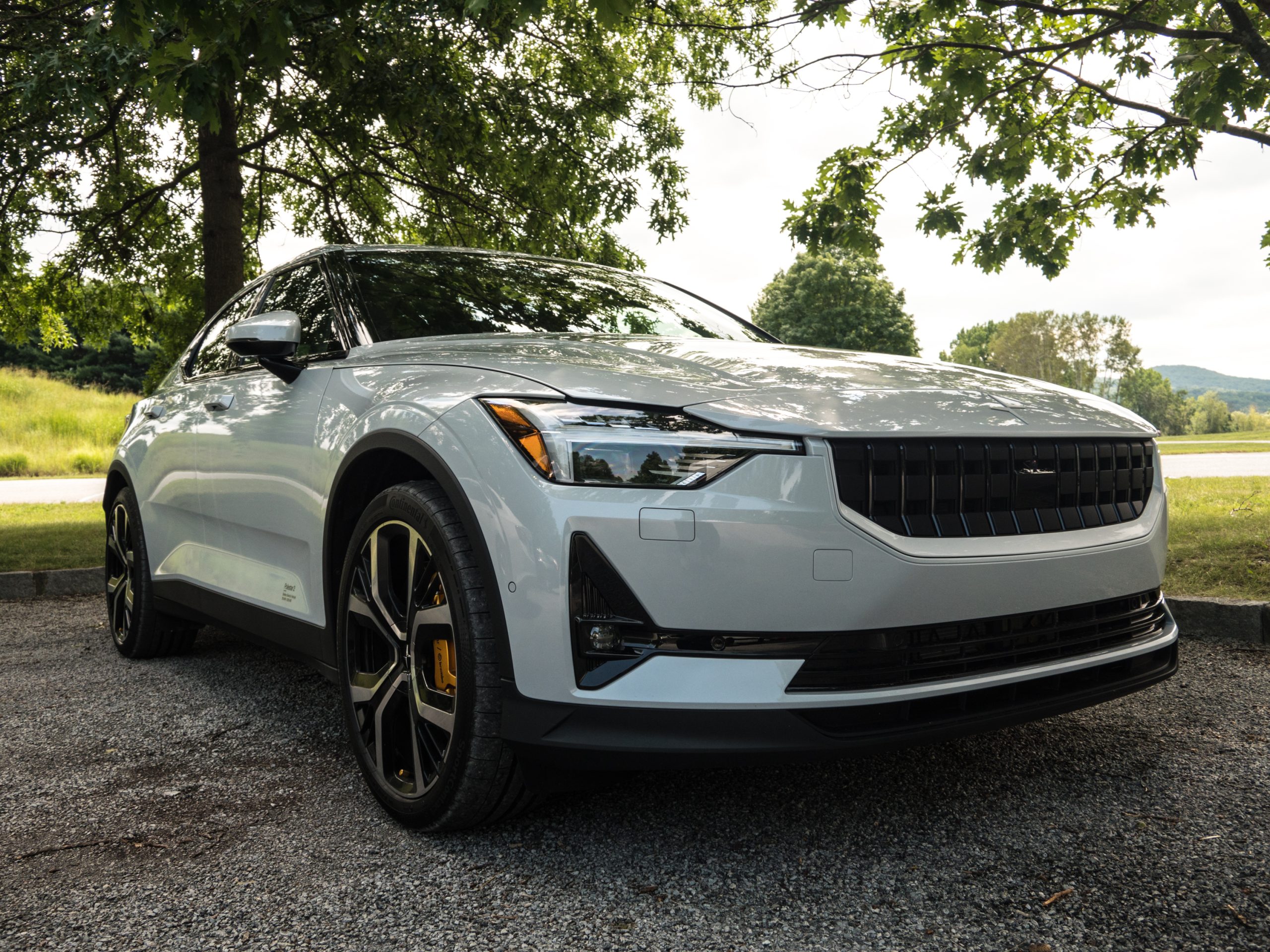
The Polestar 2 is built using Geely group’s Compact Modular Architecture, which also underpins the Volvo XC40 as well as vehicles from stablemate Lynk and Co. This car is no crossover, though. Rather, it’s a fastback sedan that mostly manages to hide the fact that it’s full of batteries, with a decent but not class-leading drag coefficient of 0.28. Size-wise, it’s a little smaller than a Tesla Model 3 or a Jaguar I-Pace, measuring 181.3 inches (4,606mm) long, 70.8 inches (1,800mm) wide, 58.2 inches (1,479mm) tall, and with a wheelbase of 107.7 inches (2,735mm). The weight distribution is 51:49 (towards the front), and at 4,680lbs (2,123kg), it is closer to the Jaguar than to the much lighter Tesla.

Under the skin, you’ll find a pair of identical permanent magnet AC motor-generator units (MGUs) from Valeo-Siemens, each rated for 150kW (204hp) and 330Nm (243lb-ft), one for each axle. You can’t often just add together the outputs of both MGUs to get a total output for a BEV, but in this case the Polestar 2 is capable of putting down all 300kW or 660Nm on the road. Each motor uses a single-speed gear with a ratio of 8.57:1.

Those MGUs are powered by a 78kWh, 400V lithium-ion battery pack with a useable 75kWh. For US-market Polestar 2s, the pouch cells (of which there are 324 in a total of 27 modules) come from LG Chem, with CATL supplying prismatic cells for Chinese-market vehicles. The packs have been developed by Volvo (and will be shared with the XC40 Recharge BEV, which goes on sale in late 2020), and they are built in-house and supplied to Polestar.

Although the battery pack is where you expect to find it, Polestar says that its vehicle does not really have a skateboard layout. Instead, the shape makes best use of CMA by filling what would be a transmission tunnel in a conventionally powered vehicle with cells, as well as double-stacking them at the back, underneath the rear seats. This leaves room for the rear seat passengers’ feet, similar to the Porsche Taycan (without awkwardly calling them “foot garages”). The pack weighs 1,100lbs (499kg), including its structural reinforcement, and is warrantied for eight years or 100,000 miles.

AC charging is via an onboard 11kW charger, which will take up to 22 hours if you plug it into a standard 110V socket. With an AC charger in your garage or car port (or a public level-2 AC charger) Polestar says it takes up to 8 hours to go from zero to 100 percent. For road trips, you can DC fast charge at up to 150kW, which should take 40 minutes to go from zero to 80 percent.

As with other CMA-based vehicles, the Polestar 2 uses a MacPherson strut for the front suspension and a multilink arrangement at the rear. Opt for the $5,000 performance pack (as in our test car) and you get a 0.2-inch (5mm) lower ride height, some very fancy Öhlins dampers (along with different spring and anti-roll bar rates), and bigger front brake disks with four-piston calipers from Brembo.

The interior of a polestar 2
There’s a great mix of materials and textures.
The interior of a polestar 2
The fabric is called WeaveTech and it’s made from recycled materials with no phthalate plasticizers.

The Polestar 2’s interior is one of the car’s best features. Polestar is serious about being more sustainable than the average OEM, which is most evident in the choice of cabin materials. The standard interior uses a textile called WeaveTech, which incorporates lots of recycled materials and uses almost no phthalates as plasticizers. (A brown nappa leather is a $4,000 option, and this uses no chrome in the tanning process.) Similarly, the carpets are made from recycled water bottles. The mix of materials is very modern and feels influenced by techwear.

If you’ve been in a recent Volvo, you’ll instantly recognize the Polestar’s multifunction steering wheel. In fact, from the driver’s seat the layout may be familiar if you’ve sat in an XC40. Ahead of you, there’s a 12.3-inch digital main instrument panel, which has 3 different UI modes; one with basic information like speed, another that adds a bit more situational awareness from the car’s sensors, and a third with full map display. One neat feature is the power display, which shows when you’re using or regenerating energy. This is a pretty standard feature for a BEV, but the Polestar 2 might be the first car I’ve noticed that, under deceleration, indicates when it has switched over from regenerative to friction braking. (The switch from regen to the friction brakes only happens above a 0.3G braking threshold.)

To your right is an 11.2-inch touchscreen, which is mounted on the dash. Underneath this infotainment screen is a cubby to place your phone (with wireless charging built in), and then the rather high center console where you’ll find the gear selector and some physical controls for audio system. One button or control that’s conspicuously absent is a start button—like a Tesla, the Polestar 2 turns on as soon as you unlock it (either with the physical remote or by using an NFC key on your smartphone). To drive away you simply engage forward or reverse, and at the end of your journey you engage Park and then lock the car and walk away.

The touchscreen is mostly fine to use, although I did find that my hand sometimes knocked the large volume dial when reaching for the infotainment’s “home” button, which is at the bottom of the display. And while I’m complaining about ergonomics, I found that if there’s anything bigger than a can of Diet Coke in the main cupholder, it will interfere with resting your right arm on the center console.

Despite the use of dark materials, the Polestar 2’s cabin doesn’t feel gloomy. The full-length glass roof is a big help with that, although it’s only tinted; there’s no retractable fabric panel or clever electrochromatic darkening to counteract the midday sun.

As discussed, this isn’t a gigantic car, but with the front seat in position for a 5’7″ (1.7m) driver like me, there should be room for a taller adult in the back. (Rear legroom is officially measured at 33.9 inches/862mm.) There are a useful amount of storage cubbies in the doors and center console, and with the rear seats in use the car has 14.2 cubic feet (405L) of cargo volume; fold both of the rear seats flat and that goes up to 38.7 cubic feet (1,095L). The cargo area should be large enough to get a surfboard or bicycle in there—or the occasional bit of lumber. Unusually for a smaller BEV, the Polestar 2 is tow-rated, and in the US you can pull a 2,000lb (907kg) load from an optional tow hook that retracts out of sight when not in use.

The infotainment system in a polestar 2
The car also features an 11.2-inch touchscreen that runs Android Automotive.
The infotainment system in a polestar 2
This is the home screen.

Perhaps the most notable thing about the Polestar 2 as far as it relates to the Ars Technica audience is the fact that this is the first car on the market to use Google’s Android Automotive OS. Note that I wrote “Android Automotive,” because this is different from Android Auto, which you may well be familiar with as the method of casting your not-an-iPhone to the infotainment system of your car. Polestar says it picked Google to supply the infotainment OS because of the large Android developer base, which means there should be robust third-party app support.

Obviously, one benefit of using Android for the infotainment is access to the Google Assistant, which you access by saying “Hey Google.” This brings a level of voice control to the infotainment system that will seem light years ahead of most other voice recognition implementations. You can use Google Assistant to control many (but not all) functions inside the car. For example, playing music from Spotify or tuning to a radio station are each as simple as telling the system to do just that. You also have voice control over the Polestar 2’s climate control and navigation (which uses Google Maps), and you can ask the car how much range you have left. However, there are some settings that are walled off from Google Assistant—you can’t get it to put the car into reverse or drive, for example, or to switch between different settings for one-pedal driving or steering weight.

If you’re logged into the infotainment system with the same Google account you use for home automation, you can interact with those home functions from your car. However, Polestar thinks that most owners will create a separate Google account for use in their car—this would be my preferred option. The car also supports multiple profiles, should you just want one account for the car but different settings for individual drivers; in this case the digital key on your phone would tell the car to switch to your profile.

In practice, I found Google Assistant utterly painless to use. It found destinations with ease, and saying “hey Google, set the temperature to 70 degrees” or “hey Google, play me some Eric B and Rakim” is easier when you’re driving than taking a hand off the wheel to use the touchscreen. You can expect a slightly slower response if you’re driving in an area devoid of cell reception, but even in dead zones you shouldn’t be stuck without navigation because the car will download maps for offline use based upon where you are and where you’re heading.

At the same time, you can always use the car without logging into Google, although with some reduced functionality. Android Auto and Apple CarPlay are both included if you prefer to use those instead. CarPlay was not active on the test car I drove, but I was perfectly able to connect my iPhone XS via Bluetooth and used that to stream music and make calls. In addition to Bluetooth and wireless charging, there are also four USB-C ports in the car, two for the front seats and two for the back seat.

One possible concern about using Android Automotive is Google’s propensity to get bored with a product and discontinue it. However, Polestar says that other OEMs will also be switching to the OS for their infotainment in the next few years, and that as they’re all paying customers, it believes that there is no danger of the Internet behemoth giving anyone’s car the Google Reader treatment.

Credit: Jonathan Gitlin

In addition to Android Automotive, the other significant digital tech in the Polestar 2 is its suite of advanced driver assistance systems or ADAS. These are a new generation, developed by Volvo’s ADAS partner Zenuity, and they include adaptive cruise control, lane keeping, automatic emergency braking (including pedestrian and cyclist detection), rear collision warning, cross-traffic alerts, and road sign detection. The sensor suite includes a forward-looking radar and camera, a surround camera system for parking, 12 ultrasonic sensors, and two rear-looking radar sensors for blind-spot detection.

Given the tight family link with Volvo, you can expect all the same active and passive safety features on a Polestar as you might get on a current Volvo—which is to say it should be a very safe car. And both the car and infotainment system are able to receive over-the-air updates.

How’s the driving experience?

One of Polestar’s defining characteristics compared to Volvo is an emphasis on performance and driver engagement. In this regard, I can state that a Polestar 2 is more engaging to drive than a Volvo XC40, with pretty good steering feel and a compliant ride that soaks up broken roads well. (Those fancy gold-colored Öhlins DFV dampers deserve a lot of credit here, and if you wanted to buy them on the aftermarket, you’d pay a lot more than the $5,000 that gets you the whole performance pack.) It’s not quite the same magic carpet ride I found with the Polestar 1 (which also rides on Öhlins), but it does help disguise the car’s not-inconsiderable mass.

There are three different settings for one-pedal driving (which determines the amount of regen that occurs when you lift your foot off the accelerator pedal). Off does what it sounds like—lift your foot and the car will coast; if you want to slow down, you had better press the brake pedal. In Standard, I found the rate of deceleration to actually be a little much for my tastes in settings other than heavy city traffic. Meanwhile, Low was the sweet spot, particularly on a winding road.

The polestar 2 trip computer
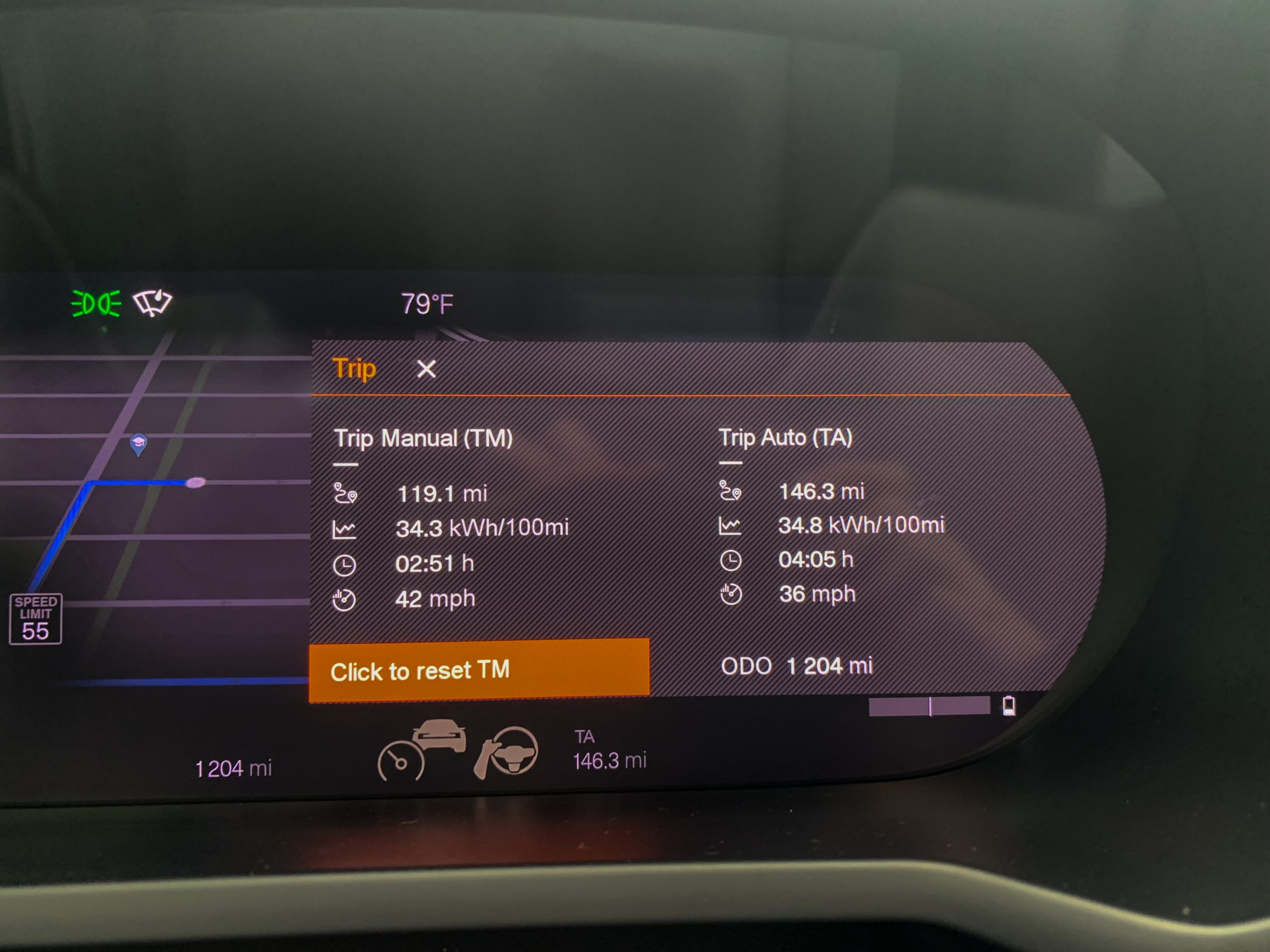
Energy consumption is between a Model 3 Performance and an Audi e-tron. Credit: Jonathan Gitlin

I’d describe the Polestar 2’s performance as brisk. Zero to 60mph takes 4.45 seconds (4.5 second 0-100km/h), which might sound quick, but it’s noticeably slower than an I-Pace or Model 3 Performance. But that should be expected, for both of those performance-focused BEVs boast many more kW.

Polestar is still waiting for its official EPA range, which is due in the next few weeks. Under the European WLTP test cycle, the car is rated at 291 miles (470km), and the company says it’s expecting a US range of 250-270 miles. Because our test car was fitted with the performance pack, it was riding on 20-inch forged alloy wheels shod with sticky Continental summer tires. Bigger wheels and sticky tires are the enemy of long range, but even so, over the course of the day’s drive I averaged 34.8 kWh/100 miles (or 2.87 miles/kWh, which I think is a more useful way of saying the same thing).

For context, the EPA rates a 299-mile range Model 3 Performance on 20-inch wheels and sticky tires at 30kWh/100 miles, and a 234-mile range I-Pace at 44kWh/100 miles (For more context, Managing Editor Eric Bangeman’s I-Pace has been averaging 38.4 kWh/100 miles following the recent update, he told me.) The take-home from this range discussion is that if long-distance road trips are your main buying criteria, you still can’t beat that Tesla. I’d also put the Tesla and Jag ahead when it comes to pure driver enjoyment on a twisty road.

But, on the other hand, if you’re looking for an electric car with a wonderful interior—or that deep Google integration—the Polestar 2 delivers.

Listing image: Polestar

Photo of Jonathan M. Gitlin
Jonathan M. Gitlin Automotive Editor
Jonathan is the Automotive Editor at Ars Technica. He has a BSc and PhD in Pharmacology. In 2014 he decided to indulge his lifelong passion for the car by leaving the National Human Genome Research Institute and launching Ars Technica's automotive coverage. He lives in Washington, DC.
217 Comments