Skip to content
I <3 WEC

Getting to know the 1,000hp hybrids of the World Endurance Championship

We talk racing and tech transfer with Porsche, Audi, and Toyota in Austin, Texas.

Jonathan M. Gitlin | 16
The start of the WEC 6 Hours of Circuit of the Americas. Credit: Photo©AdrenalMedia.com
Story text

AUSTIN, TEXAS—The World Endurance Championship’s annual visit to the US is one of the hottest events in racing—figuratively and literally, given the sweltering heat and humidity that afflicts Austin in mid-September. We at Ars have made it to every Lone Star Le Mans weekend, and 2016 was no exception.

You can check out stunning images of the IMSA WeatherTech race elsewhere on the site (the first of the two double-bill headliners), but now it’s time to talk prototypes. Specifically, the 1,000hp (745kW) hybrids that compete in the Le Mans Prototype 1 class. Audi, Porsche, and Toyota each enter two-car teams which compete around the world, most often over the course of six hours, although at Le Mans in June the race is obviously four times that.

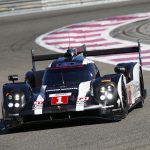
The #2 Porsche 919 Hybrid bottles up both Toyota TS050s at the beginning of the race.
F1’s loss was WEC’s gain when Mark Webber left Red Bull Racing for a job with Porsche Motorsport. He was rewarded last year with a world championship for his effort.

For our money, nothing else in the world of racing pushes so many buttons. The LMP1 hybrids are breathtakingly fast. Sure, a Formula 1 car is faster on the same FIA Grade 1 circuits; comparing fastest qualifying and racing laps at Spa for both series’ visits in 2016 shows the former to be between eight and nine seconds faster over the same 4.3 miles (7km). But the LMP1s weigh an extra 381 lbs (172 kg), and adding 2.2 lbs (1 kg) to an F1 car is commonly held to add 0.1 seconds to a lap.

The allure of LMP1 is more than speed. For one thing, cars run on (Michelin) tires that aren’t designed to artificially degrade in order to spice things up. Endurance Drivers can—and indeed must—push from the moment the race starts until the checkered flag waves. And compared to F1, the rulebook is wide-open. Manufacturers simply pick how much energy they intend to deploy from the hybrid systems—currently Audi is at 6MJ per lap of Le Mans, while Toyota and Porsche are both at the maximum of 8MJ—and off they go.

Want a naturally aspirated V8? Go for it. Four-cylinder turbocharged V4? Why not. How about a V6 turbodiesel? All have or are being raced in WEC. And there’s freedom with the hybrid systems as well: currently two are allowed on each car, with three being permissible from 2018 with the addition of a new 10MJ class. Oh, and we’ve also seen electromechanical flywheels and supercapacitors as energy stores in previous years, although by 2016 all three had coalesced around lithium-ion batteries. (You can read a more in-depth technical look at the Audi, Porsche, and Toyota in this piece from March.)

What really caps our love of the World Endurance Championship is how this technological arms-race has direct relevance for our road cars. The new direct injection turbocharged engines in Porsche’s 911 and 718 road cars use a cylinder head design that’s almost carried over from the 919 Hybrid’s V4, and if you drive a new Toyota Prius, the control electronics that govern its hybrid system were first tested on the TS040.

2016 has been quite the year in the LMP1 class, particularly after 2015 was utterly dominated by Porsche’s 919 Hybrid. A look at the results suggests a repeat performance, with Porsche winning every round bar the Spa-Francorchamps in May. Reliability woes cost Toyota’s TS050 the win in Belgium (their loss being Audi’s gain) and at Le Mans (where the lead car failed with three minutes left on the clock). As for Audi, where caution and conservatism have ruled in the past, this year’s R18 pushes the envelope such that it’s unquestionably the fastest of the three—the consequence being a level of unreliability that we’ve not seen from the four rings since the turn of the century.

The Porsche team services a 919 Hybrid late in the evening.
LMP1 teams are allowed many fewer mechanics working on the cars during pitstops compared to F1, but that makes them no less spectacular.

Porsche

As far as Porsche Team Principal Andreas Seidl is concerned, there’s always room to improve. He told Ars:

We’re still a young team, and we can still make huge steps compared to last year. The lap times in qualifying were quite a bit quicker than last year even though per the regulations we lost quite a lot of performance on the fuel flow side and so on. So it just confirms how motorsport is—you never stand still, you’re always looking for improvements on the car, there’s always something to improve, and looking at us, being a young team, even the basics of the car you can still find a lot of performance improvements.

Seidl told us the decision to start the 919 Hybrid program in 2014 in the top 8MJ class wasn’t without consequences, but the results the past two years appear to have borne that strategy out. He told us:

We went straight to lithium batteries plus two energy recovery systems, including the only ones using an exhaust energy recovery system. We paid our price in the first year for being so aggressive with some reliability issues, which is normal if you set something up from scratch, but obviously we benefited big time last year—we clearly had the fastest car over the entire season.

Porsche team principal Andreas Seidl told me, “The spirit of the team is that we question ourselves every morning what we can do better, and that’s pushed us to the success we’ve had so far.”
Porsche team principal Andreas Seidl told me, “The spirit of the team is that we question ourselves every morning what we can do better, and that’s pushed us to the success we’ve had so far.” Credit: Elle Cayabyab Gitlin

This year’s 919 Hybrid keeps the same basic concept—a 2.0L turbocharged V4 gasoline engine driving the rear wheels, a motor-generator unit recovering and deploying kinetic energy at the front axle, and an exhaust energy recovery system that also sends its power to the front (via the car’s lithium-ion batteries).

If you look what we did over the winter, we kept the basic concept the same, but touched nearly 80-90 percent of the parts on the car—every area. There are improvements on the engine side—efficiency, weight, performance. And the same on the hybrid side. Obviously we’re working a lot on the drivability of the car; sensitivity of the aerodynamics especially during cornering, the sensitivity regarding side winds, crosswinds, and so on. We’re acting on what we learned on every race last year. Even if you have dominant performances—and we had a lot of those last year—there’s always a long list of things that can be done better.

Although Porsche has decades of success at the top level of endurance racing, that didn’t mean the 919 Hybrid program has been simple. Aside from an aborted program in 2000 that was quickly consigned to the memory hole, the company hadn’t built and raced a prototype for many years. That meant starting a team from scratch. We asked Seidl if having a hybrid system was challenging. He said with a smile:

Since there was, for a long time, no project at Porsche at this level, in this class, it’s difficult to say that, for example, the hybrid was the most difficult thing, because everything was difficult. Even the monocoque—it was the first time in quite a long time building one. The same with the suspension, the aerodynamics. At the beginning putting all that up with a project that started from zero, that was quite painful. But it’s normal, the price you have to pay when you start everything from scratch. But on the other hand you have the benefit that you’re able to start from scratch and can have everything set up the way you want to have it.

Audi

As far as Stefan Dreyer—head of Audi’s LMP1 program—was concerned, this race and the one that preceded it in Mexico City were the two biggest tests of the year. He told Ars:

In Mexico we had to cope with high altitude, and here it’s very hot. It’s not just the hybrid system which is suffering, it’s basically the whole car—engine, gearbox, everything. You have to cope with this; you have to develop in a direction where you know where you’re going, which continent you are racing in, and we have to make sure we’re well prepared.

Audi Motorsport head Dr. Wolfgang Ullrich looks disappointingly down the pit lane. 2016 was yet again Audi’s race to lose, and it did.
Audi Motorsport head Dr. Wolfgang Ullrich looks disappointingly down the pit lane. 2016 was yet again Audi’s race to lose, and it did. Credit: Elle Cayabyab Gitlin

2016 is the first year that Audi has used lithium-ion batteries instead of a flywheel. Dr. Wolfgang Ullrich, the head of Audi Motorsport, didn’t foresee a similar switch from diesel to petrol, even if diesel is a topic of contention for Volkswagen group these days. “The flywheel was at the limit of capacity,” he told us, “so there was no way to continue with it in the 6MJ class. But it was just something we took in hand and developed our own battery package.”

But as for switching to a different fossil fuel, Dr. Ullrich explained:

At present we don’t see that happening. We want to be efficient, and gasoline engines are not efficient. If you look at what happened over years, for sure gasoline engines are a lot more efficient than they were five or ten years ago. But from the pure physics, the thermal dynamic advantage of the diesel engine is always there. And whatever you do to the petrol engine you’ll never match it, there’s no way.

Indeed, although Mercedes-Benz and Ferrari are approaching 47 percent thermal efficiency with their current Formula 1 engines, we believe that’s still less than Audi’s 4.0L V6 turbodiesel. “For us it makes sense to continue with that,” Ullrich said. “As others develop their gasoline engines to be more efficient, we’ll work to make our diesel engine more and more efficient. But that gap will remain. [The gain] is just coming out of the thermodynamic process.”

Toyota

After a performance at Le Mans that left many thinking of Toyota as the moral victor, we found Rob Leupen, Toyota’s team director, in an upbeat mood in Austin. “We knew our qualifying pace wouldn’t be on the level of the other two. But our race pace compared to the others is a bit better. Here we’re back. I think the track is OK for us,” he said. Leupen was also not afraid of the September sun. “The temperatures cannot be high enough for us; the car prefers it quite hot. If you look at our competitors I think Porsche would like it a bit cooler. So I think we’ll get an interesting race, with Audi dictating the pace, and, as the race is developing, we’ll start to push,” he told us.

Rob Leupen, team director for Toyota Gazoo Racing, talking to Ars before the race.
Rob Leupen, team director for Toyota Gazoo Racing, talking to Ars before the race. Credit: Elle Cayabyab Gitlin

Still, the season’s lows have not been without toll. Leupen said:

Our two most important races of the year, we were leading. But in Spa we had an engine failure in both cars, and at Le Mans a few minutes before the end… Definitely heartbreaking. What I hear everywhere, I’m still gutted about it, but it was a great experience on the other side, and we’d say the hardship we’ve received has been good for us. Here we’re back.

With a new monocoque and a completely new hybrid powertrain (a 2.4L twin-turbocharged direct injection gasoline V6 coupled to MGUs front and rear and lithium-ion batteries), the Cologne-based team had an awful lot of work to do in the off-season. Leupen told us:

We not only moved to 8MJ, but also the turbo engine. Both of us had a very strong learning curve. For example at Silverstone, where we really had to learn the systems, we were late, because last year we were off the pace. We had to take this step, and we’ve done it. I’m extremely impressed with what our colleagues in Japan have done, which means we’re back in the game again. Still chasing the others, based on our development rate, based on the newness of the system. Audi ha[s] also got quite a new engine, but they planned it longer ago.

What’s more, Toyota Gazoo doesn’t have the same level of resources as its two VW group rivals. Porsche and Audi are each believed to spend between $200-$300 million a year on their LMP1 programs, while Toyota has to make do with about $80 million. Leupen confirmed that his budget was smaller than his competitors’, “but on the other side that’s a position taken by Toyota, so this is the position we have to work with, and we try to make the best out of it. On the other side, if you see our facilities in Cologne, everything is quite efficient. It doesn’t compensate for the gap but it makes life a bit easier. The focus is still to build a strong car with Toyota hybrid technology.”

Plans for next year—which may include a third car at Le Mans—are firmly underway in Cologne. “We’re not too bad this year, but I think next year we’ll make another step. We’ll stay on 8MJ, the same monocoque. We’ll do the complete aero, we’ll look at the suspension and the gearbox—items on the old transmission were an issue, so you’ll find except on a few parts it will be all new,” he said.

Marcel Fässler (left) speaks to Mr. Le Mans himself, Tom Kristensen, entertaining the guests in Audi’s hospitality suite.
A late-race pitstop for the #6 Toyota. Sarazzin’s magnificent drive yet again showed the TS050 is faster than its results this year suggest.

Tech transfer

All three teams were keen to discuss the road-relevance of their LMP1 programs. “We have engineers from Japan in Cologne developing the cars and the systems,” Leupen told us. “And our engineers are trained on Japan’s side. We’re doing a lot of road car projects in the prototype stage at Toyota Motorsports, so the powertrain colleagues at Toyota Motor Corporation are working together closely with the hybrid group there. It’s a constant exchange of information. What are the main topics? You won’t see this car running on the street,” he said, referring to the TS050, “but you will see elements like software management, efficiency of the system itself, new data we get on the engine, because if you compare this to five or eight years back it runs with much less fuel—up to 70 percent less. For example the engine which we ran in 1998 used 100 liters per 100km. Today we do the same 100km in 28.5L. That’s what we’re doing here and what gets fed back to the company.”

Siedl was similarly effusive about the role the 919 Hybrid plays in making better Porsche road cars. “There’s a lot of stuff on the hybrid side, the high voltage electronics, which we’ll see in the Mission-E car. The way we use the hybrid software strategies and stuff, there’s a lot of transfer happening,” he told us. But the benefits aren’t just tangible components or systems. He explained:

We shouldn’t forget, it’s not just the technical details that get transferred, it’s [not just] the people that work in this environment using this championship as a way to develop future stuff, but how these guys build up in themselves the working mythology, and all this stuff is a big benefit for the road cars, too.

This is the fastest laboratory we have, not just in terms of speed on the track, but in how quick we develop, and that’s obviously to the benefit of the road car division. There’s a lot of interaction between people from our departments and the road car division, and just by this there’s a lot of transference of the know-how. But it also goes in the other direction. At the beginning of the project we benefited a lot from the experience that was there with the 918 Spyder, for example, and used that experience for our project. It’s not just a one-way.

The race

Qualifying for the race went to Audi. The #7 car of Marcel Fässler, André Lotterer, and Benoît Tréluyer took pole, with the sister #8 car of Lucas di Grassi, Loïc Duval, and Oliver Jarvis 0.233 seconds behind. Then came the championship-leading #1 Porsche of Timo Bernhard, Mark Webber, and Brendon Hartley, the #6 Toyota of Stéphane Sarrazin, Mike Conway, and Kamui Kobiyashi, the #2 Porsche of Romain Dumas, Neel Jani, and Marc Leib, and finally the #5 Toyota of Anthony Davidson, Sébastian Buemi, and Kazuki Nakajima.

With the mercury still above 95 degrees Fahrenheit (35 degrees Celsius) when the green flag waved at 5pm on Saturday for the start of the race, all 18 drivers had their work cut out for them. Regulations require cockpit temperatures to not exceed a certain delta beyond ambient. But, even within the proscribed limits, a single 50-minute stint is an arduous challenge for these Nomex-clad athletes. At the first turn, Webber found his way past the #8 Audi for a while before the red-and-black diesels took control. Behind them, Dumas bottled up both Toyotas for several laps, letting the front three cars build up a decent lead.

Just as at Mexico City, the race was Audi’s to lose. And, sadly for the massed ranks of Audi staff and customers at the track, that’s exactly what happened. The #8 should have taken victory, but an electrical shutdown cost the #8 car 40 seconds, and then an unscheduled pitstop late in the race to secure a loose door lost the car even more time. Without that final problem it may well have delivered glory.

The #6 Toyota recovered from being held up at the start. As with the previous round, Sarazzin put in a virtuoso performance during his final stint, resulting in a third-place finish. Judging by the elation shown by the team members on the pit wall, he may as well have been first place.

In the end, the day belonged to the #1 Porsche. Perfect timing meant the car was able to pit during a virtual safety car period (when an incident on track means the cars all have to circulate at the same fixed speed), gaining time over the #8 Audi, which hit the pitlane under green flag conditions shortly before.

There are three rounds left for the WEC this year. The next race takes place at Japan’s Fuji circuit on October 16.

Listing image: Photo©AdrenalMedia.com

Photo of Jonathan M. Gitlin
Jonathan M. Gitlin Automotive Editor
Jonathan is the Automotive Editor at Ars Technica. He has a BSc and PhD in Pharmacology. In 2014 he decided to indulge his lifelong passion for the car by leaving the National Human Genome Research Institute and launching Ars Technica's automotive coverage. He lives in Washington, DC.
16 Comments