Skip to content
Policy

Cram this: a firsthand account of my recent cramming

When my phone and Internet bill mysteriously doubled in a single month, I …

Nate Anderson | 4
Story text

Check that bill

According to the charges that appeared on my phone/Internet bill last month, I signed up for some form of voicemail from MyIProducts Imail for $14.95 a month. Maybe I spent much of the month drunk, as I also appear to have signed up for a similar voicemail service from Orbit Telecom, again at the staggering rate of $14.95 a month. A closer look at the bill shows that I may have been high as well, since I went ahead and signed up for a third voicemail service from Selected Services, Inc. At least I showed better financial judgment this time; it cost only $12.95.
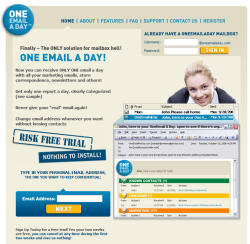

One of the many services I did not sign up for

Finally, because my three voicemail accounts just weren't enough, my AT&T bill included yet one more $14.95 monthly charge from a company called OneMailADay, LLC. Their product? Some kind of daily e-mail digest, the point of which manages to escape me still.

The bottom line from this weirdness: my AT&T bill doubled from $50 to $100 because of the four charges, and the charges would recur every month until the end of time.

After giving the matter careful thought, I concluded that I had been neither drunk nor high during the previous month and, unless my seventeen-month old had signed up for a series of voicemail services, I was being scammed. The first hour after this realization was spent concocting elaborate scenarios under which the scammers in question would suffer the torments of the damned (or at least of the Illinois correctional system), but this turned out to be an unproductive use of my time.

Instead, I set out to learn what had happened, stop it from happening again, and recover all of my money. What I found along the way was troubling: this sort of thing could happen to you, too, with no warning and no verification, and your own phone company can't help you resolve it.

Welcome to Crammerville

What happened to me (and what happens to thousands of others each month) is known as "cramming." The Federal Trade Commission calls this "the practice of placing unauthorized, misleading, or deceptive charges on your telephone bill. Crammers rely on confusing telephone bills in an attempt to trick consumers into paying for services they did not authorize or receive, or that cost more than the consumer was led to believe."

Your phone company will generally pass along third-party charges, assuming that they are valid. And they can be; all sorts of charges (such as collect calls) can actually be billed to your account by telecom companies but, for obvious reasons like the total lack of verification, this system is also a scam magnet.

When I called AT&T, the customer service rep sympathized but could do nothing. The charges had not come from AT&T, I was told, and the company simply had no involvement with them. What I could do was request a block on such third-party charges, but the block would also prevent AT&T from processing any credit that the companies might issue for the charges. These credits might take two or even three billing cycles. In the meantime, these companies or others could continue to add charges to each new bill. This cycle could continue indefinitely.

Surely, given just how common the practice has become, there was a better way to handle the situation?

I was told that there was not. The pause in our conversation was filled with the grinding of my teeth.

Surely, I continued, it couldn't possibly be true that any billing company on the planet could simply charge me whatever it wanted just by entering my phone number?

I was told that it could. Then, cheerfully: "Is there anything else I can help you with today, Mr. Anderson?"

I hung up the phone, jogged to the gym, and spent the rest of the hour punching a body bag. It didn't help.

Shoot the messenger

I had no intention of paying these ridiculous charges; fortunately, each billing entry came with a toll-free phone number, but I wanted to learn a bit about these companies before I picked up the handset. It didn't take long to turn up the dirt.

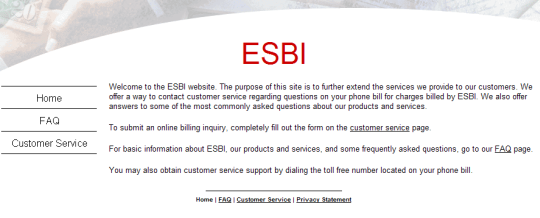
Three of the bills were added to my phone bill by a firm called ESBI, while the fourth came from ILD. These companies claim to be mere billing aggregators dealing with smaller firms; in other words, they're just the messenger. And we don't shoot the messenger, do we?

The FTC did. Way back in 2001, the Commission brought charges against ESBI for cramming. According to the FTC, ESBI "falsely represented that consumers were legally obligated to pay charges on their telephone bills for web sites and other items they had not ordered or authorized others to order for them" and that "consumers were unable to prevent ESBI from causing such unauthorized charges to appear on their phone bills."


ESBI's home page, a model of professionalism

The Better Business Bureau of Central & South Central Texas, where the company is based, gives ESBI an "unsatisfactory record."

As for ILD, a Google search on the company's name turns up a consumer complaints website as the second result. Not a good sign, that. I looked through the stories, many from this very month, with a creeping dread.


Why, yes, I do have a question

"Two bills for $12.95 appeared on my 2/25/08 phone bill for Nations 1st Comm. Voicemail Monthly Fee, which I did not order," wrote Ron of Concord, California. "I called the 866 number and they told me that my wife had ordered it in December. We've had voicemail with AT&T for over 10 years and have no need for another voicemail, so I told them to cancel the service and refund the charges. They told me that they would, and that the refund would appear on my next bill. The next bill (3/25/08) arrived, and I had yet another $12.95 charge."

Uh-oh.

Certainly, the company knows that its billing is problematic; a prominent link on the front page of its corporate web page is to "Questions about your bill?" An MSNBC report from earlier this year noted that cramming was on the rise and that ILD is "the company at the center of the accusations."

Cramming is a lucrative business, and, despite repeated FTC actions, it continues unabated. In March 2008, the FTC wrung a $1.9 million fine out of the largest US billing aggregators and, in December 2007, a US court ordered a firm called Nationwide Connections to repay a staggering $34 million in phony charges. With that kind of money at stake, no wonder the practice continues.

With a heavy heart, I started calling to see if I could get those charges reversed.

The politest operators I have ever met

I started with the three charges for ESBI. Although each charge ostensibly comes from a different company, all three numbers led to a similar setup: operators who were still available at 11:30pm and a direct connection to said operator (that is, no phone tree or greeting of any kind). All asked me the same questions, all offered the same excuses. After calling all three, I'd bet good money that the same firm was behind the $48.21 of charges that ESBI wanted me to pay.

The calls started with the same questions. I was asked for my phone number, which I provided. The account was pulled up on their computers. Then I was asked for my address.

"Why do you need that?" I asked.

"To verify your account."

"But you slapped a $14.95 charge onto my phone bill without verifying my account. Isn't it odd that you care about security now?"

"Sir, I have to enter it in the computer."

After much back and forth, all three firms allowed me to proceed without providing a complete address, and all three firms then provided the address of whoever had allegedly signed up for their "services." This address, which turned out to be the same for all four of the charges on my AT&T bill, was not mine. Despite this, each company allowed me to proceed and to dispute the charges. That's some security policy.

"Why did you ask me to verify my address when you don't actually require it to match what's on the account anyway?" I asked. "What kind of verification is that? What possible purpose does that accomplish?"

I got no good answer. This sort of thing was typical of all the interactions, and I wondered at times if I had fallen into a Kafka novel.

Each operator was polite, even cheerful. Each agreed to refund my charges immediately, and each offered the exact same explanation of why I was billed in the first place. "Someone must have made a mistake when typing their phone number into some form online, and they entered yours instead," I was told.

I asked each operator if I understood this correctly: the company they worked for was billing people based on nothing more than phone numbers typed into online forms, and it conducted no sort of verification at all on these accounts? That is, if I went online right now and entered their (the operators') phone numbers into these same online forms, they would billed? And they had no problem with that sort of setup?

They did not. In fact, each assured me that they did not get many calls about this issue, a claim that even the most cursory web searching shows is a dubious one. In the end, everyone at ESBI seemed anxious to reverse my charges, probably hoping that, by making this process simple enough, callers would be mollified enough not to seek further action from a state Attorney General or the FTC.

The ESBI firms all let slip bits of information about whoever had allegedly signed me up for these services, but it was ILD's operator who filled in the picture. Through her, I finally assembled the complete name and address that had been entered into an online form, and I finally got the address of the form in question: usprizedraw.com.

Well, if that doesn't sound dodgy, I don't know what does.

Win a Vegas vacation… and a solid cramming

Usprizedraw.com is a single page with a picture of Vegas in the background and a form in the foreground. That form promises a drawing for a free vacation. All you have to do is provide your address, phone number, e-mail address, date of birth, and gender. What could possibly go wrong?


The source of my ILD bill

A close look at the site's "prize draw rules" shows that contestants "also agree to accept e-mail messages from, Clash Media Advertising Ltd, and their respective advertising affiliates" in return for the chance to win. I could find no mention of signing up for a $12.95 per month voice mail service.

I requested comment from Clash Media Advertising regarding the form, the promotion, and the company's relationship with ILD, but have yet to receive a response. The company's website shows its "Corperate Headquarters" [sic] as being in the UK, though it runs numerous US-focused websites like ushigherlearning.com.

Such web forms and prize drawings are common vectors for these charges. The FTC notes that "contest entry forms" are one of the primary ways these companies get "permission" to start billing users, along with direct mail sweepstakes and certain "instant" calling cards and 800 numbers.

While crammers could of course troll through phone books and start slamming people at random, that would be obviously illegal and unethical. By getting the cover of a web form, even if that form says nothing about the service in question, the companies earn at least a fig leaf's worth of plausible deniability.

In my case, I had initially assumed that this was all a straight-up scam, but the fact that the same name, address, and phone number were on file with both the ILD and ESBI charges suggested that someone, somewhere did choose to enter my number into a set of web forms, perhaps wisely aware that free trips to Vegas usually come with a catch.

The address I was given appeared to be for an apartment complex in a neighboring town. Curious to know who might be entering my phone number into dubious online forms, I drove to the complex a few days ago over lunch. I found the building, but the buzzers had no names on them. Like MacArthur, though, I will return.

Who will rid me of this meddlesome crammer?

Not that the person at this address was necessarily responsible; anyone could have entered any information into any of these forms and I would have ended up paying the cost. Sound ridiculous? It is.

Imagine a payment system that could charge anyone in the US who has a phone number, and could do so simply by having access to that publicly-available number. The biller would not need to have any sort of verification and would not need to do even something as basic as match the phone number to the address on file with the local phone company. The bill could be for any amount, and it could recur every month. It sounds like a recipe for disaster, and it is, but it's basically what we have now.

As bad as the entire system is, I'm one of the lucky ones. With an increasing number of bills directly debited from bank accounts and with paper statements increasingly replaced by e-mail notifications, I could well have missed the charges altogether. Had I not taken a close look at an AT&T e-bill that seemed unusually high, I never would have noticed the suspect charges, and the companies who filed them could simply lap up the fees.

According to the FTC, there's not even that much for consumers to do. The agency's advice is to:

  • Immediately call the company that charged you for calls you did not place, or services you did not authorize or use. Ask the company to explain the charges. Request an adjustment to your bill for any incorrect charges.
  • Call your own local telephone company. Explain your concerns about the charges and ask your local telephone company the procedure for removing incorrect charges from your bill.
  • File a complaint with the FTC.

But there's no guarantee that the charges will in fact come off my bill, and numerous online accounts testify that they often don't. You won't be disconnected if you don't pay these bills but, if you're on an automatic debit plan, avoiding payment may prove a bit trickier. Plus, your account could still go into collection if you don't take care of the charges in some way.

Putting a third-party block on the line appears to be the best defense, though if you've already been hit, you may never recover the cash.

It's difficult to imagine just how withered the souls of the people who run these operations must be. One hopes they are making a pile of cash and living it up right now, because they'll be first against the wall when the revolution comes.

Photo of Nate Anderson
Nate Anderson Deputy Editor
Nate is the deputy editor at Ars Technica. His most recent book is In Emergency, Break Glass: What Nietzsche Can Teach Us About Joyful Living in a Tech-Saturated World, which is much funnier than it sounds.
4 Comments