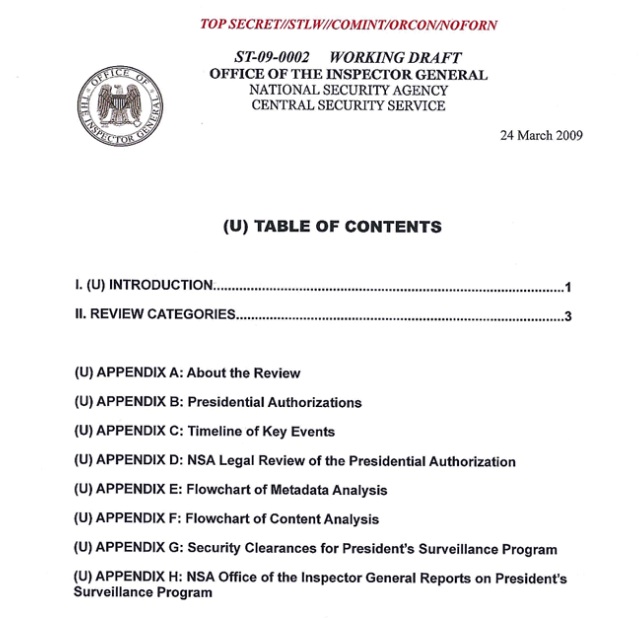
As stories based on Edward Snowden’s trove of leaked National Security Agency (NSA) documents continue to trickle out, most reporters have focused on what they can tell us about the spy agency’s current or recent surveillance activities. Yet one of the most interesting documents from Snowden’s cache, published in full by The Guardian back in June, sheds new light on the granddaddy of them all: President Bush’s original warrantless wiretap program.
It was this program, itself one component of a broader initiative known as STELLAR WIND, that kicked off the modern debate over NSA surveillance powers when it was exposed in a bombshell 2005 New York Times story. An unclassified report on the “President’s Surveillance Program,” jointly authored by the Inspectors General of the major intelligence agencies, was released in 2009. But the newly leaked classified draft report by the NSA’s Inspector General (IG) has painted a far more complete picture of STELLAR WIND’s genesis and evolution. Here are five of the most interesting details either revealed or confirmed in that classified draft.
The program was broader than originally reported
Both president Bush and members of his administration repeatedly stressed that the warrantless wiretap program was narrowly limited to “persons reasonably believed to be members or agents of al Qaeda or affiliated terrorist organizations.” Perhaps that was true by the time the New York Times revealed the program’s existence. But the description of the NSA’s IG suggests that, at least initially, the president authorized far broader surveillance, encompassing all communications between the United States and Afghanistan. As the draft report explains:
The Authorization specified that NSA could acquire the content and associated metadata of telephony and Internet communications for which there was probable cause to believe that one of the communicants was in Afghanistan or that one communicant was engaged in or preparing for acts of international terrorism. In addition, NSA was authorized to acquire telephony and Internet metadata for communications with at least one communicant outside the United States or for which no communicant was known to be a citizen of the United States.
The surveillance authorization changed over time, as the report notes, and it eventually dropped the specific reference to Afghanistan. Though the report does reference an appendix further detailing the evolution of the president’s authorization over time, that document hasn’t yet been published. That means it’s unclear whether other countries or regions—such as, say, Iraq or Pakistan—were later subject to similar blanket surveillance authorization.
 Loading comments...