Skip to content
Policy

666 chip? Why a Texas student thinks her school ID is the “Mark of the Beast”

The theology behind a battle over RFID tags.

Nate Anderson and Eric Bangeman | 335
Credit: Aurich Lawson
Story text

By now, you’ve probably heard the story: exemplary student Andrea Hernandez has decided to fight her San Antonio high school’s plan to outfit every student with an RFID-equipped badge in order to better take attendance and track students while on school property. (Radio frequency identification tags are short-range tracking tags that can be scanned by local readers, though they don’t enable any sort of GPS-style location tracking of a student’s movements around town, at home, etc.) Hernandez objects to the plan, which the district instituted in order to better recover its daily per-pupil funding from the state of Texas, on the grounds that it was a terrific invasion of her privacy—and of her religious liberty.

How can a plastic badge with a tiny built-in microchip violate religious liberty? The Rutherford Institute, which has taken the Hernandez case and filed a lawsuit (PDF) over it in Bexar County, Texas, puts it this way:

Plaintiff and her father object to the requirement that Plaintiff wear the Smart ID badge on the basis of Scriptures found in the book of Revelation. According to these Scriptures, an individual’s acceptance of a certain code, identified with his or her person, as a pass conferring certain privileges from a secular ruling authority, is a form of idolatry or submission to a false god.

The hugely broad definition offered here would seem to sweep up many things, including my children’s annual city pool passes, but what’s actually being discussed is something more specific: the Mark of the Beast.

The hundreds of news stories on the controversy have focused largely on the privacy element, though some have repeated the Mark of the Beast claims without much in the way of explanation. Many Ars readers, encountering the story for the first time, might well have shared some of the privacy concerns expressed by Hernandez, but come up short in understanding the reason for her objection. What is this mark, and why has it been so tied to certain specific forms of technology? Why do RFID tags and bar codes, in particular, arouse such concerns? And did “John the Revelator” really record long-ago prophecies about contactless payment solutions and geolocation?
Good questions.

A long and very strange trip

A great aunt of mine (Nate) once sent my entire family on a two-week tour of Europe’s greatest hits. Those who have been on such tours will recognize the type: expensive international hotels in city centers at night, lengthy bus trips down Europe’s finest stretches of tarmac during the day, all in order to make it from London to Rome and back to Paris within 14 days. The bus portions of the trip were not specially remarkable for anything other than epic card games—except for the moment when we pulled out of Brussels one morning on our way to points further east.

The Mark of the Beast—or death!

Our tour guide pointed to a set of European Union buildings in the distance; just behind me, an older man turned to his wife and announced that these were the buildings in which an infamous computer called the BEAST resided, ready and waiting to be put to the use of the Antichrist after he had turned the EU into the dictatorship that would eventually bring us all to the apocalypse and thus to the utter end of the world. This computer would apparently be responsible for tracking us all and our payments, and it would freeze the true believers out of the global commerce stream. His wife did not appear to think this was an unusual thing to say, and she continued to film the roadside scenery with her video camera.

And it was not actually such an unusual thing to say if you came of age within American evangelical and fundamentalist circles during the 20th century—most particularly the ’70s and ’80s. These were true golden years of apocalyptic, Mark of the Beast, Antichrist-driven thinking. Famous nonfiction books like The Late Great Planet Earth translated the fascinating apocalyptic imagery of the Bible into blueprints for impending doom, matching cryptic ancient words to concrete contemporary events. In this view, the world was likely to end soon-ish—quite possibly within 20-50 years—at which point the Second Coming of Jesus Christ would bring about the creation of a new, remade world for humanity. Before that happened, though, there would be suffering, as the power of the Antichrist waxed and the power of Christians in the world waned (most having been raptured before the final “Great Tribulation” began).

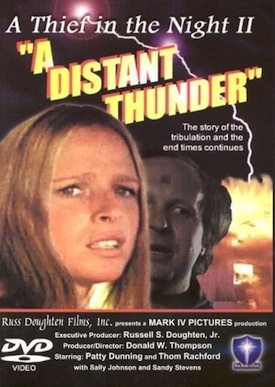
This set the background for a thousand Christian youth group meetings throughout the 1980s, in which kids watched films like 1972’s A Thief in the Night or 1978’s Distant Thunder, the latter perhaps the most classic late-’70s apocalypse flick. Short version of Thunder: everyone left after the rapture eventually gets rounded up if they don’t take a special mark on their foreheads. Those who refuse the mark are ushered into a back room, after which many come out screaming and accept the dotted pattern on their skin. What’s in the horrible room that can shake the new faith of those “left behind” after the rapture? SPOILER ALERT: it’s a guillotine. (Skip to the 6:50 mark in the clip below to get the flavor.) Those who take the Mark of the Beast are spared, of course—though their souls are doomed. You can still buy the film on DVD from Amazon (sold by “armageddonbooks,” naturally) for $26.95.

A few minutes from A Distant Thunder.

This basic view of the world’s end saw perhaps its greatest cultural breakthrough into the mainstream with the 1990s “Left Behind” series, which included original books, children’s books, audiobooks, nonfiction books, military books, movies, video games, background wallpaperscreensavers, etc, etc.

With all of the attention some Christians have given the Mark of the Beast throughout the centuries, the phrase appears only once in the Bible, as part of the last book of the Christian New Testament, the Revelation of John. While apocalyptic passages exist in books of the Hebrew Bible like Daniel and Ezekiel, Revelation is the single book where the genre predominates.

Apocalyptic literature is defined by biblical scholar John J. Collins as “a genre of revelatory literature with a narrative framework, in which a revelation is mediated by an otherworldly being to a human recipient, disclosing a transcendent reality which is both temporal, insofar as it envisages eschatological salvation, and spatial insofar as it involves another, supernatural world.”

This type of literature most often appeared when the faith community was under some sort of duress, whether it involved the remnant of Israel living in Babylonian captivity (as was the case with Daniel) or the early Christian church being persecuted by the Roman Empire (as was the case in the late first century when Revelation was written). The key message: live faithfully even under the thumb of your enemies—not necessarily because the Lord will return to bust open a giant can of Smite Thee on them some day, but because God’s justice will eventually prevail and the good guys will win in the end.

Being apocalyptic in nature, one of Revelation’s concerns is to reveal “the truth about unseen present realities… and unknown future realties, such as judgment and salvation,” as Michael J. Gorman, author of Reading Revelation Responsibly: Uncivil Worship and Witness: Following the Lamb Into the New Creation, puts it. Likely written around 95 CE, much of the book is devoted to fantastic images: a scroll with seven seals, seven trumpets that sound, a final battle on the plain of Megiddo (“Armageddon”), and—most germane to our purposes—one dragon and a pair of beasts.

Two beasts, one mark

The dragon shows up in chapter 12 and is identified as Satan (literally “the adversary,” a figure who opposes the followers of God). Shortly after the dragon’s dramatic appearance, a beast arises from the sea. It has seven heads and 10 horns and is given power and authority by the dragon so that humankind will worship it. (The first beast is often identified as the Antichrist, although the term does not appear in Revelation.)

After the first beast wages war upon the faithful, a second beast appears on the scene, this one having two horns like a lamb and emerging out of the earth to promote the worship of the first beast. Think of him as the first beast’s more charming PR flack.

Many biblical scholars see the dragon and two beasts of Revelation 13 as an unholy parody of the Christian trinity (Father, Son, and Holy Spirit), but for our purposes, we’re interested only in the second beast, the one who has the bright idea of marking people.

Also it [the second beast] causes all, both small and great, both rich and poor, both free and slave, to be marked on the right hand or the forehead, so that no one can buy or sell who does not have the mark, that is, the name of the beast or the number of its name. This calls for wisdom: let anyone with understanding calculate the number of the beast, for it is the number of a person. Its number is six hundred sixty-six.

Revelation 13:15-18 (New Revised Standard Version)

It’s this section that has caused no small part of consternation for some fundamentalist and evangelical Christians over the past few decades. Those preoccupied with divining the hidden secrets of Revelation and Christian eschatology—the study of the end times—generally adhere to an interpretative scheme described as “premillennialist.” They attempt to map the fantastic visions and imagery in Revelation to specific present and future events. We’re not going to go into detail into Christian eschatology—though we did offer a high-level overview of the concepts in our 2006 review of Left Behind: Eternal Forces.

That approach to Revelation and to the world can see technological advances in particular as something to be feared, especially because the Mark of the Beast sounds more than a bit like electronic tracking and payment systems of today. Implanted NFC ID/payment chips? RFID tags? Bar code tattoos? It’s all technically possible.

But the line that calls for “wisdom” remains far more mysterious.

666

The number 666 has pervaded popular culture over the centuries. Sci-fi author Robert Heinlein wrote a universe-shifting thriller titled The Number of the Beast, and Iron Maiden’s song by the same title still rocks hard three decades after its release. But the identity of the man whose number it is has remained mysterious.

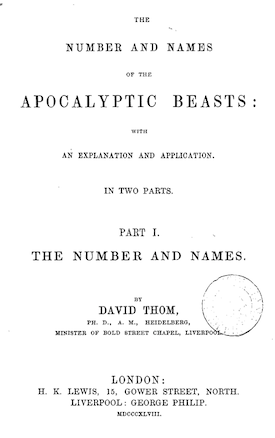
One of the many books throughout history that have attempted to work it all out.

Throughout the ages, different candidates for the identity of the Antichrist, or the first beast, have been offered up. They have ranged from various Popes (and the Papacy itself) to historical figures like Peter the Great, Napoleon, Hitler, Stalin—even John F. Kennedy. Even whole years came in for scrutiny. In February 1666, the great English diarist Samuel Pepys noted that he “took coach, and calling by the way at my bookseller’s for a booke, writ about twenty years ago in prophecy of this year coming on, 1666, explaining it to be the marke of the beast, I home, and there fell to reading, and then to supper, and to bed.”

But the 666 of Revelation is most likely an example of “gematria,” a device of ancient languages that used letters to represent numbers, giving a word or phrase some sort of numerical value.

Most biblical scholars today are of the opinion that 666 is a reference to the Roman Emperor Nero. Nerōn kaisar, Greek for Nero Caesar, adds up to 666 when using Hebrew gematria. (If you drop the final “n” in nerōn, the letters add up to 616, which likely accounts for a variant reading in some early manuscripts of Revelation.) You can mess with the gematria and come up with the names of other emperors like Gaius, Domitian, or Caligula, but the takeaway is the same: the first beast is an imperial figure. So we’ve got a historical figure to work with, one without access to RFID tags and bar codes. What do we make of his mark?

The mark, then…

Under the interpretive framework we’re using, the Mark of the Beast is best understood to be the imperial seal of the Roman Empire, or perhaps a slogan or image. In the middle of the third century CE, during the reign of Decius, only those who had a certificate showing that they had made a sacrifice to the emperor could work in a trade. This may have also been the case by the end of the first century.

Roman coins also carried the emperor’s likeness. Charagma, the Greek word used in Revelation 13:15 for “mark,” also can mean a stamp, engraving, or even a coin. Given that the Jews in Palestine revolted during Nero’s reign, about 30 years before Revelation was written, and coined their own money, it’s also plausible that the passage is referring to the coin of the realm.

So, problem solved. The first beast is Nero or another Roman emperor of the first century, while the Mark of this Beast is the imperial seal or Roman coinage. Case closed?

Not exactly. The vivid, apocalyptic language of Revelation lends itself to all sorts of interpretations, especially when combined with other apocalyptic and prophetic literature in the Bible. Revelation may well have been an apocalyptic work intended to give comfort to a first-century faith community suffering from persecution. But for those who have “ears to hear,” it’s simultaneously a kind of prophetic roadmap, offering clues to how the future will unfold. For example, Revelation 8 describes a terrible rain of fire coming down on the earth—that’s got to be a reference to nuclear weapons, right?

Because of the 20th century reconstitution of the nation-state of Israel, many contemporary premillennial Christians now believe that the time these prophecies predicted is at hand, and it doesn’t hurt that technology could now make the Mark of the Beast a literal reality.

Premillennialism is insanely complicated, and its backers have long tended to create charts to explain how prophetic events map to the late 20th century. Here are just a handful.

…and now

Which brings us to a certain attitude about any form of tracking and payment technology. A few decades ago, some believed that credit cards were the prime candidate for the Mark. All you need is the end of paper currency and a cashless society; the credit card then becomes necessary to buy or sell. Voilà! The Mark of the Beast! (And if the mark is not your credit card, it may very well be your FICO score. No, really.)

Take credit cards a step further and you’ve got smart cards. That combination of a credit card and implanted microchip became a contender for the Mark of the Beast not long after it came into the public’s consciousness.

Bar codes were also looked at with some suspicion when they appeared in the 1970s. The upside? They made buying groceries a lot quicker and easier. The downside? They could be tattooed on your forehead and right hand as envisioned in Revelation 13.

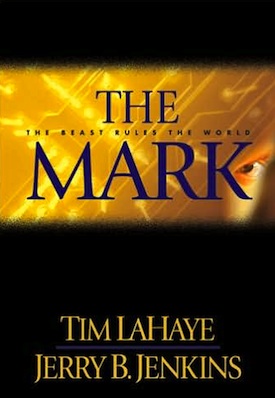
“The Mark,” one of the original Left Behind novels. Subtitle: “The Beast Rules the World.”

Today, the concerns tend to focus mostly on microchips or RFID tags, and the technology that upset Andrea Hernandez is one of the latest candidates. Used to track products and wayward pets, RFID holds a special place in the fears of some believers. Revelation 16:2 describes those having the Mark of the Beast coming down with a “foul and painful sore,” and one anti-RFID chip crusader points out that implanted chips could produce just such a sore if subjected to the wrong kind of radiation.

So if you’re convinced that Revelation foretells the rise of a demonic ruler who will force all of his subjects to bear his mark in order to buy groceries or pay the electric bill, RFID chips might fill you with a particular type of worry. Former intelligence analyst Terry L. Cook, author of the book Mark of the New World Order, writes: “It is my well-researched opinion that the Mark of the Beast, as related in scripture, is absolutely literal. Soon, all people on earth will be coerced into accepting a Mark in their right hand or forehead. I am convinced that it will be an injectable passive RFID transponder with a computer chip—a literal injection with a literal electronic biochip ‘mark.”

These beliefs have become so common that they have spawned their own urban legends around things like forced chip implantation, and debunking sites like snopes.com have tried to extinguish the flames of panic. Sample claim: a widely forwarded 2004 PowerPoint deck claiming that a company called Mondex wanted to replace cash with biochips embedded in people’s hands. (Snopes has also debunked myths such as the one that “666” appears somewhere within every barcode.)

But sites like Snopes can’t quiet sites like YouTube, where 55,000 “Mark of the Beast” videos offer up every possible variation on the concept. While most hew close to the current concerns about implantable RFID chips, there are interesting subgenres, such as the claim that “Obamacare” will require every American to have such an implant by 2013. Those looking to understand this worldview might start with the following six videos:

(If being shouted at by a guy from Indiana is your preferred learning style, try this video.)

It’s fantastic stuff, and arguably outside the mainstream of Christian thought throughout the centuries.

But if you subscribe to the basic worldview outlined here, as the Hernandez family apparently does, wearing a high school ID card with an RFID chip might look like the first step to these dystopian visions, rather than just one more case of invasive tracking technology with which our society is currently wrestling. Indeed, it might look more like the first step down the broad road to perdition. And the message of films like Distant Thunder has long been a clear one: when that moment comes at which technology and theology meet, and you are asked to take the Mark, will you stand for what you believe with no care for the consequences?

Listing image: Aurich Lawson

335 Comments