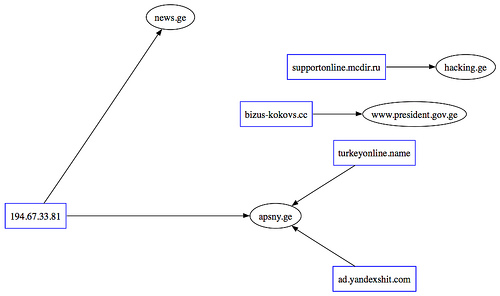
Earlier this week, we covered a report from the Georgian Foreign Ministry, claiming that the Russian Business Network (RBN) was actively engaged in cyberwarfare against Georgia—with the blessing and backing of the Russian government. There have been no new reports from that source, but several security experts have spoken up, and raised the question of whether or not the Russian government is actually involved.
According to Gadi Evron, former Chief information security officer (CISO) for the Israeli government's ISP, there's compelling historical evidence to suggest that the Russian military is not involved. He confirms that Georgian websites are under botnet attack, and that yes, these attacks are affecting that country's infrastructure, but then notes that every politically tense moment over the past ten years has been followed by a spate of online attacks. It was only after Estonia made its well-publicized (and ultimately inaccurate) accusations against Russia that such attacks began to be referred to as cyberwarfare instead of politically motivated hackers. Evron writes:
Running security for the Israeli government Internet operation and later the Israeli government CERT such attacks were routine…While Georgia is obviously under a DDoS attacks and it is political in nature, it doesn't so far seem different than any other online after-math by fans. Political tensions are always followed by online attacks by sympathizers. Could this somehow be indirect Russian action? Yes, but considering Russia is past playing nice and uses real bombs, they could have attacked more strategic targets or eliminated the infrastructure kinetically.
Arbor Networks' Jose Nazario offers additional proof of Evron's statements, writing: "While some are speculating about cyber-warfare and state sponsorship, we have no data to indicate anything of the sort at this time. We are seeing some botnets, some well known and some not so well known, take aim at Georgia websites…These attacks were mostly TCP SYN floods with one TCP RST flood in the mix. No ICMP or UDP floods detected here. These attacks were all globally sourced, suggesting a botnet (or multiple botnets) were behind them."