The upload and download speeds promised by satellite Internet providers may not be huge, but it turns out that satellite service delivers much better speeds than it advertises.
Satellite’s latency has improved too, but unfortunately it’s still 20 times worse than non-satellite services.
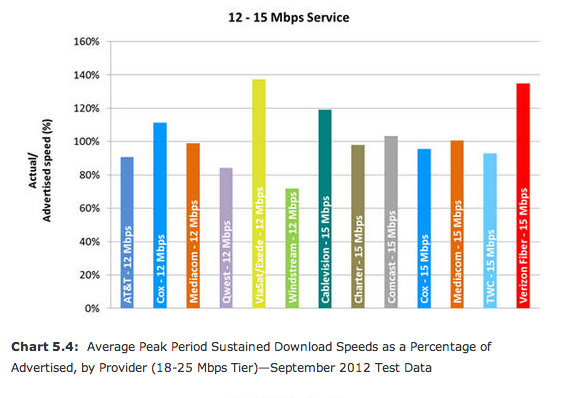
The Federal Communications Commission today released its latest Measuring Broadband America report, and for the first time it included results on satellite technology alongside cable, DSL, and fiber-to-the-home. ViaSat is the only satellite provider measured. The company’s Exede service promises 12Mbps down and 3Mbps up, but in reality it does much better.
“On average, during peak periods DSL-based services delivered download speeds that were 85 percent of advertised speeds, cable-based services delivered 99 percent of advertised speeds, fiber-to-the-home services delivered 115 percent of advertised speeds, and satellite delivered 137 percent of advertised speeds,” the FCC said.
ViaSat upload speeds were 161 percent of what was promised, while “fiber-to-the-home and cable-based services delivered 108 percent, and DSL-based services delivered 99 percent of advertised upload speeds.”
The FCC tested speeds at the homes of 6,733 volunteers over the course of a month, in September 2012.
Satellite merited inclusion in the latest report because newer satellites have greatly expanded the performance of satellite broadband in general. Latency, though, remains satellite’s Achilles’ heel. The lengthy round trip that data packets have to make between Earth and satellites results in a noticeable delay between the moment a user clicks on something and the moment in which the user sees the result.
This is particularly troublesome for online gaming. The satellite providers themselves admit that satellite is generally only the best option in parts of the country where the other choices are dial-up or slow DSL service. Data caps also reduce the desirability of satellite. If you can get cable or FiOS, that would be the way to go (even if service offered by the major players leaves much to be desired).

 Loading comments...