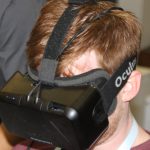
Giant social networking company Facebook has just announced it has “reached a definitive agreement” to acquire virtual reality headset maker Oculus for $400 million in cash and 23.1 million shares valued at $1.6 billion. Oculus can earn another $300 million if it reaches unspecified performance milestones, and the deal is expected to close in the second quarter of 2014.
In announcing the deal, Facebook founder and CEO Mark Zuckerberg indicated that the move is about much more than gaming, and goes well beyond the kneejerk FarmVille VR jokes that propagated at warp speed immediately in the announcement’s wake. “While the applications for virtual reality technology beyond gaming are in their nascent stages, several industries are already experimenting with the technology,” Facebook said in a blog post. “Facebook plans to extend Oculus’ existing advantage in gaming to new verticals, including communications, media and entertainment, education, and other areas,” he wrote.
“Mobile is the platform of today, and now we’re also getting ready for the platforms of tomorrow,” Zuckerberg said in a statement. “Oculus has the chance to create the most social platform ever and change the way we work, play, and communicate.”
“The history of our industry is that every 10 or 15 years, there’s a new major computing platform, whether it’s the PC, the web, or now mobile,” Zuckerberg continued on a conference call following the announcement. “History suggests that there will be more platforms to come, and that whoever builds and defines these will not only shape all of these experiences that our industry builds, but also benefit financially and strategically.” He believe that “vision,” in the form of virtual and augmented reality technologies, will form the basis of that next major platform.
Zuckerberg went on to characterize the Oculus acquisition as a “long term bet on the future of computing” that could take “five or ten years to get there,” as smartphones have over the past five to ten years. While he assured listeners that Oculus’ plans in gaming “won’t be changing,” he said he also sees VR as a much wider platform, capable of driving experiences from real-time chat to virtual tourism.

 Loading comments...