Skip to content
Gaming

Can you really learn to race by playing racing games? Ars takes to the track

Each generation of console racing games promises a more immersive experience …

Jonathan M. Gitlin | 105
Story text

As a hardcore racing fan, the first racing game I remember really getting into was an F1 game for the SNES. But it wasn’t until the release of Gran Turismo (GT) on the PSone that the game console was at last able to provide a virtual outlet for those of us whose desire to race exceeded our budgets. Since that day, racing games have continued to give us more life-like physics, more realistic graphics, better AI, and the chance to race against other humans as online multiplayer action became possible. Peripherals have gotten better (and more expensive), and the best of them promise to immerse us in the paddock from the comfort of our couches. All of this has been great fun for racing fans, but is any of it really true-to-life? What do racing video games teach you about racing real cars? I was recently able answer to this question when I got the opportunity to go ChumpCar racing.

Before I get any further, let’s get something out of the way. I know there are PC racing sims that have more realistic physics models out there. I’ve played a couple of hours of GTR, but nothing more. But I have played lots of GT and Forza Motorsport, along with other console racers down the years, and that’s the gaming experience I drew from as I tried doing it in real life.
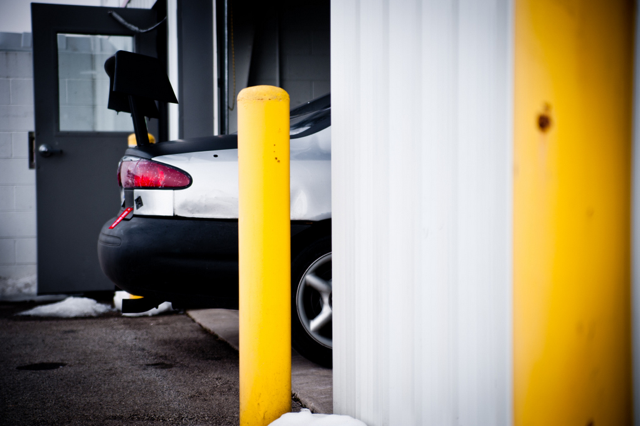
Nice ass Credit: Alex Bellus

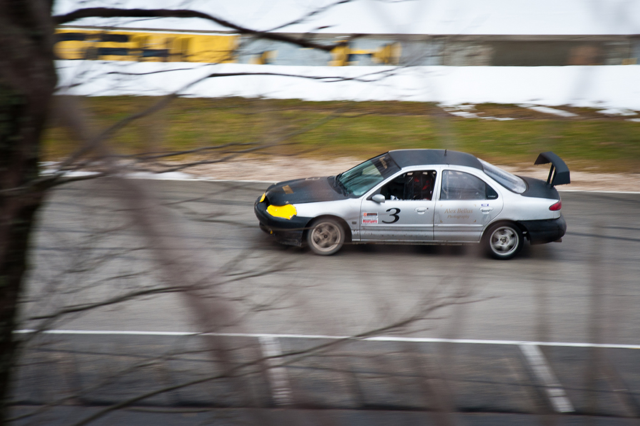
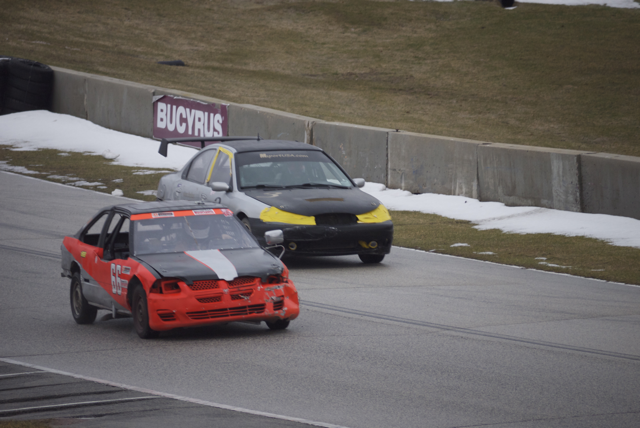
It’s a cold, gray April Fool’s Day in Wisconsin. There are still banks of snow here and there, along with frigid icy puddles. I could be sitting in my office in Bethesda, but instead, I’m wearing nomex and standing on a low wall wondering if I’ve made a terrible mistake. A Ford Contour pulls up alongside. It’s not exactly in showroom condition—the headlights are gone, replaced by plastic covers; one headlight has an air duct in it; the hood isn’t standard; and she’s painted rattle-can black rather than the silver that Ford sprayed her. The windows have been replaced with Lexan, and there’s an impressive roll cage in place of the factory interior. I jump in, winding my way through the roll cage, and quickly get strapped in. I can barely see over the dash, but there’s no time to worry about that. I get the signal to accelerate out of the pit lane and out onto the tarmac of Road America, one of the country’s truly legendary racing circuits.
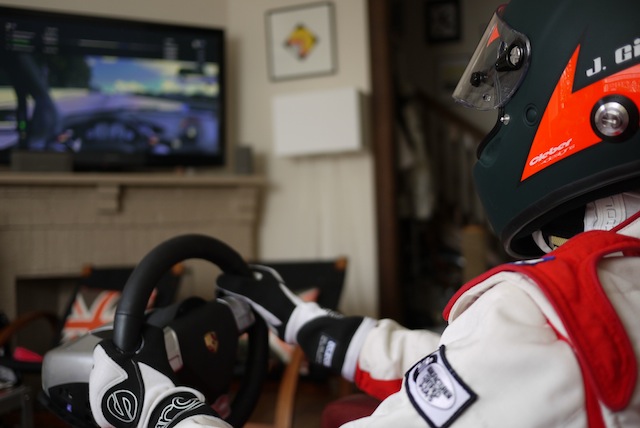
You can never be too careful. Ninety percent of accidents happen in the home. Credit: Elle Cayabyab Gitlin

Regular readers will be aware of my passion for motorsport. People who know me in person know that the only video games I play are racing games, and I’d be lying if I said my honeymoon didn’t involve the Monaco Grand Prix. (Yes, my wife is totally awesome, and I am a lucky man.) I didn’t really get into cars until high school, but once I got a driver’s license I was hooked. Devouring car magazines like the weekly Autocar meant exposure to racing series like Formula 1, touring cars, and Le Mans. However, it also became apparent that getting into motorsport was not the cheapest of hobbies, and with parents who were distinctly cool on the very idea, it seemed to be a non-starter, at least until I had the means myself. I’m also not much of a grease monkey. I grew up in a city with street parking, I live in a city with street parking, and I’ve never had the space or the opportunity to learn how to wrench or spanner for myself (beyond the easy stuff). If I still lived in flyover country, it’s quite possible that I’d have turned our family Miata into a track car, but instead, I live in Washington, DC, and currently my time is worth more working in an office or writing for Ars Technica than learning how to fix car things. Thank heavens for video games.

Batteries not included

Sony is already making a fairly big deal about their GT Academy, where virtual racers can earn a spot racing a sports prototype. Recently, iRacing gave one of the best players a test at Road Atlanta… where his lack of fitness brought the test to a premature end. Even Top Gear got in the act, comparing Clarkson’s performance around Laguna Seca in a real and virtual NSX. Now it’s our turn.

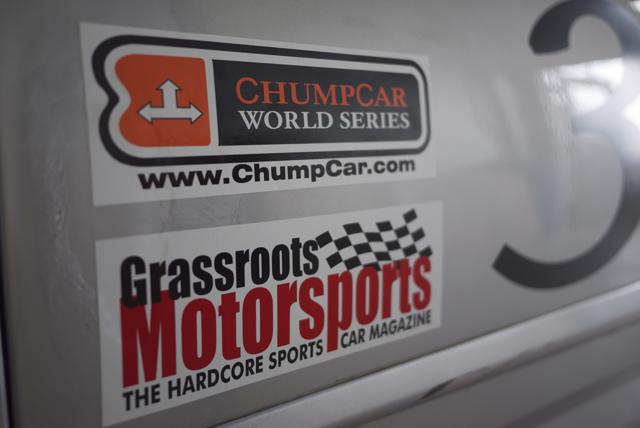
Three, that’s the magic number. Credit: Elle Cayabyab Gitlin

A blossoming of grassroots motorsport here in the US has reduced the barrier to entry. Maybe not down quite as low as the price of a console and a fancypants steering wheel/pedals combo, but it’s down to a price that fits my wallet. The 24 Hours of LeMons series is the best-known of the low-cost racing series that are springing up, but it wasn’t particularly attractive. It seems to be more about parade floats and the organizers having a good time harassing the entrants than flat-out racing, with tales of black flags for putting a wheel off the track. But LeMons isn’t the only game in town. Enter the ChumpCar World Series, an endurance series for cheap cars and real gear-heads.

My friend Nick had run some ChumpCar races last year in a Ford Escort. Over the winter, he and some other friends had been building a new car for 2011, the silver and black star of the first page. Since it was almost as easy to bring two cars to the track as was one, they asked if I’d like to race the Escort. Oh, and the first race of the year would be at Road America in Wisconsin, a legendary US road course. One thing led to another, and finding the extra drivers prepared to commit to sharing the car proved harder than imagined. Fortunately for me, Nick called to say that there had been some changes to the roster, and I would be joining him, Mike, and Alex in the Contour.

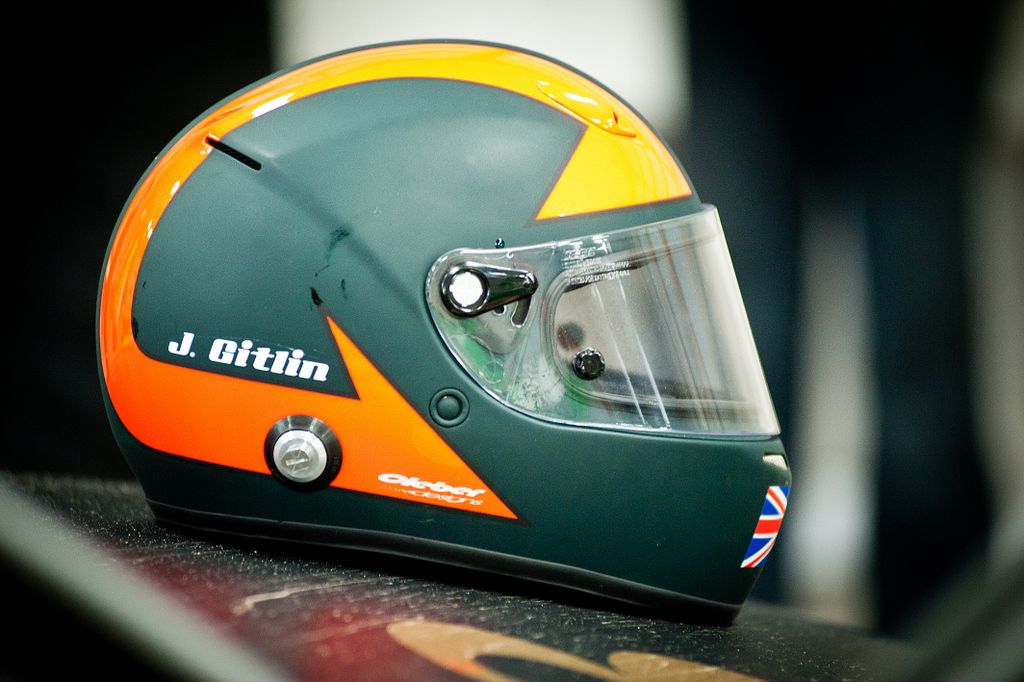
Things started getting real when, early in the new year, I made a trip to OG Racing in Sterling, VA, to buy a helmet, suit, gloves, boots, and nomex underwear. I could probably have done it all over the Internet, but when it comes to helmets, the fit is important, and being able to try a bunch on means it’s worth seeking out a brick-and-mortar retailer. I decided that looking fast and feeling fast would be integral to actually being fast, and I sent my helmet off to be painted. This could be a double-edged sword, as there could be little more embarrassing than turning up at the track with a fancy painted helmet but no talent; clearly, I had to be quick in the car.

Train hard, race easy Credit: Elle Cayabyab Gitlin

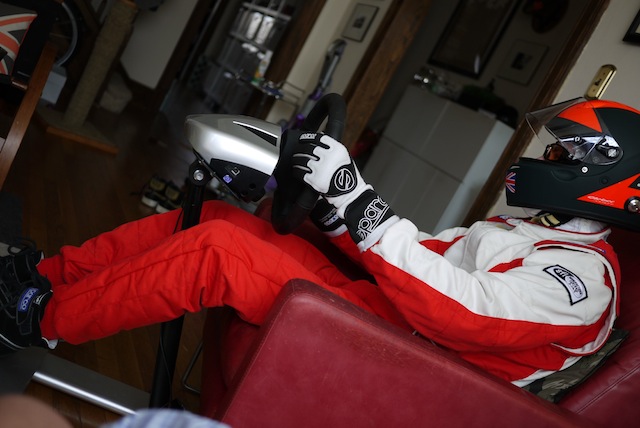
My training regime wasn’t rigorous, but that’s the point of this article, really. I played racing games from the comfort of my living room, and I’d done an hour’s karting endurance race on a chilly Sunday morning in November when visiting family in the UK. Oh, and I read “The Unfair Advantage,” Mark Donohue’s memoir. I also conducted a dress rehearsal of sorts. In Forza, I built up a car I thought would be similar to Contour, in this case a Ford Focus, and upgraded it to roughly match what I knew about the Contour. Wearing my racing gear (helmet, balaclava, nomex race suit, gloves, boots), I then sat down and proceeded to lap Road America, until after about 45 minutes a combination of boredom and being quite hot prompted me to call it a day. I was able to make sure that my helmet was comfortable, and that my glasses wouldn’t fog, but those virtual laps felt more remote than normal, something I think was down to the layers of fireproof fabric between my hands and the wheel, and the extra sound absorption of the helmet.

My excitement continued to build throughout February and March; each time I checked the webcam at Road America’s website, the snow seemed to have melted a bit more. But fate is cruel, and with two days to go before getting on a plane, the area was blanketed with snow and the race postponed for a week. As a racing game nerd, I probably should have expected it. I certainly got used to GT and Forza releases slipping well past their original dates; at least it was just a week and not six months. The delay proved to be a blessing in disguise, as the organizers were arranging a test session on Friday, the day before the first race, as a thank you for the participants being so accommodating. Had the race run the weekend it was originally scheduled for, my first laps in the car were to have been at the start of my stint on Saturday, so the opportunity to get some track time before the green flag dropped was a huge relief.

Must be this tall to ride

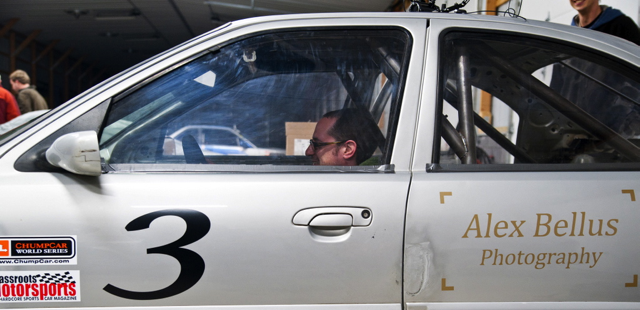
That brings us back to the cold pitwall on April Fool’s day. As it turned out, that familiarization would only extend to an out lap, a flying lap, and an in lap, and things weren’t looking promising. I’m not the tallest person in the world, and the seat was about an inch too low. I could just about see over the dash, but not anywhere near to the degree I wanted, and my lap time was embarrassingly slow—15 seconds off my teammates. I went to bed sure I would be the guy in the fancy painted helmet who couldn’t drive. I did begin to get answers to my question about what video games had taught me, though.

Aren’t you kind of short for a racing driver? Credit: Alex Bellus

Showing you the way around a track is a big one. Of course, this assumes that the track in question appears in the game, but in this case, Road America has been part of the Forza line-up since its arrival as DLC in Forza Motorsport 2. Thanks to many virtual laps around the circuit, I knew the sequence of turns and had a rough idea of the line through each corner. Apparently even Formula One racers have used video games as a way of learning unfamiliar circuits. Of course, professional racing drivers also play video games for fun like the rest of us. GT was a firm favorite with the Corvette Racing team back when I polled them in 2008, and iRacing is supposed to be frequented by many of the current IndyCar drivers.

She might not look like much… Credit: Alex Bellus

Looking far enough down the road is also something you can practice in the comfort of your home, and the introduction of motion tracking should really help. Looking at the corner you’ve just arrived at rather than the next one down the road impedes good lap times as much on an Xbox or PS3 as it does when you’re actually there. In contrast, the farther down the road you’re looking, the more you’re able to set the car up for the turn well in advance. Of course, this assumes you can actually see over the dash to look down the road. Like me, this was Alex’s first race, and he thought he’d had some benefit from racing games: “You certainly learn a few things about roughly what line to take, how to get around traffic, when to time pit stops, and some of the fundamentals, but I’d say I’ve learned just as much by watching races on TV and in person.” 

The game also wasn’t a perfect representation of the track. In Forza, Road America isn’t rendered to look like the beginning of April, with grey skies, patches of snow, and an absence of leaves on the trees, and it doesn’t feature dynamic weather, either. I also thought that turn 13 seemed quite different in real life; I struggle with this corner on the Xbox, but found it one of the most enjoyable in real life, partly because the uphill, off-camber nature of the turn wasn’t much like the game.

The seating problem was taken care of by a pre-dawn trip to Walmart to buy the makings of a seat insert. Saturday morning involved some last-minute car prep, and which is where I realized the camera mount I’d improvised wasn’t going to be beefy enough to hold up to the effect of g-forces on track. That explains the in-car footage, unfortunately. It was a little easier getting video out of Forza to compare it with. Street tires, cheap cars, and melting snow all probably figured into the decision to use the chicane instead of the much faster Kink at turn 11. The chicane is rendered, and you can drive it. Take note, Polyphony Digital; don’t put walls where they don’t belong (Monaco, Daytona). Anyway, that explains the cones I drive through.

Turn 11 as seen in Forza Motorsport 3, and then from the cockpit of the Team 3 Sheets Racing Ford Contour

Wearing his team manager hat, Nick decided that the experienced drivers would go first. The order was: Mike, who built a lot of the car, then Nick himself, followed by me and then Alex. The race format was a seven-hour race on Saturday, followed by a seven-hour race on Sunday, each starting at 9 AM. I’m not trying to brag, but the car was fast. We had straight-line speed, more than enough torque, and the brakes were better than anything else I’ve driven. If we could keep our nose clean and get decent fuel mileage, we were in with a shot. ChumpCar races start behind a pace car, and once the entire field has been across the start-finish line at least once and all the timing transponders are working, they pick a car at random and drop the green flag after it passes. This is somewhat confusing, but it lowers the chances of multi-car pileups going into the first few turns.

On Saturday, the race started on time, and almost immediately things stopped going to plan. We were called in to remove the driver-side Lexan window, which put us down a lap, but Mike’s times were consistent, and at just over three minutes a lap, fast. That was when the next shoe dropped. Road America is a long track at just over four miles, and quite a lot of that is spent at full throttle. Hopes of getting nearly two hours out of a tank of gas vanished, as it became apparent that 75 minutes was closer to the truth. In the interest of safety, ChumpCar rules mandate a minimum five-minute pit stop for refueling, so every extra stop meant losing nearly two laps. Since the alternative was running out of gas somewhere on track, we didn’t have a choice. Nick took the next stint and carried on lapping in the low three-minute range, right up until the front differential decided that what the gearbox housing really wanted was a hole in its side. It duly obliged, stranding him on track.

That? That’s just a flesh wound

When Turn 10 or Polyphony Digital takes you racing, one of the things they don’t model down to the last detail is damage and repairs. It’s understandable, though. Even in their endurance races, not that many gamers would put up with watching their car get worked on for 20 minutes—they’d just restart the game. Add to that car makers who haven’t always been happy to have their models smashed to bits, and you can see why no one’s wasting too much time worrying about it. Real cars don’t get fixed in 15 seconds by invisible mechanics during pit stops. If something breaks, it costs a lot of time, and not everything can be repaired.

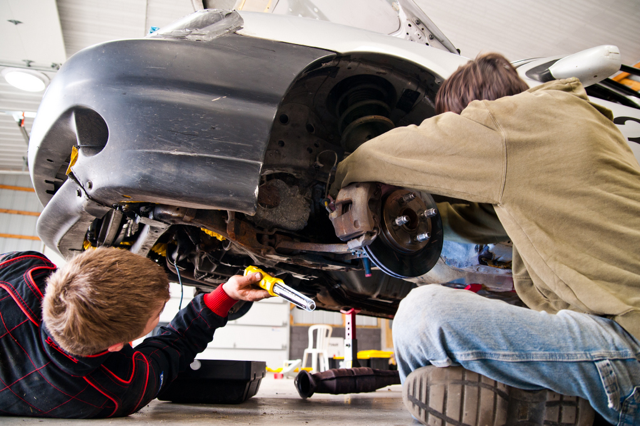
Mike (left) and Kent (right) replacing the gearbox Credit: Alex Bellus

The car was recovered to our garage, wearing a large yellow diaper to contain some of the transmission fluid that was now pouring out. A not-very happy Nick got out of the car, and what followed was, to my eyes, nothing short of remarkable. Mike, along with our other mechanics Kent and James, set about the car with a calm but determined focus, first removing the gearbox to determine the damage, and then replacing it with a conveniently handy spare. They’ve since told me that two and a half hours for a gearbox change is quite leisurely compared to the 45-minute jobs needed in rallying, where they cut their chops, but I’m still in awe.

We’d lost a little over three hours off-track at this point, so any hopes of a decent finish were done. But the car was fixed, and with an hour and a half left in the race, there was no point sitting around in the garage. That meant it was my turn, and the moment of reckoning. Being strapped into a racing car is quite different from just wearing a seatbelt in a road car. Between the five-point harness and the HANS (head and neck restraint system) device, you’re well fixed in place. There’s little range of motion for your head, but being tightly secured in the car does a lot to inspire confidence in your ability to interpret the messages being transmitted to you through the wheels. The seat insert appeared to be doing its job, as I could actually see where I was going. A good thing too, since I had to find my way from the garage to the entry to the pit lane, preferably without running over anyone in the paddock on my way.

Turns 8 and 9 at Road America. Managed to spin here on my first green flag lap before I quite got the hang of keeping my foot in. Turn 9 is a lot of fun.

The route negotiated, all that was left was a quick radio check, and then I got out there to race. During my brief foray on track the day before, I had discovered that the engine had a lot of torque, and the brakes were better than anything I’d ever experienced on the road. So good, in fact, that I managed to overdo it going into turn 8 on my first lap and spun the car… but of course the tires and brakes were cold, I was just getting the feel of things, and [insert other racing driver excuse here]. Once that momentary lapse of concentration was over and done, within a couple of laps I was concentrating on the fundamentals: looking well down the road, modulating braking, choosing my moments to pass. Track conditions don’t really change much when you’re gaming, which is something that can’t be said for real life. When people run off a corner, they bring mud back on with them, and it’s not always in the same spot it was the lap before. This was a particular issue with the Carousel, turn 9.

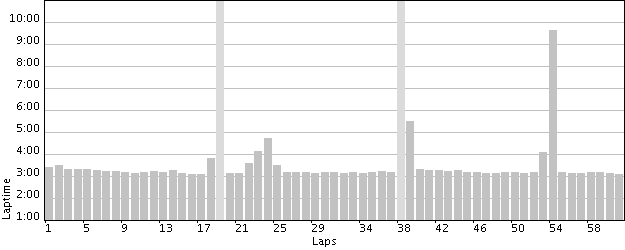
That big grey bar at lap 38? That’s the garage repairs.

I was greatly relieved to see that all those hours spent with a PlayStation or Xbox were not for naught; between the times I was getting over the radio and the times from our in-car telemetry I was matching the times of my teammates and reeling in cars left, right, and center. Okay, we were 60 laps down, but that’s no excuse for driving slowly, and with the exception of a Spec Miata that was running unclassified, no one was going to overtake me, and no one did. I handed the car off to Alex who took the checkered flag for Saturday’s race. We managed to finish not quite dead last, but took solace in the fact that the three hours we spent off-track was about as long as it would have taken us to make up the 60 laps on the winner.

In Forza you take turn 5 in 2nd. In the Contour, I was happy to do it in 4th.

Barring costly simulators mounted on hydraulic posts or being sucked into your computer a la Tron, not many of the physical sensations make the jump from actual to virtual reality. Force-feedback wheels are doing ever-better jobs at recreating the experience of steering a car, but by and large, pedals and gearshifts aren’t there yet. Digital elevation change is something that doesn’t come across well at all. Hills can seem much bigger when you’re strapped into a car blasting up them, and video games are as yet unable to give you that feeling in the pit of your stomach as you experience the effects of gravity and inertia. That extra level of feedback makes driving on track a bit easier, in my opinion. As a driver, you get a lot of information through the steering, but just as much through the seat of your pants. Being strapped in much more tightly than you would in a road car further amplifies the feeling of being able to sense what the car is doing by its attitude. I put the matter to my co-drivers to get their take on it. As far as Nick is concerned, “Nothing replaces that ‘X’ factor you get while actually racing. It doesn’t matter if you’re on a three-axis super-duper simulator machine.”

Tomorrow is another day

Sunday held more promise. We knew the car had speed, and we were all more familiar with the circuit. Sunday also had something Saturday didn’t have, though: weather. The morning started off with drizzle, then light rain, followed by light rain and snow, then rain and sleet. Alex took over for the second stint, and shortly afterwards lightning strikes meant the race was stopped for about 20 minutes for the safety of the corner workers. Make no mistake, it was a thoroughly grim day in Elkhart Lake.

Finally, the worst of the weather passed, the race got going again, and so did we. This time I took the final stint, on a drying but still damp circuit, and in the interests of mechanical sympathy (read: not wanting to blow another gearbox) drove my stint in 4th and 5th gear, with the occasional use of 3rd to dispatch cars that hadn’t received the “we’re much faster than you—just get out of the way” memo. Again, with the exception of the Spec Miata car, I was able to get past every car I encountered on track.

Turn 12. I overheard corner workers joke about the giant electromagnet hidden underneath the gravel.

In the greasy conditions, some of our fellow competitors were having quite a time keeping the car pointed straight, and overtaking opportunities had to be picked to make sure I didn’t become part of someone else’s accident.

You can definitely learn about car control playing racing games, and a little about racecraft, but real life has consequences and no rewind or restart button. Online racing helps pick up skills such as knowing how to defend a corner or set up an overtaking opportunity after following an opponent and learning their strengths and weaknesses. Overtaking another car in GT5 often involves physical contact because there’s no penalty. In fact, with that game, using other cars to make corners can actually benefit the player. Forza and other series that model damage better reduce this impulse, and playing against other sentient humans rather than racing AI cars does, in my experience, make players a little more conscious of not hitting others, but barely. Doing that sort of thing on a real track would be foolish for lots of reasons, and so you give other cars more space than you would online.

Car #3 takes a trip to the gravel trap at turn 12. This happened slightly too often. Credit: Elle Cayabyab Gitlin

Driving on a fairly slippery track gives you the opportunity to learn things about the way a car handles that isn’t possible on the road. I knew conceptually, and from many years watching the British Touring Car Championship, that the solution to getting sideways in a front wheel drive car involves more, not less, power. Now it’s something I know from experience, too. You also need to quickly wind on and then off the right amount of steering lock (known these days as “a dab of oppo”). The Countour was able to recover from slip angles I’d previously have thought terminal, and did it while putting a huge grin on my face. As force-feedback wheels have gotten better, these are skills that you can practice on a console, less so if you use the controller.

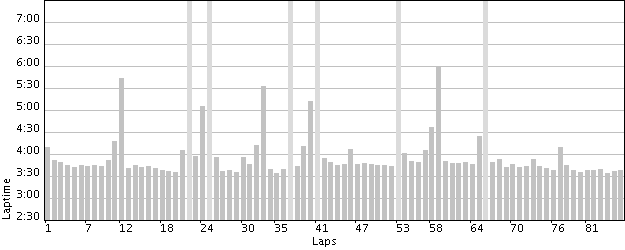
A few less of those long grey bars and we’d have won

We took the checkered flag in 6th place, with a real sense of achievement given the trials of the previous day. Closer analysis of our race pace compared to the other cars suggested that we could have done a lot better, assuming fewer trips into the gravel at Turn 12 (something we won an award for, although I’d like to note that I managed to stay out of the kitty litter), access to live timing (so we could see how much time we needed to make up) and a little less sympathy for the car. (I’m getting good at this racing-driver-excuses thing, as you can see.)

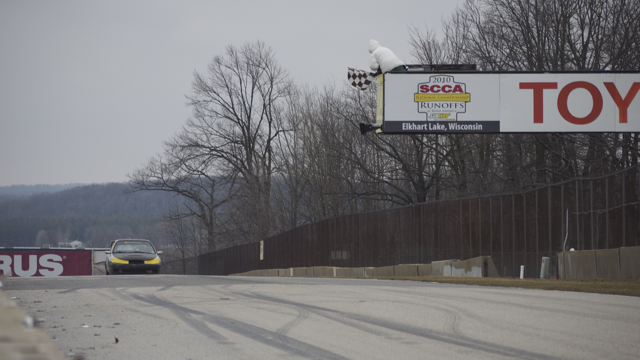
Taking the checkered flag Credit: Elle Cayabyab Gitlin

The smells, the sounds, the rain and the hail and the bratwurst

I went, I raced, I had more fun than I’ve ever had surfing or skateboarding or skiing. But did all those years playing GT actually teach me anything? Are the latest generation of console racers anything close to real-life racing? The answer, at least in my experience, is that they do help with some things, but there’s no substitute for the real thing.

I’m not sure the #66 appreciated me unlapping our car. Credit: Elle Cayabyab Gitlin

My living-room setup also doesn’t do a good job of conveying just how cold the footwell of a stripped-out car can be, nor the water that would drip down from the mirror under heavy braking. You also don’t get the smells of being at a track. People have considered olfactory enhancements for games in the past, but it’s never really gone anywhere, even though (or perhaps because) smell can be one of the most powerful triggers for memories and experiences. Car races smell like oil and gasoline and rubber and brakes, and beyond GT2’s scratch-and-sniff CD, that never comes across to gamers.

Then there’s the danger aspect. Motorsport is dangerous. It says so on the back of your ticket, and it says so on the release forms you sign at the track. It’s the reason you wear fireproof clothing and a crash helmet, and it’s the reason why there’s a rigorous technical inspection of all the cars. Video games, on the other hand, are not dangerous, unless you’re the kind of scaremongering reactionary who hates kids and provides Ben Kuchera with so much to write about.

Racing can also be cruel. Real cars break, and sometimes you can’t fix them and get them back out. That could have happened on Saturday, and this would have been a much shorter article. As Alex puts it, “One of my concerns when I got into the race car for the first time was that I was going to go really slow, because in the racing games, you don’t have to worry about things like crashing, breaking things on the car, or running out of fuel. In real life, all of those things have very real consequences.”

According to the GPS data, the speedo’s indicated 130 mph at the braking point for turn 1 was optimistic.

In a real race, tires and brakes take longer to warm up, and there’s no handy heads-up display indicator to tell you how much life they have in them, although that sounds like a pretty cool augmented-reality project for someone to get cracking on. Forza or GT replays give you time to take a more reflective look at your driving, as you can look at the data instead of the track. 

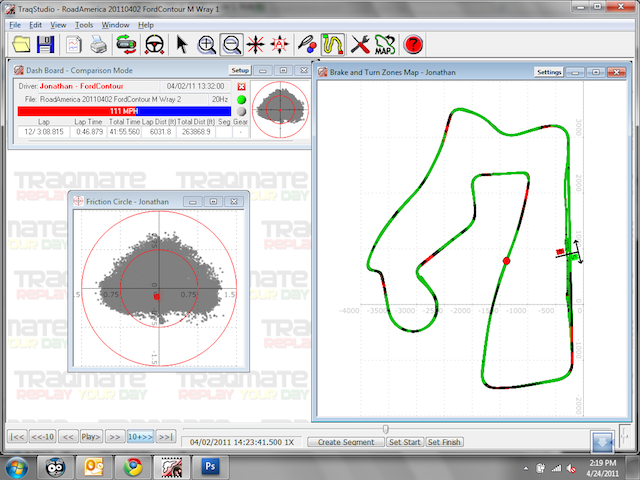
Of course, thanks to the relentless pace of technology, a real race does throw off a fair amount of data to analyze, now that data acquisition systems aren’t just the preserve of big-budget racing teams. Using GPS to detect speed and track position, and accelerometers for g-forces, acquisition systems can feed you your last lap time or estimated time for the lap you’re currently on. The more expensive setups will also record engine data and overlay it on top of camera footage, which I hope to be able to play around with later this season. These systems can be very helpful in analyzing driving performance. Even without 11 hours of in-car footage, the GPS data had good enough spatial resolution that you could see differences in driving style between the four of us sharing the car.

I think video games definitely helped me make (some) sense of the data

In a video game you can drive flat out the whole time, but even Formula One drivers aren’t on maximum attack for 90+ minutes at a time. As Alex puts it, “When I got home from Road America, I fired up GT5 and found that I was actually slower than I had been before I’d raced. I think I had more respect (or more mechanical sympathy at least) for the car in the game after seeing what could happen in real life if you beat on a race car too hard.”

Racing for real is enormous fun, but requires more effort than turning on the console and staring at the TV. A lot of effort goes into getting the car to the start line, and a lot more work is needed to get it to the finish. As I found out with my ‘dress rehearsal,’ when boredom or discomfort strikes, it’s quite easy to decide you’ve had enough. At the track, you cope with adversity and dig deeper, instead of going off to do the laundry instead.

But the reward is you get at the end is that much greater because of that increased effort. Nick again: “Nothing can compete with the sensory machine gun. Add some fatigue, some adrenaline, some anger and extreme joy together, and yeah, you understand why people do drugs. But it can’t possibly be that good.”

Alex concurs: “There’s also a psychological impact as well. When I win a race in a game, it’s a very short-term feeling of excitement, but the effect is much more long-term—and hits so much harder—if you do the real thing.”

Getting to the end of a race feels more like completing an entire console game, but driving back to the pits on a cool-down lap after taking the checkered flag will stay with me in a way no ending movie or credits roll could ever hope to.

Photo of Jonathan M. Gitlin
Jonathan M. Gitlin Automotive Editor
Jonathan is the Automotive Editor at Ars Technica. He has a BSc and PhD in Pharmacology. In 2014 he decided to indulge his lifelong passion for the car by leaving the National Human Genome Research Institute and launching Ars Technica's automotive coverage. He lives in Washington, DC.
105 Comments