Skip to content
Tech

2016 Google Tracker: Everything Google is working on for the new year

Android N, a big VR program, Google Glass, and lots more are in store for Alphabet.

Ron Amadeo | 66
Our (updated) understanding of the current Alphabet companies. Credit: Ron Amadeo
Story text

It’s that time of the year again—welcome to the Google Tracker! This is a bi-annual series where we recap every ongoing project (that we know about, at least) inside of Google’s sprawling empire.

Though from now on, perhaps we should say, “Every ongoing project inside of Alphabets sprawling empire.” “Google” is now a mere company inside of “Alphabet,” the newly formed umbrella company created by Google’s founders. Most of the Google side projects we’ve been tracking in the past have been spun off into companies inside of Alphabet, but rest assured we’re still keeping track of everything.

As always, the Tracker is a big roundup of previous announcements, rumors, and a bit of speculation. The 2015 entries worked out well—the Chromecast 2, Google On, Google Photos, YouTube Gaming, and tons of Android features were represented. We can’t promise everything listed here will be released in 2016, but this is certainly a running list of everything we’ve heard about. If you’ve been slacking all of 2015 and not paying attention to the news, consider this your “Google CliffsNotes” for the upcoming year.

Table of Contents

The Alphabet Empire

2015 saw Google transform from a single company packed with side projects into a Berkshire Hathaway-style “company full of companies” known as “Alphabet.” So what exactly is inside of Alphabet? An 8-K form filed during the initial Alphabet announcement flagged “search, ads, maps, apps, YouTube, Android and the related technical infrastructure,” as “Google.” Calico, Nest, Google Fiber, Google Ventures, Google Capital, and Google X were all identified as individual companies inside of Alphabet.

That list leaves out a ton of Google projects, though, so there is certainly more to Alphabet than what was initially revealed. We’ve compiled the above chart from news and reliable sources from around the Web, and we’ve tacked a few more companies onto Google’s original list:

  • Verily is the new name for Google Life Sciences. The group just got a rebrand and a snazzy new website. This group is working on Baseline Study, the smart contact lens, and a wrist computer that reads diagnostic nanoparticles injected in the bloodstream. Life Sciences is not to be confused with Alphabet’s other healthcare company, Calico, which is “only” out to “cure death” with anti-aging research.
  • Sidewalk Labs, a group that wants to apply moonshot thinking to city life, took Google’s Calico model and started off with its own CEO. Google told The Wall Street Journal that Sidewalk Labs is a separate Alphabet company.
  • DeepMind, an artificial intelligence group, is also a company under Alphabet according to this report from The Information.
  • The division for Google X’s Self-Driving Car (also a robot) recently had someone appointed as “CEO.” It’s expected to be spun off into an Alphabet company in 2016, but for now it’s still part of Google X.
  • Google Fiber is not a top-level Alphabet company. It’s been rolled into Access and Energy, a Google division formed in 2014. You can hear Alphabet’s CFO, Ruth Porat, mention this in the latest earnings report. Access and Energy is also home to the Google OnHub router and the Titan Drones.
  • We’re also adding ATAP to the “Google” section since it seems like it should be an Alphabet company given that Regina Dugan, the former head of DARPA, is running it. For now, Google recently confirmed to Mashable that it is still part of Google proper. The full name of the unit is “Google Advanced Technology and Products.”

Google recently announced it was condensing its cloud businesses into a single unit led by Diane Greene, co-founder and CEO of VMWare. Is this a new division inside of Google or Alphabet? Does it have a name? We have no idea. Starting a new division with a superstar CEO definitely seems like the same model that created Calico, Sidewalk Labs, Replicant, and Verily, but we haven’t heard of a name or anything official.

As Google’s “moonshot factory,” Google X houses a number of projects that seem like they could one day be Alphabet companies. A representative told us the group is in charge of Project Wing, Replicant (Google’s robot division), and Google Self-Driving Cars, and this MIT Technology Review article says Google X is still in charge of Project Loon. Makani, Google’s power-generating kit project, also seems to be part of Google X.

Update: We updated the above section a bit. Based on prior reports, we originally pegged Project Wing, Replicant, and Google Self-Driving Cars as Alphabet companies, but a Google X rep reached out to us and claimed ownership of all of them. Alphabet’s exact layout is still very speculative, and we’re hoping we’ll get more official information during Google/Alphabet’s next earnings call.

Rebrands for everyone?

When the switch to “Alphabet” was announced, the organization put a lot of units with the “Google” brand outside of Google, the company. Google Capital, Google Fiber, and Google X all use the “Google” brand but aren’t part of the new Google—they’re Alphabet companies. We wondered if the reorganization meant all the non-Google “Google” units would eventually get a rebrand.

We don’t have a definitive answer to the Alphabet companies going Google-free, but things are trending that way. Google Ventures just got a big rebranding in early December with a redesigned “GV” logo and “gv.com” website. Everyone still reads GV as “Google Ventures,” but “GV” is actually the full name now—it’s not an acronym. Google Life Sciences dropped “Google” too—it’s Verily Life Sciences now. While GV alludes to the Google heritage, Verily has completely distanced itself from its founding brand.

Will everyone else follow suit? Alphabet’s branding would be much clearer if only Google was allowed to use “Google.” Such a change would also make Alphabet feel like a sincere separate entity instead of “Google trickery,” which is what it comes across as now. Google X could turn into “X Labs,” which it sometimes gets referred to as, but we’re blanking on rebrands for the other units. “Google [Product]” was always easy, predictable, and available for trademark registration. After “Verily,” all bets for predictability are off.

We should hear more about the inner workings of Alphabet during the next earnings call, which should come in early February.

Android Everywhere

For actual products, we’ll start with Google’s pet operating system, Android. If all the projects we’re hearing about come to fruition, Android will be everywhere. In addition to being Google’s OS for watches, smartphones, tablets, and TVs, rumors put Android running on PCs, cars, VR headsets, and Internet of Things devices. Android has so much traction at Google that it sounds like it’s going to scoop up the best parts of the company’s other OS, Chrome OS, and merge together.

Android merges with Chrome OS and takes on the PC market

Credit: Google/Ron Amadeo

Lots of virtual ink is spilled over how smartphones are becoming people’s primary computing devices. Android has something like 75-percent market share in the worldwide smartphone market, but Google sees no reason why Android can’t also take over the old primary personal computing device—the PC.

The Wall Street Journal brought us the original report, which said Chrome OS would be “folded into” Android and that the combined OS would move into the PC market. Then the floodgates opened and follow-up reports came from Re/Code, TechCrunch, and Business Insider. The whole Internet seems to agree that this is happening—Android will be made to run on a PC.

The Journal says the final version will be out in 2017, but in 2016 Google will show off “an early version.” A desktop version of Android would require a ton of changes from Google and third-party app developers, so it makes sense to get this out as quickly as possible and let everyone wrap their heads around it. Like with Android M, we’d expect a lengthy developer preview.

Google responded to the reports and said there was “no plan to phase out Chrome OS” but admitted it was “working on ways to bring together the best of both operating systems.” An open source project can never really “die,” so Chrome OS will always be with us in some form, but it’s hard to believe Chrome OS will be favored inside of Google after it releases a new, Android-based OS that directly competes with it. Various reports have pointed to Chrome winding down into a maintenance-only release cycle, and that sounds very plausible to us. It makes sense that Google won’t formally “kill” Chrome OS, but at some point major feature development on Chrome OS will stop, and Google’s focus will shift to promoting the Android juggernaut on PCs.

Chrome OS has a lot of functionality that Android can’t match right now, but with the transition supposedly not happening until 2017, Android has a lot of time to catch up. Chrome OS today is favored by schools and businesses, thanks to its no-nonsense, locked-down nature—it’s really hard to break something that’s “just a browser.” Google’s Android for Work project has been working on whipping Android into business shape, and in Android 6.0 Marshmallow, it added a locked-down, “Corporate-Owned, Single-Use (COSU)” mode. COSU mode can block the user from accessing the home screen, settings, notifications, recent apps, and everything else, leaving only a single app on the screen. Make that single app Chrome and you have a product that can seemingly handle a lot of Chrome OS’ business and school use cases.

2017 is a long way away, and merging Android with Chrome OS and turning it into a PC operating system would mean massive changes for the mobile OS. Our hope is that Google will take this opportunity to do a ground-up revamp of the OS and fix some of its long-standing issues, like the lack of a scalable, Google-controlled update system. At some point every major OS has had to blow everything up and start over—Microsoft did it by switching to the NT codebase with Windows XP, Apple did it by switching to a Unix-based OS in Mac OS X. Now it feels like it’s Android’s turn.

“Android Automotive”—Android’s in-car operating system

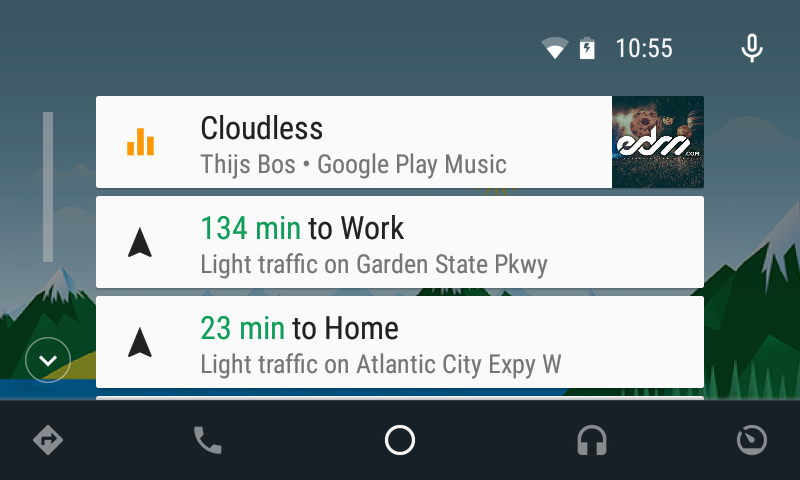
This is just the “casted” Android Auto interface, but we’d imagine the full OS would still look something like this.

Google already has one in-car interface, Android Auto, but Auto is not an operating system. It’s an app that runs on your smartphone and renders an interface, which is sent to the car’s dashboard screen. Everything happens on your phone, and it uses the car’s dashboard screen as an external monitor and touchscreen. The car infotainment system still runs an operating system of its own, and it’s this system that Google wants to replace. It wants car manufacturers to preload Android in the car.

Car infotainment systems today are not very good. Just like with the transition to smartphones, a hardware company (first phone OEMs, now car manufacturers) finds itself expected to ship a “smart” device, and Google wants to provide software to these manufacturers. Cars today can ship with Linux, BlackBerry’s QNX, Windows Embedded Automotive, and sometimes even Android. The “Android” we’ve seen in cars has always been an AOSP-fork that isn’t blessed by Google, though, and it’s usually woefully outdated. We’re talking about 2016 cars shipping with Android 2.3 and 4.0—OSes from 2011.

There is a ton of evidence that suggests that, just like with smartphones, Google wants to move in and provide these hardware manufacturers with software. A report from Reuters in May 2014 claimed Google was working on a car infotainment OS that would launch with “Android M.” A year and a half later, Android M launched as Android 6.0 Marshmallow, but there was no car offshoot in sight.

The project seems to have been delayed from that initial timeline, but there are still signs of life. Google publishes the Android Compatibility Definition Document (CDD), which details how equipment manufacturers can create hardware that is “compatible” with Android and worthy of getting access to Google Play. As expected, the document lists phones, tablets, TV, and watches as hardware Android can run on… but it also lists cars! This isn’t a reference to Android Auto, because—again—it’s not an operating system. The CCD plainly states “‘Android Automotive implementation’ refers to a vehicle head unit running Android as an operating system for part or all of the system and/or infotainment functionality.”

Since the whole point of CDD compliance is to get a license to the Google Play Store and other Google apps, this means at some point someone will sell a car with Google Play apps on board. We’ve yet to see any car manufacturer actually do this, but it sounds like Google is working on it.

Car infotainment feels like it’s on the same track as smartphones but about seven years behind—right now we’re in the “Windows Mobile” stage. In the smartphone market, the iPhone arrived and kicked everyone’s butt for a while. Once Android was out for a year or two, hardware companies flocked to it as the only other competitive OS. In cars, there is no butt kicking “iPhone” competition to force car infotainment makers to improve, though. All car infotainment systems kind of suck right now, and car manufacturers seem to be fine with it. If Google builds Android Automotive, it might be better than what’s out there, but will any car manufacturer want to give up enough control to use it?

Android N and upcoming Android features

What could the “N” stand for?
What could the “N” stand for? Credit: Ron Amadeo / Nutella

It’s obvious that some version after “Android M” (later dubbed “Marshmallow”) will be “Android N,” but we’ve already heard Googlers reference Android N’s existence. This makes it sound like N will be the next immediate version.

The last two major versions—Lollipop and Marshmallow—are a good predictor for Google’s typical Android launch schedule. Both OSes had developer previews released in the middle of the year at Google I/O, and both later saw release that year in October or November. Normally, we’d expect Android N to repeat this pattern in 2016.

There is a lot of chatter about Android and Chrome OS merging, though, so does this throw a wrench into the usual schedule? Reports expect a preview of the Chrome/Android hybrid OS to be released sometime in 2016 with a final merged OS out sometime in 2017. Are Android N and the hybrid OS the same thing, or is Android N a stop-gap OS while work continues on merging Chrome and Android? The two possible options we see are:

  1. N and the hybrid OS are the same thing, and the larger project is given extended development time and is pushed back into 2017.
  2. The final version of Android N and the preview version of the hybrid OS are separate products, with N being released at the usual time and a Honeycomb-style “Android for PCs only” releasing in 2017.

Regardless of whether or not the next version of Android gives birth to the Chrome/Android hybrid, we do know a good amount about future features that are headed to Android. Thanks to the way Android is structured, it’s a toss-up as to whether these features are locked into an OS update or get parted out to one of the many components in the Play Store. That won’t stop us from trying to guess what goes where.

A new messaging app—Goodbye Google Hangouts?

Instant Messaging has always been a sore spot for Google. The company has produced a ton of texting and IM apps: Google Talk, Google+ Messenger, Google Voice, Google Hangouts, and various Android SMS clients. None of Google’s solutions has ever taken off or been loved the way iMessage, Facebook Messenger, WhatsApp, and WeChat are. Other companies are investing billions of dollars into instant messaging, but Google has never really taken IM as seriously as we think it should.

A recent report from The Wall Street Journal claims that Google is working on yet another entry into the space by building a “new, smarter messaging app.” The report says Google “plans to integrate chatbots” into the client, which would let people ask questions inside the messaging app. These chatbots will then “scour the Web and other sources for information to answer a question,” according to the report.

The project is being led by Google’s VP of communications products, Nick Fox. Fox is currently in charge of Hangouts, Project Fi, and Google’s WebRTC efforts. The report states that in October, Fox offered to buy a company called “200 Labs,” which made a chatbot rating service for the IM app Telegram. The company declined to join Google, but Google is apparently still building a similar service.

WSJ is calling this a “new” instant messaging service, which implies that Google Hangouts is going away, and we’ll have yet another Google Talk to Google Hangouts-style transition. The report says the current timetable is “unclear,” but given that Google was just looking to acqui-hire people for the project a few months ago, we’d guess it’s still a long way away. Like with Hangouts, we’d expect most Android users to get this via an app update.

Split Screen

Turning multi-window mode on adds a small button to each app in the Recents list.
Tap that icon, and you can choose which part of the screen you’d like that app to live in.

We definitely know split screen is coming—not just because all of Android competitors already have support for it, but because an experimental version is already hidden in Marshmallow. It’s buggy and unfinished, but it allows for two side-by-side apps in a horizontal or vertical configuration or four apps in a 2×2 configuration. The design needs a lot of work. Right now, there’s really no way to close or manage open split screen windows.

In a Reddit AMA about the Pixel C launch, Andrew Bowers, a director of product management at Google, said, “We’re working on lots of things right now for [Android] N that, of course, we wish we had, you know, yesterday. But we’d spoil the surprise of N if we shared all of them. Split screen is in the works!” If you read carefully, this doesn’t definitively state that Android N will have split screen, but it is very suggestive.

Window management is a core OS feature, so the finalized version of split screen will definitely require a full OS update.

Rich Communications Services (RCS) Adoption

Rich Communications Services (RCS) is a new standard created by the GSMA as an upgrade to SMS and MMS. The standard brings a lot of “instant messaging” features to basic carrier texting, like the ability to see when someone is typing, contact presence, message delivery status, location sharing, and higher caps on photo and video sizes. It also allows you to easily transfer video and photos to the person you’re calling, and the spec even includes screen sharing. Once the marketing departments of the world got ahold of RCS, it grew a lot of alternative names. T-Mobile was the first US carrier to implement it, and it calls RCS “Advanced Messaging.” Sprint calls it “Messaging Plus,” and the GSMA calls it “Joyn.”

In September 2015, Google officially announced its intention to bring RCS support to Android, saying it has acquired a company called “Jibe Mobile” to get the job done. Jibe actually built the custom solution for T-Mobile and Sprint, and it also ships RCS solutions on Samsung and Sony devices. As part of Google, the group will work on integrating RCS into Android, allowing the extra features to be supported in the stock SMS apps. There’s also a potential to integrate some of the features into the phone and contact apps.

SMS is popular not because it is good, but because it is ubiquitous, which makes replacing it with something new a difficult task. Integrating it into the world’s biggest operating system is a good start, though. With the GSMA and just about all of the telcos onboard, a transition seems inevitable. Presumably this will be invisible to the end user—RCS will be used if both clients support it while SMS will exist as a fallback.

Considering RCS is already supported in some Android distributions, we’d guess that an app update could bring some of this functionality to the stock SMS app.

Google Photos gets a video editor

Google previously shipped a stock Android video editor way back in Android 3.0 Honeycomb, and it was awful. The editor officially died when it stopped shipping in 4.4 KitKat. It looks like Google will be jumping back into mobile video editors soon, though. In November 2015, it acquired Fly Labs, which makes a whopping four different video editing apps.

There isn’t a lot of mystery here. In Fly Labs’ going away message, the company announced it was joining the Google Photos team. The apps were all mostly single use: one allowed you to change the speed of the video for slow-mo or time-lapse video, another let you crop vertical videos and move the crop window around as the video progressed, and the last two were more traditional video editing apps that let you splice together clips with transitions and effects.

We’d look for all of these features to make it into the Google Photos app, which already has a photo editor. Will they still call it “Google Photos,” though?

Google Play Podcasts

This is another product that Google had covered, killed, and is now bringing back from the dead. Google previously shipped an Android podcast app called “Google Listen” way back in 2009, but the app officially died in 2012 during one of Google’s “spring cleanings.” Podcasting then rose from the Google graves, and in October 2015 the company announced the awkwardly named “Google Play Music Podcasts.”

That announcement called for podcast creators to submit their RSS feeds to a landing page so Google would have a whole catalog ready to go at launch. The page only said the service would be launching “soon.” “Google Play Podcasts” would be a much more obvious name, so we’re guessing that the “Play Music” inclusion means it will just be another section on the Play Music app and website.

Vulkan graphics API

Microsoft has Direct X, Apple has Metal, and soon Google will have Vulkan. Vulkan is a 3D graphics API created by the Khronos Group, an open standards consortium that is also responsible for OpenGL. Vulkan was conceived as a “ground-up redesign” and replacement for the 22-year-old OpenGL APIs. Vulkan offers better parallelization and multi-threading, lower overhead, and more direct access to the GPU. Vulkan also has better cross-platform support than OpenGL—the API is the same on mobile or the desktop, where OpenGL was split up into “OpenGL” for desktops and “OpenGL ES” for mobile devices.

On the official Android Developer Blog, Google announced the Vulkan graphics API would be coming to Android. Google said it would be working closely with the Khronos group on Android compatibility, and it would even be contributing tests to Vulkan’s open source Conformance Test Suite.

Google actually hired the entire mobile team from LunarG, a 3D graphics technology company, to help out with its Vulkan implementation. The desktop half of LunarG is partnered with Valve to work on Windows and Linux support for the new graphics API.

Don’t think OpenGL ES isn’t going away, though. Google says it plans on supporting OpenGL and Vulkan, giving developers a choice of a more complicated, more powerful API or a simpler, more resource-intensive one. A graphics API would require an OS update, so we’re guessing Vulkan will arrive with Android N.

Android swaps Java implementations to OpenJDK

Most 2D Android apps are written in Java using Google’s Android SDK. Android’s Java implementation is currently based on Apache Harmony, a “clean” open source implementation of Oracle’s Java. However, Apache Harmony is also a dead open source project. Google recently told VentureBeat that “Android N” was dumping Google’s Harmony-based implementation and would “move Android’s Java language libraries to an OpenJDK-based approach.” OpenJDK is another free and open source implementation of Java, but this is the “official” one under the control of Oracle.

This news is of some note because Oracle, the owner of Java, is currently suing Google over its use of Java in Android. Things are still being battled out in the courtroom, but Google seems to believe switching to OpenJDK will reduce its legal liability moving forward.

After pushing commits to the Android Open Source Project, Google told the court “On December 24, 2015, Google released new versions of the Android platform that are expressly licensed by Oracle for use by Google under the free, open source license provided by Oracle as part of its OpenJDK project. Specifically, these newly released versions of Android utilize the method headers (and the associated sequence, structure, and organization of those method headers) at issue in this litigation under the open source OpenJDK license from Oracle.” The company went on to say “any damages claim associated with the new versions expressly licensed by Oracle under OpenJDK would require a separate analysis of damages from earlier releases, which are not expressly licensed by Oracle under OpenJDK.”

Google seems to be saying that switching to the OpenJDK, which is released by Oracle under a GPL license, means that future versions of Android are safe from Oracle’s patents and copyrights. If Oracle has a problem with that, Google believes it would require a new lawsuit.

VentureBeat spoke with Google again after the initial report and came away with a clear conclusion. “The company is still making changes to OpenJDK to make it work on Android. As a result, future versions of Android will continue to contain parts of Google’s “own implementation,” just based on OpenJDK,” it wrote. It seems Google just wants to upgrade.

Ripping the Harmony-based guts out of the Android Runtime and replacing it with OpenJDK will be a lot of work. All sorts of tiny little things will change from Harmony to OpenJDK, which will require a large effort from Google and could potentially cause problems for app developers. On the plus side, using OpenJDK also opens the door to the latest Java features such as lambdas, providing a significant quality of life improvement for Android developers. Android’s Java implementation is currently based on Java 7, while OpenJDK supports the latest version, Java 8, and should be updated to support all the future versions of Java. Apache Harmony retired at Java 6.

Google sets your schedule for you with its “Timeful” acquisition

Sometimes Google acquires a company quietly, and we’re left to wonder what the company is up to. Other times, it acquires a company and writes up a full blog post detailing its future plans! Google did the latter when it acquired Timeful Inc., maker of an artificial intelligence scheduling app. A user could tell Timeful that they wanted to exercise three times a week, and the system would schedule it “based on an understanding of both your schedule and your priorities.”

Timeful took the form of a calendar app, so a Google Calendar integration is a natural fit. In the announcement, Google said it was “excited about all the ways Timeful’s technology can be applied across products like Inbox, Calendar and beyond.” Look for auto-scheduling features in those products in the future.

Google Play comes to China

As the world’s most populated country, China is also the world’s biggest smartphone market. Google isn’t really involved in China, though. After a series of cyber attacks on Chinese Gmail users and disagreements over search censorship, Google stopped cooperating with the Chinese government. Its services were promptly blocked by the Great Firewall.

With the Alphabet restructuring, though, Google seems to be warming up to China. Sergey Brin was quoted by The Wall Street Journal as saying, “Each Alphabet business can make its own decisions on which countries to operate in.”

In September 2015, both The Journal and The Information wrote articles saying Google Play was headed back to China. WSJ says that Google has been working on a special version of the Play Store that includes “only apps and services approved by the Chinese government.”

Data sourced from TalkingData. The total adds up to more than 100 percent because some users have more than one app store.

With no “default” Android app store in China, the app store market is a fragmented mess. The lack of the Google Play Store created a power vacuum, which was filled up by app stores from Internet companies like Qihoo, Tencent, and Baidu or Android OEMs like Xiaomi and Huawei.

We’re very interested to see what happens with the MADA (Mobile Application Distribution Agreement) contracts Google makes every Google Play Licensee sign. The contract has “anti-fragmentation” clauses that require any OEM licensing the Google Play ecosystem to only ship Google Play on all of their devices—they aren’t allowed to make non-Google AOSP forks and can’t ship rival app stores. This clause only applies to territories Google does business in, which in the past has created a loophole allowing China’s fragment app store market to flourish.

All the major Android OEMs in China are international companies that are under contract with Google, so what happens when Google moves into China? Do new Android devices in China suddenly all have to ship with Google Play? Does Google give everyone time to transition? Will the rules in China be totally different? We really have no idea.

It’s worth noting that MADA contracts are confidential, and we’ve only seen versions that are a few years old. More recent contracts could provide a clearer picture of what happens in the event of a Google China expansion, but we aren’t privy to that information for now. The only way we’ll really be able to find out is to watch what the major OEMs do and try to draw conclusions from it.

Google’s big push into virtual reality

Google is devoting such a large amount of resources to VR, it has to have more than Cardboard planned.
Google is devoting such a large amount of resources to VR, it has to have more than Cardboard planned. Credit: Google

Google sort of has a VR platform today with the ultra-cheap “Google Cardboard” program. Just throw your current smartphone in a specially shaped cardboard box with a pair of plastic lenses, and the experience is enough to get a rough idea of virtual reality. Cardboard isn’t really “good,” though. It’s designed to be cheap above all else, which makes it a sub-par experience that you wouldn’t want to use for any significant amount of time. The founder of Oculus, Palmer Luckey, was once asked if the Oculus Rift could compete with the inexpensive Google Cardboard program. Luckey answered, “Yes, because the Rift is actually good. Kind of like how fancy wine competes with muddy water.”

The cheapness hasn’t stopped Google, though. In April 2015, it launched the “Works with Google Cardboard” program, which allows third parties to make Google Cardboard-compatible viewers like the rebooted Mattel View-Master. There’s a VR section for Cardboard in the Play Store, and Google continues to do developer outreach and content partnerships for the program.

Cardboard is just the tip of the iceberg for Google in VR, though. Google seems to be slowly assembling the pieces for a full end-to-end solution that covers hardware and software, but we aren’t exactly sure what form this will take. All we know is that there’s a ton of resources being devoted to some kind of VR project.

The first is employees. Some of Google’s best and brightest, at the highest positions at the company, have left to join the VR team. The lead designer of Google Search, Jon Wiley, stopped working on Google’s biggest product to join the VR team. Alex Faaborg, the former lead designer for Firefox, Google Now, and Android Wear, also left some of Google’s biggest products to join the VR team. High-ranking people like this aren’t taking new positions to work on a mere piece of cardboard.

The Wall Street Journal gave us a small glimpse into what they might be building, saying the company was working on “a version of the Android operating system to power virtual-reality applications.” Google is also working on 3D audio of some sort. It recently acquired a company called “Thrive Audio,” which is focused on creating an “ultra-realistic soundfield” for VR audio.

Google Processors—A “recommended hardware spec” for smartphone VR

To get enough horsepower to run this mysterious VR project, Google supposedly wants to dive deep into hardware and design its own SoCs. A pair of reports from The Information claims Google met with component vendors to discuss co-developing chip designs aimed at virtual reality and augmented reality. The reports quote a source as saying Google was looking to “get into the guts of the chip and make sure chip vendors are provisioning enough horsepower.”

Let’s speculate a bit on what this could mean. Any smartphone SoC today is going to be geared primarily for 2D app and OS usage—things like smoothly scrolling through Chrome or a setting page and quickly launching an app. Smartphone SoCs can do some 3D processing for games, but that is a secondary function. The chip design’s allocation of power, heat, and die space requirements will prioritize CPU horsepower over GPU horsepower, because when you’re primarily browsing the Web and viewing apps, that’s what you want.

Smartphone chips are also primarily designed for “burst” power. You load an app or a webpage, and you want everything to power up really fast, load whatever you need, and then go back to sleep to save power. If you run a 3D game for more than a few minutes, you’ll quickly overheat the SoC. It will “throttle”—or purposefully slow down—so that it doesn’t have a meltdown.

For a virtual reality device, you would want to change a lot of this design. For VR, everything has to be rendered in 3D space, and everything has to be rendered twice for your left and right eye. You’re basically running a heavy 3D game all the time. You’d want to allocate a lot more of your horsepower budget to the GPU, which a custom chip design could easily do at the expense of a top-end CPU. Since you’re doing complex 3D processing all the time, you’d also want to design a chip with a thermal budget that allows it to run at top speed for long periods. The “burst power” design of a regular smartphone SoC wouldn’t be ideal.

VR requires a special mix of hardware, and Oculus outlined what it needed when it released the recommended hardware specs for the consumer version of the Oculus Rift. The company said “your CPU needs to be this fast, your GPU needs to be this fast” and so on. Oculus has the luxury of doing this on a PC, though, where the CPU, GPU, and other components are all separate pieces. Customers or PC OEMs can look at this list and easily assemble computers. Google needs to lay out a recommended hardware spec, too, but because it is dealing with a system on a chip where the whole “computer” is a single piece, it must become a chip designer if it wants to specify the CPU, GPU, and other components.

We don’t think Google really needs to do anything revolutionary or proprietary when it comes to a VR chip. Off-the-shelf ARM components would be fine for the most part. A VR device just has different system requirements from a smartphone, and current SoC vendors are only building smartphone chips. Once VR takes off, we’d imagine Qualcomm would offer a line of SoCs meant for VR, but since Google is being a trailblazer here, it has to make chips on its own for now.

The reports also note that Google wants to make a lot of changes to the camera image processor, which is something that could potentially power an augmented reality device. It’s apparently looking for something that can act like a “third eye” and “scan the environment and push images to Google’s cloud-based systems for analysis.” Google’s servers would then respond and “give you context back.” The reports say Google is also looking to “add support for a wider range of sensors, including one that can measure distance.”

Google itself actually seems to back this report up. The company has a public job listing for a “Multimedia Chip Architect” that will “Lead a chip development effort” working in “aspects of multimedia including image processing, video processing, stabilization, etc.” The job listing asks for “experience with image/video/display pipeline in SoC,” and the eventual goal is to take the chip “to product shipment.” That sounds a lot like the rumored image processor mentioned in The Information‘s report.

A custom camera image processor would be a big help if Google wants to build an augmented reality device. Augmented reality is a lot harder than VR, since it basically combines all the challenges and processing power of virtual reality and then overlays it on top of the environment in front of you in real time. This “overlying” can happen either on top of a video feed or on a transparent display, but either way doing it well means tracking the real world in front of the device in 3D, sending it to the GPU, and combining it with computer-generating elements. It’s hard enough to do this once, but all of this has to happen many times a second (video is minimum 24FPS; the Oculus Rift runs at 90 FPS) to make it seem like the virtual object really exists in the 3D world.

A smartphone image processor designed to take pictures and the occasional video just isn’t up to the task. Like in our VR example, this will take a smartphone component that is designed to only be used in short bursts and require it to be turned on 24/7. Currently, Google’s is working on Project Tango, which is a tablet packed with sensors that allow it to do augmented reality on a smartphone screen. On that device, the computer vision is handled by a co-processor from a company called “Movidius.” A Google VR SoC might want to license component designs from Movidius or some other company and integrate it directly on the SoC.

Apple has been building its own chips for the iPhone and iPad for some time now, which gives it a level of hardware and software coordination that puts it at a clear advantage over Android. Apple was the first to release 64-bit devices, and the hardware/software combination is a big part of what made Apple the leader in mobile cameras for a long time. Because Android’s hardware and software come from different vendors, any new hardware feature on Android faces a chicken-and-egg problem. There’s no software support because there’s no hardware, and there’s no hardware support because there’s no software. By designing its own chips, Google is solving this problem for its VR division.

A software effort is pretty much expected from Google, but the act of wanting to design your own SoC says that Google will probably have a big hand in the hardware design of whatever this is. We still don’t know what we’re looking at, though. Is this a self-contained headset? Is it a normal-looking smartphone that drops into a headset like Cardboard and Gear VR? Is it an even more specialized smartphone-sized device, like Project Tango, which then drops into a headset?

Cardboard does not feel like the answer to all this. Cardboard is a very poor VR experience, and it seems to be held back on purpose. Google won’t even make extremely basic, inexpensive improvements like a head strap. Right now you want to stop using it after five minutes, because you get tired of holding the device to your face. We think this is designed to keep Cardboard as a VR “taste test” and not let it evolve into something more serious. Cardboard feels like a developer kit or funny promotional item more than anything. We think Google’s real VR initiative will come later.

Google’s Internet of Things Ecosystem

Built for Google On?
Built for Google On? Credit: Ron Amadeo

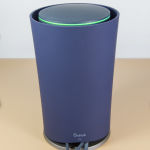
Google sort-of released a home automation product with the release of the Google OnHub—Google’s Wi-Fi router. Despite being released and on sale for $200, Google’s OnHub is still shrouded in mystery. The bottom of the device says it is “built for Google On,” but Google won’t say what “Google On” is. In addition to Wi-Fi, the OnHub is packing dormant Bluetooth and 802.15.4 radios, but Google won’t say what those are for either.

The URL for the OnHub website is “https://on.google.com/hub/,” and the app is just called “Google On.” To us, this branding suggests the OnHub is the first of many “Google On” products. We think it’s the name for Google’s home automation ecosystem, but the company has never really confirmed that.

Google has a ton of “Internet of Things” projects going on. There’s Brillo, an Android-based operating system for embedded devices. This is a lightweight OS that would run on all your IoT devices—door locks, light bulbs, sensors, and whatever other things you want to make “smart.” The OS supports ARM, x86, and MIPS hardware, and it can fit into as little as 128MB of storage and 32MB of RAM. Brillo currently has a website up and running, and it will eventually be open source. For now, you have to request an invite to use it.

While Brillo is the OS, Weave is Google’s communications platform. Weave covers “device setup, phone-to-device-to-cloud communication, and user interaction from mobile devices and the Web.” The goal is to get all your stuff to talk to all your other stuff, even if everything is from a different manufacturer. Weave can run over Wi-Fi, Bluetooth, or whatever else you have for a network connection—it can even be tunneled over the Internet. Like with Brillo, there’s a public website, but most of the good stuff is hidden behind an “invite” system.

Thread is Google’s low-power network protocol that would compete with Zigbee and Z-Wave. All of these low-power IoT network protocols are out to solve the same problem—Wi-Fi and Bluetooth are too fast and power-hungry for these battery-powered IoT devices. Use a low-power IoT protocol, and a battery-powered door lock can last for months on just a few AA batteries.

Thread uses IEEE 802.15.4 wireless protocol for mesh communication, which is one of the dormant antennas in the Google OnHub. Zigbee also runs on 802.15.4, but it has a royalty fee associated with it. Thread, in addition to the boost from Google’s scale, has no fee. Also unlike Zigbee, a Thread network is IPv6-based, which makes every device IP-addressable and able to jump right onto the Internet. Thread really seems like it’s out to kill Zigbee—Google says a small software update is all it takes to turn a Zigbee device into a Thread device.

Thread originated at Nest Labs but now lives as a product of “Thread Group,” a not-for-profit organization with board members from Nest, Silicon Labs, NXP, ARM, and Yale Residential Lock. Samsung and Qualcomm are also listed as “sponsors” of the protocol.

That’s a lot of branding and codenames to throw at someone, but you can think of the whole Google IoT stack like this: Thread is the physical “wire” that connects every device to every other device (it’s wireless, but you get the idea), Weave is the language they speak over that wire, and Brillo is the OS it all runs on.

Once all of these products get up and running and stop being secretive betas, look for the rest of Google to get involved. It sounds like Android TV will be one of the first Google products to jump onto the home automation bandwagon. In an interview with PCWorldSascha Prueter, Android TV’s engineering program manager, mentioned that Android TV was working with the Brillo and Weave groups. “We are working with these teams to see where they are going and where we can actually collaborate,” he told PC World. “And if you own the underlying platform and APIs, you can build out experiences that are very, very advanced and very hard to replicate.”

Nest’s mysterious audio product

Nest can already take up a sizeable chunk of your home’s gadgets. There’s the Nest Learning Thermostat, a smoke detector called the “Nest Protect,” and a cloud-accessible webcam called the Nest Cam. Now it seems Nest is looking to expand into home audio.

In the middle of 2015, the company posted a job listing seeking a leader for “Nest Audio.” The job description said the person would “lead the Nest Audio team” and be in charge of “developing an audio roadmap for Nest products.”

It’s easy to picture a Sonos-style smart speaker, but we really have no idea what Nest is working on other than the above description.

Google Glass is back from the dead

The last known image of whatever Google Glass has become; now, we’re pretty confident that it won’t bear the name Google Glass.
Missing from this picture: the bone-conduction earpiece and power button. We think Glass switched to a regular speaker, and the manual says the power button is now on the back. Here you can also get a look at the recording light next to the camera.

Speaking of Nest, Google Glass still resides under Nest’s founder, Tony Fadell. Google Glass “graduated” from Google X and “reset their strategy” according to information given out in a Google earnings call. Multiple reports say that the group is now going by the codename “Project Aura.”

A new version of Google Glass recently popped up in the FCC database, showing a few design tweaks, like a larger prism, a camera recording light, and a folding hinge. Reports from 9to5Google and others say this is the “Enterprise Edition” of Google Glass, which will be quietly distributed to enterprises and not available for sale to the general public. The unit reportedly switched to an Intel Atom processor and has an external battery pack attachment. It runs minimal software, and companies will need to build their own software for any real enterprise use.

We get the feeling “Project Aura” is the new consumer version of the device, which is still in development and separate from the device in the FCC documents. The Italian eyewear maker Luxottica has partnered with Google for the development of Glass, and a comment from the CEO seems to back up this interpretation. According to The Wall Street Journalthe Luxottica CEO told shareholders, “In Google, there are some second thoughts on how to interpret version three. What you saw was version one. We’re now working on version two, which is in preparation.”

“Version one” is the Google Glass unit that saw wide release. We think “version two” is the “Enterprise Edition” in the FCC documents. “Version three” would be “Project Aura,” and the comment that Google had “Second thoughts” on how to interpret it is a reference to the “reset” the group had in 2015.

A report from The Information also mentions that the Glass team was working on an alternate design that didn’t have a screen targeted at “sport” users. We’d imagine that would look something like the Motorola Hint, a Bluetooth earpiece you could talk to. The report also mentions that Project Aura is targeting 2016 for release.

YouTube wants to be Netflix

Credit: Ron Amadeo

After starting its own subscription service in 2015 with the ad-free YouTube Red, Google’s streaming company wants to move even further into Netflix’s territory by offering online TV shows and movies.

YouTube Red is a $9.99-a-month subscription service, but right now it only offers ad-free content and “premium” content from some of YouTube’s biggest homegrown stars like “PewDiePie.” Adding traditional TV shows and movies would definitely expand the appeal of the service.

Google already offers some TV shows and movies to users through Google Play. Considering that YouTube and Google Play’s content negotiators work out of the same office, those existing relationships should help YouTube get some deals done. We wonder what the interface would look like. Does Google stick Family Guy right next to cat videos, or does it separate things somehow?

Google’s Self-Driving Cars seek a partner

We’ve been hearing about Google X’s self-driving car for years, but the division is really starting to heat up with talks of actually releasing a commercial product. The biggest news for the Google Self-Driving Car division seemed to come via a Yahoo Autos report that claimed that Ford and Google would announce a joint venture to start a driverless ride-sharing business. Ford’s CES press conference came and went though, without a single mention of Google. Was the report totally wrong, or does a partnership exist that just didn’t get announced?

It’s widely believed that Google’s self-driving car announcement has spurred industry-wide interest in driving automation, but commercialization has always been a tricky subject. Car makers are terrified of the possible legal consequences that could happen if a computer-driven car kills or injures someone. The report claimed that Ford and Google found a way to make it work, though, by creating a joint venture that was “legally separate” from Ford, shielding the automaker from liability concerns. The report described the arrangement as “non-exclusive.” The business would have seen Ford build vehicles with Google’s self-driving technology, but with Google free to sign similar deals with other car manufacturers.

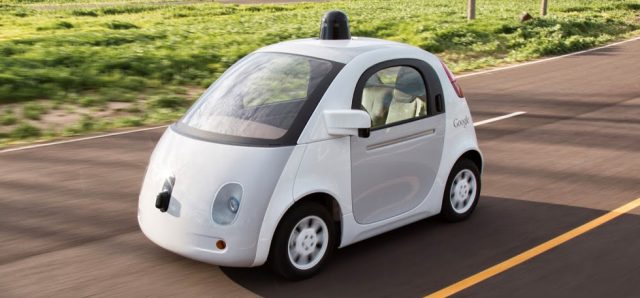
Again though, the deal was never announced the way the report said it would be, so we’re not sure if any of this will actually happen. It does line up rather well with what Google has said in the past though—it would rather not build cars on its own, and is seeking a partner company. Google’s current self-driving prototypes were designed in-house and built by Roush, and since the vehicles are purpose-built for automated driving, they can do away with unimportant things like steering wheels and pedals (though temporary controls are required by law for testing).

The report claimed the joint venture would be a ride sharing business, which is a great place for a self-driving car business to start—ride-sharing means Google doesn’t actually have to sell the cars to anyone. Google’s cars are packed with sensors and computers, which make them pretty expensive—the Velodyne LIDAR system used on the first self-driving car models cost $70,000. Google’s solution to this seems to be to start diving deeper into the sensor hardware and possibly design its own. A job listing for the self-driving car project is titled “Mechanical Engineer, Laser” and asks the applicant to be able to “Drive the mechanical design of novel LIDAR systems” and “collaborate with external suppliers and our internal manufacturing team to see your designs through to manufacturing.” The list asks that the applicant be able to “Specify and document your designs fully… for external suppliers.”

It sounds to us like Google is looking to design a LIDAR system that someone else would manufacture. The move makes sense, since there really is no existing “parts bin” Google can pull from in order to build its cars. Self-driving cars don’t really exist as a commercial product right now, so component vendors aren’t making what Google needs. When you’re inventing a new product category, you must do a lot of things yourself.

Some help might be coming from Samsung, which recently announced it was launching an “automotive components” division with a focus on infotainment and autonomous driving. Internally this sounds like a huge deal for Samsung Electronics, as the automotive group would be a fourth division inside the company. Currently there is the mobile (smartphone) division; a components division, which makes displays, SoCs, and flash memory; and a consumer-electronics division, which makes TVs, appliances, and everything else you’d find in a Best Buy.

Samsung getting involved is actually one of the more exciting things to happen to self-driving cars. As much as we focus on the company’s end-user products, Samsung is a juggernaut when it comes to component manufacturing. More component vendors doing R&D will be a great way to get the cost of the components down, and when it comes to electronic components, Samsung is one of the biggest.

Google is also still plugging along on the software side of things. Google’s cars have driven 1.3 million miles without being at fault in an accident, but they do get rear-ended a lot. Google told The Wall Street Journal that it is focused on getting the cars to drive more “humanistically” and less like terrified little robots fearful of the distracted human drivers that surround them. Google taught the cars to “cut corners” for a smoother, more pleasant driving path. It now creeps into an intersection before taking off to let other drivers know its intentions. The cars have also been programmed to be more flexible in certain situations—if a car is blocking its lane, it will now assess oncoming traffic and drive around the car when traffic is clear, just like a human would.

The Google X division has gotten a “CEO”—a former Ford executive—and is expected to transition to an Alphabet company sometime in 2016. The current goal for commercialization is the year 2020. At first blush it might seem like Google will need a flying self-driving car by then, but 2020 is only four years away.

The “Replicant” robot division is in a tough spot

Andy Rubin, the founder of Android, left the Android division at Google in 2013. It later surfaced that he left to start a robot division inside of Google X, and the division acquired eight robotics-related companies in about six months, including heavy hitters like DARPA-challenge winner Schaft and Boston Dynamics, creator of four-legged robots for the US military. In an interview with The New York TimesRubin called the division a “Moonshot” project with a “10-year” plan. About a year later, he left Google.

We think any division would suffer under circumstances like that. A report from Business Insider claims to have the details, though, and this paints a very believable story of a rudderless hodgepodge of companies that never really integrated into a single team once their leader left. The report says Replicant is now up to “roughly 10” acquired companies that have “little in common” and are “scattered across different countries and working on unrelated projects.” The upshot? “Many of the people who had joined Google through the robotics M&A felt confused and disappointed,” the report said.

Business Insider says Rubin gave the group a goal to build a consumer robot by 2020. We’ve previously heard reports of that robot being a general-purpose “human assistant.” A Wall Street Journal report mentioned the group was working on automating Foxconn’s factories and said the group is working on a robotic operating system of its own. A report from Bloomberg says the group has also been contributing to ROS, the open source Robotic Operating System. Whether any of that will still happen with Rubin’s departure is anyone’s guess.

Sidewalk Labs—Converting NYC’s pay phones for the modern age

The black part here is an LCD screen, which will eventually show advertisements.
In between the two advertisement panels is a small Android tablet. Here the user is making a phone call.

Sidewalk Labs wants to apply “moonshot thinking” to cities, and it’s run by Dan Doctoroff, former CEO of Bloomberg LP and the former deputy mayor of economic development and rebuilding for New York City. The group’s only public project seems to be LinkNYC, a project that aims to replace New York’s public phone booths with something a little more useful in the modern age: free Wi-Fi hotspots.

The installations aren’t just Wi-Fi hotspots; the project calls them “communication hubs.” A small Android tablet will let you browse Google Maps, make a phone call, browse the Web, and access city services. There’s a power-only USB port for charging your phone. The Wi-Fi is going to be blazing fast Gigabit Wi-Fi, and, since this is New York City, the left and right sides of the installation will have large LCD screens on them for advertisements. The fresh ad space will pay for the entire project and the Wi-Fi access to boot, meaning it comes at no cost to taxpayers.

The project’s website says the first two units have already been installed, but most of the features aren’t turned on yet. Eventually the plan is to replace all of NYC’s 7,500 pay phones with LinkNYC terminals. Sidewalk Labs notes that LinkNYC is “just the first of many urban challenges we will be tackling,” so we’ll be on the lookout for more news in 2016.

Internet Access Projects

In the US, Google Fiber’s buildout is still slowly moving from city to city, but that’s a release product without too much mystery to it. Google likes to attack problems from multiple angles at the same time, and for Internet access it has a ton of projects going on concurrently. All of these seem to be aimed at bringing Internet to areas where there isn’t any Internet, and they all happen to be airborne solutions.

Project Loon

As crazy as it sounds (even to those involved, it seems), Google X’s plan to host a balloon-based mesh network in the sky is a feasible idea that isn’t going away. Project Loon has evolved quite a bit since it was announced in 2013. The original setup would beam Internet access to a proprietary red ball stuck to the side of a house, but the newest iteration is a “cell tower in the sky” blasting 4G LTE down to anything that can receive it. A single balloon can stay in the air for six months and provides 4G LTE to an area the size of Rhode Island.

As interesting as it would be to have Google augment its own Project Fi cellular service with these balloons, Project Loon is focused on integrating the balloons with existing carriers. So far it has partnered with Vodafone New Zealand, Telstra in Australia, and Telefónica in Latin America. Loon is cheaper than building cell towers, so the group has focused on bringing cell service to areas where it normally wouldn’t be economically feasible.

Loon has also focused on “scaling up.” It has a semi-automated manufacturing facility now that produces a balloon in “just a few hours” instead of the days-long process the group started with. In a YouTube video about the larger scale, the group mentioned they are “getting close to the point where we can roll out thousands of balloons” and are able to launch dozens of balloons a day.

In November 2015, Google filed a request with the FCC for some kind of two-year nationwide test of radios in the 71-76 and 81-86 GHz millimeter-wave bands. The request is heavily redacted, so we don’t exactly know what Google is up to. One piece of paperwork listed the station location as “max altitude 75,459 ft,” suggesting this is an airborne test of some kind. The application was filed by Google employee Jeff Gilbert, and if that’s this Jeff Gilbert, he works for Google X—the same division responsible for Project Loon. It all suggests that Google wants to float its balloons over US soil.

Project Titan

Google bought Titan Aerospace, a company producing plane-like drones called “atmospheric satellites,” in 2014. The group turned into Project Titan and is another method to get some kind of Internet sending device into the sky permanently. The drones are solar-powered and supposedly can fly for five years without landing.

Sundar Pichai, the current head of Google, gave an update on the project at Mobile World Congress 2015. He said the plan is for Titan and Loon to join the same mesh network and provide cellular access. Pichai said Titan was “at the same stage Loon was about two years ago.” Loon is only about two-and-a-half years old, so in other words, Titan is still a very early project.

A SpaceX satellite network

We’ve got balloons, drones, and next, satellites! A report from The Information claimed that Google was going to invest in Elon Musk’s Space X to support a plan to build a fleet of low-orbit, Internet-delivering satellites. Space X’s plan is to have hundreds of satellites orbit at just 750 miles above Earth (traditional satellite orbit can go up to 22,000 miles) and deliver low-cost Internet. The lower orbit would make for much lower latency than traditional satellite Internet.

This rumor quickly seemed to jump from rumor to fact. Shortly after the report, SpaceX closed a financing round with Google. The company’s notice stated “Google and Fidelity (another new investor) will collectively own just under 10 percent of the company.” While GV (formerly Google Ventures) and Google Capital often invest in companies, it’s rare for Google itself to do so.

Google had planned to pursue an idea like this on its own by acquiring O3b Networks, but after key employees left, Google invested in SpaceX as a “Plan B.”

Project Wing—Drone deliveries

Besides beaming Internet over everyone’s heads, Google/Alphabet also hopes to someday deliver products with “Project Wing,” a drone-delivery program in development.

One of the prototypes is rather unique as far as drones go. It has four engines, but it’s not a quadcopter. Instead, the design is a “tail sitter”—it’s a winged plane that is oriented vertically for vertical takeoff, landing, and hovering, and then rotates into a more plane-like horizontal mode for faster, more long-distance flight. For delivery, the drone switches to a vertical orientation, hovers, and delivers the package to the ground via a retractable tether.

Update: Another model was only recently seen in a blurry video, so it’s hard to make out what exactly it is. A fixed wing appears to sit on top of two long bars. It appears there are four vertical propellers on the ends of the bars, and another two horizontal props attached to the wings. This model wouldn’t have to worry about switching from horizontal to vertical mode thanks to the propellers in different orientations, but also looks more complex to build and maintain.

Google launching a drone delivery program is a little odd, since Google doesn’t have a whole lot of products it would want to deliver. Presumably, if Wing becomes a real service, it would have to license the service out to other companies. You can count Amazon out as a potential customer, though, as the company already has a drone program of its own in the works.

Wing is a Google X project, but this one is a little closer than Google’s other moonshots—David Vos, the project leader, announced in November that, “Our goal is to have commercial business up and running in 2017.”

Makani—Flying wind turbines

The current prototype parked in its hangar.
An engineer next to the flying turbine. It is huge.

Along with air-based Internet access and product deliveries, how about electricity? Makani, a Google X company, wants to take the concept of a wind turbine and mount it on a flying kite tethered to the ground. The kites can be higher up in the atmosphere than a turbine, where winds are stronger and there is more energy to capture. The wind requirements are also lower, allowing a tethered kite to work in places where there isn’t enough wind to power a turbine. Makani says the idea will one day provide cheaper power than a wind turbine, because the kite design “eliminates 90 percent of the materials” used in a conventional wind turbine.

Whether Makani’s idea turns out to be a viable energy solution remains to be seen. There are all sorts of issues with the FAA, considering how tall these are. Judging by Makani’s own videos, they also seem to make quite a bit of noise, so you might not want to have one in your neighborhood. There’s also the question of how well they do in a storm—will they have to land?

The project doesn’t get talked about much except for a Google+ page the team runs. Makani started out with a small 20kW prototype, but in 2015 it set out to build and test a 600kW model, which is now up and running in California. Makani’s own website lists a large wind turbine as generating 6,000kW—10 times more power—so it seems the team still has a ways to go.

Calico—Death still isn’t cured

While we didn’t really know it at the time, Calico—Google’s anti-aging research company—was one of the first Alphabet companies. Calico is where the “Alphabet” plan seemed to originate. Find someone important to run the new division (in this case, Art Levinson, the current chairman of Genentech and Apple), give them a bunch of money, have them build a team, and (hopefully) make something cool. Calico was started as a separate company inside of Google to pursue the moonshot of “curing death,” and once Alphabet was formalized, the company was moved over to the conglomerate.

Calico hasn’t “cured death” yet, but the company’s website has shared a little about what the company is doing. It mostly boils down to research partnerships with other companies. AncestryDNA, The Buck Institute, QB3, the Broad Institute, AbbVie, and The University of Texas Southwestern have all partnered with Calico to research the cause of aging and age-related diseases.

Verily—The new face for Google Life Sciences

“Verily” is the new name for the Google Life Sciences division, which dropped the “Google” name after leaving Google and becoming an Alphabet company. Other than the new name and spiffy new website, the group is mostly still chugging along on the same products we covered last year.

There’s a glucose-monitoring smart contact lens project being made in partnership with Novartis, a leading pharmaceutical company. Baseline Study seeks to measure what a “healthy human” looks like. Once you have a basic idea of what “healthy” looks like, the group hopes to detect problems early by continuously monitoring a patient with blood-borne nanoparticles. Liftware, a line of actively stabilized eating utensils for people with hand tremors, is already for sale.

Recruitment is apparently going well, as this article from Nature rattles off a list of “biomedical superstars” that have left academia and headed to Google HQ. Leaving for the tech company is apparently appealing thanks to more funding, better technology, and a ‘Get stuff done’ measuring stick rather than worrying about publishing academic papers.

In terms of new stuff, the company has partnered with Johnson and Johnson to create its own spinoff company called “Verb Surgical Inc.” Verb Surgical is in the business of making robo-surgeons. This isn’t as crazy as it sounds—robots have been used in surgeries for some time now. Compact arm design allows for minimally invasive surgery by fitting the small robot arms and cameras inside the patient, rather than splaying the patent open so a human hand can manipulate things directly. (Just check out this surgical robot stitch a grape back together while it sits inside a glass bottle!)

The press release helpfully notes that “The team has already made meaningful progress on the robotics platform, which is being developed for application across a host of surgical specialties.” The goal is to make a “comprehensive surgical solutions platform.”

DeepMind—Google’s artificial intelligence lab

DeepMind’s Algorithm learns how to play Atari classics Space Invaders and Breakout.

DeepMind is an artificial intelligence company Google acquired in 2014, and today the group is an Alphabet company. The group deals with lots of machine-learning technology, which seems to find its way all across Google. DeepMind’s recently published work shows it teaching a computer how to do things the same way many children learn—by playing games.

DeepMind built a neural network and set it loose on a game of Breakout. With no input other than the pixels on the screen and the score, the program was able to figure out how to optimally push buttons on the controller in a way that makes it better than any human player.

Building a program to specifically beat Breakout wouldn’t be groundbreaking research, but DeepMind’s program is a “general” artificial intelligence program—it’s not specifically programmed to beat Breakout the way IBM’s DeepBlue is programmed to play chess, or how Watson was programmed to play Jeopardy. It’s designed from the ground up to be “flexible, general, and adaptive,” and it has to learn the game’s rules and controls from scratch. The same algorithm can best humans in 31 other games, and the group hopes to move on to 3D games like Quake and other more complex tasks like robotic control simulators.

ATAP keeps building its crazy ideas


ATAP is the Advanced Technology and Projects group inside of Google. It’s a research arm led by Regina Dugan, the former head of DARPA. The group follows a rigorous research schedule pioneered at DARPA—it hires a bunch of outside experts and gives them two years to create something worthwhile. After two years, the project is either shutdown or spun out of ATAP, with the idea being the limited time frame creates a sense of urgency.

ATAP can be tough to get a handle on. The group tends to tackle a lot of ambitious hardware projects, which generate a lot of hype, but, so far, we’ve rarely seen the group produce any kind of commercial product. The one thing that has graduated from the group and actually reached consumer release is a smartphone app called “Spotlight Stories,” which has a scene play out around the user with the smartphone screen acting as the camera.

ATAP rarely gives out release dates for its projects, and when it does actually give an ETA for something, it tends to miss the date. It’s a messy division, but we think that’s the whole point of ATAP.

Project Ara—an oft-delayed modular phone project

Project Ara’s aim is to build a modular smartphone. There’s an “endoskeleton” that holds various modules, like the SoC, battery, camera, display, and other components. The idea is that you’ll be able to easily swap out modules for customizability and upgradability, and there is a hope that a module ecosystem springs up around the phone.

Ara was announced in October 2013, and it had to be extended past its two-year ATAP deadline. While it still isn’t a commercial product, some progress is being made. At Google I/O 2015, ATAP showed a prototype booting for the first time, and it was able to take a picture with a camera that was added after it had booted.

The device was scheduled for a 2015 launch in Puerto Rico, but for undisclosed reasons the launch was canceled. Now according to Project Ara’s Twitter page, the group is hoping for a 2016 launch in the US.

Since the delay, the group’s Twitter page has briefly described a number of changes. “We want to give users more space for more modules. So we grouped the core functionality to free up space” one tweet read. To us that sounds like Ara is thinking about watering down the original customizability and upgradability promises in exchange for more room for battery and accessories.

The core problem we have with Project Ara still exists: technology gets smaller and more integrated as it matures, and modularity is going in the opposite direction. Space is at a premium in mobile phones, with every free cubic millimeter used to cram in more battery. As a requirement of its design, Ara will spend a lot of that space on modular cases, physical support, and interconnects, leaving less room for battery. An integrated device will always outperform a modular one—will customers accept a size, weight, and battery tradeoff in exchange for modularity?

Project Tango—A 3D computer vision smartphone, coming to consumers this summer

Concept renders of Levnovo’s Project Tango phone.
The camera setup is, well, complicated.
This Lowe’s apps turns your house into a real life game of The Sims allowing you to move virtual furniture around the house.
Jenga, without the cleanup.

Project Tango is a line of phones and tablets with computer vision sensors packed into them. This allows the device to do 3D indoor mapping, depth sensing, augmented reality, and whatever else developers can come up with. A lot of the work has to do with allowing the device to determine its position and orientation within an environment. The collection of sensors enables “six degrees of freedom”—determining a device’s three axes of orientation and three axes of motion. In 2015, the project ran over its two-year ATAP time limit and was spun out as part of Google.

Project Tango released a developer kit in 2014, and Google says more than 3,000 have been sold. At Google I/O 2014, Google and LG announced that a commercial product was coming in 2015, but that never happened. Both Intel and Qualcomm showed off Project Tango prototypes in 2015, but the biggest news for the project came at CES 2016, where Google and Lenovo announced the first commercial Tango device would launch this summer.

Lenovo and Google said the device would be “six-point-something” inches and cost “less than $500,” but didn’t show off an actual device or design or talk about specs. The two companies showed off some demos, like an augmented reality game of Jenga and a virtual pet. One of the more interesting examples was a Lowe’s home planning app, which basically turned your actual house into a game of The Sims, letting users move virtual furniture around in a real house.

Project Soli—Radar-sensed hand gesture for wearables

Project Soli uses radar to enable a device to read hand gestures performed a short distance above it. Radar can detect fine movements at a high frequency rate, and the group has been working on “a pipeline” that can take the radar input and turn it into readable gestures. Something like this could be useful in a wearable device, where the tiny screen means you can’t swipe your finger around that much. Imagine holding your hand above a smartwatch and rubbing your thumb and index finger together to scroll, then tapping your fingers together to select an item.

Soli was demoed on large developer hardware at Google I/O 2015, and it seemed to work well. The group promised an API and developer kit in 2015, but as far as we can tell that was delayed. Project Soli’s website only says it is still “planning to release a dev kit,” and you can sign up for e-mail updates.

Project Jacquard—Touch panels for textiles

Project Jacquard aims to weave touch panels into “any textile” using thin metallic thread. The idea is that you can weave “interactivity” into just about any garment, and the Jacquard team is focused on scalable techniques like making sure the whole process works with existing industrial looms.

Once you have a touch panel on your jacket sleeve—now what? Jacquard isn’t focusing on that; it’s up to developers to come up with some kind of use for it. It is often shown paired with a phone, but if you’re holding the phone, why not just touch it? For a touch panel to be of any real use, you’ll need a display somewhere. Maybe it would be a fun Google Glass accessory?

At ATAP’s Google I/O 2015 presentation, a partnership was announced with Levis (the jean company) to bring the concept to market. Like with most ATAP products, though, there’s no announced release date. Again, there’s a website with an e-mail signup for more information.

Project Abacus—Continuously calculated user authentication

Project Abacus is a smartphone authentication system and yet another attempt to kill the password. Abacus seeks to use all the sensors and signals a smartphone receives to authenticate the user—it’s kind of like Android’s “smart lock” system on steroids. Abacus calculates a continuous “trust score” using tons of signals, your location, facial recognition, speech input, how you type, motion created by how you walk, and nearby Bluetooth devices.

Authentication wouldn’t just be a binary “yes” or “no” answer, either. At ATAP’s Google I/O presentation, the Abacus demo showed the continuously calculated trust score on a scale of 1 to 100 with some apps, like a game, requiring only a low trust score. A banking app would require a much higher score, for instance.

While demoing it, Regina Dugan said the project “may prove to be ten-fold more secure than just a fingerprint sensor” and that the goal was to provide this to millions of Android devices with just a software update.

A project like this seems like it’s waiting for a battery breakthrough to become mainstream. Continuously calculating a trust score would also mean constantly firing off the GPS, front-facing camera, and every other sensor in order to keep authenticating the user. Maybe the variable trust score could alleviate this somewhat with most of the sensors only starting up once when the phone is turned on and later when a sensitive app is opened.

Project Vault—A secure computer on a MicroSD card

Project Vault is a MicroSD card that contains a “security dedicated computer” that ATAP pitches as a “digital mobile safe” for your most important stuff. The card encrypts your data and offers a “driver free” interface to the rest of the phone, and none of the encryption keys or algorithms inside Project Vault are ever exposed to the system it is plugged into. The little SD card contains an ARM processor that runs a small security-focused OS. There’s also an NFC chip and antenna, a hardware random number generator, and 4GB of storage.

Project Vault is aiming at the enterprise market first, and of course Google is one of the first to try them out, deploying 500 units internally. Two vault users can communicate with each other without exposing anything to the operating system, and the goal is to make it easy enough for any novice user to use. Since it’s an SD card form factor, it can present itself as a normal SD card. Only when authenticated correctly do the right files get sent to the OS.

At I/O, Project Vault actually released the source code for the project so far, with the goal of letting developers see how it works and trust the platform.

The new Google campus—a visionary concept with nowhere to build

The wild, sweeping design would be unlike any other office space out there.
With lots of plant life, minimal walls, and a clear roof, we’d imagine sometimes it would be hard to tell if you’re “indoors” or outdoors.

In February, Google unveiled a wildly ambitious plan for a new headquarters in Silicon Valley. The plans rendered Google’s office space as a reconfigurable, open-air greenhouse. An open grid of office space was covered by a giant, clear canopy that looks something like a spider web. With minimal barriers to the outside world, underground parking, and lots of plant life, Google says it wants to “blur the distinction between our buildings and nature.”

Each room is a modular lightweight block that can be moved around and stacked to fit whatever project Googlers are working on at the time. As Google put it in its announcement post: “Our self-driving car team, for example, has very different needs when it comes to office space from our Search engineers.” Google will invent a crane-robot to move these boxes around.

Working all day in a “greenhouse” under California’s powerful sun sounds very hot, but Google’s canopy design allows it to regulate the air and climate. Like the current Googleplex, the campus will be open to the public, but this new campus will actually give the public a reason to want to go there, with retail plazas and parks.

Forget the challenge of even building something like this, though. First Google needs to get the space. When it went to the city council with the above plans in May, the group only approved 25 percent of the space asked for. Google is now faced with exploring some other option for its visionary campus, but we’ve yet to hear what that option is.

Stay Tuned for 2016!

That’s everything we can think of happening inside of Alphabet. The company (and this series of articles) just seems to get bigger and bigger as time goes by. We’ll stay on top of all of it, though, and 2016 is sure to bring some new items and make the list even bigger next year.

The next big batch of Google news should come at I/O 2016, which should happen sometime around the middle of the year. Until then, stay tuned!

Listing image: Ron Amadeo

Photo of Ron Amadeo
Ron Amadeo Reviews Editor
Ron is the Reviews Editor at Ars Technica, where he specializes in Android OS and Google products. He is always on the hunt for a new gadget and loves to rip things apart to see how they work. He loves to tinker and always seems to be working on a new project.
66 Comments