Skip to content
Tech

The state of Android updates: Who’s fast, who’s slow, and why

Naming and shaming (sometimes praising) the update efforts of OEMs and carriers.

Ron Amadeo | 127
Credit: Aurich Lawson
Story text

Android 4.4, KitKat was released on October 31, 2013, or at least, that’s what you can say about one device: the Nexus 5. For the rest of the ecosystem, the date you got KitKat—if you got KitKat—varied wildly depending on your device, OEM, and carrier.

For every Android update, Google’s release of code to OEMs starts an industry-wide race to get the new enhancements out to customers. So how did everyone do this year? Who was the first with KitKat, and who was the last? What effect does your carrier have on updates? How has the speed of Android updates changed compared to earlier years?

Given all those variables, we wanted to check in on the specifics of Android in 2014. There are lots of slightly different ways to go about measuring something like this, so first, a word about our methodology. All of these charts measure KitKat’s update lag time in months. For our start date, we’re picking October 31, 2013, the day KitKat was released on the Nexus 5. For our finish time for each device, we’re going with the US release of an update via either OTA or downloadable system image. OTAs are done on a staggered release schedule, so it’s hard to tell exactly when they start and finish—we just went with the earliest news of an update.

The device manufacturers
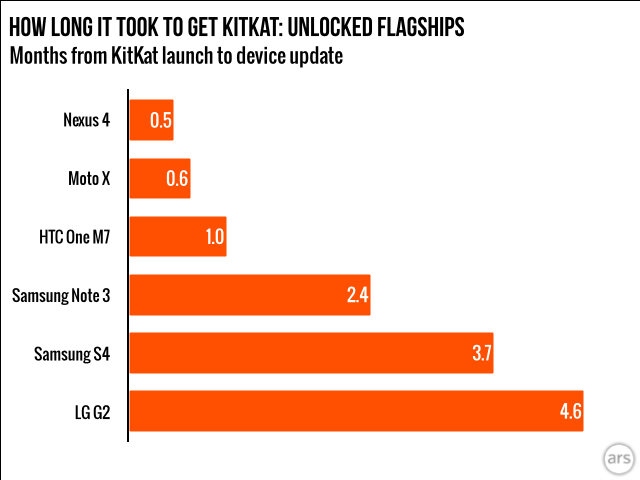
Update times from OEMs on unlocked devices. Here there are no carriers to get in the way.

The above chart shows the definition of “flagship” we’ll be using for most of this article. We picked the newest high-profile devices that didn’t ship with KitKat from each major OEM. That subset ends up being devices that largely launched in 2013. We single out flagships because those are the most exciting phones and the most relevant examples of a company’s update policy—it’s good to see how well an OEM can do when it is trying its hardest to update something quickly. (Don’t worry, we’ll tackle older devices and non-flagships later on.)

The winner for update times is, of course, the Nexus line. Stock software and a head start from being Google got KitKat out the door in just 14 days.

As for everyone else, how quickly they update seems to depend on how complicated their skin is and how much they take advantage of the update mechanisms Google has created.

Motorola—A beacon of light in the darkness

In the wide world of non-Nexus devices, the then-Google-owned Motorola did great, too, coming in at an almost-Nexus-like time of 19 days. Like the Nexus program, Motorola was helped out by a close-to-stock software loadout and a focus on a small number of devices. Motorola keeps most of its changes to bundled apps, and it tries to stay away from modifying the Android framework. When it comes time to update to a new version of Android, this means much less porting is needed. Google works very hard to not break app compatibility, so most of Motorola’s work gets done for it.

The usual justification for skinning Android is “differentiation,” and Motorola even manages to do that better than its competitors. The Moto X’s always-on voice recognition and Active Display are some of the most useful differentiators in the industry, and the excellent Motorola Spotlight Player adds a bit of exclusive fun to the equation, too.

Motorola takes full advantage of the Play Store, allowing for out-of-cycle updates for Motorola’s bundled apps. The company even mirrors Google’s Play Services strategy by offloading core libraries and services to the Play Store. There’s Motorola Contextual Services, which handles detection for the automatic do not disturb, driving, and home modes, and Motorola Modality Services, which helps out accelerometer-driven apps.

Motorola is a shining example of “doing it right” when it comes to skinning Android; every other OEM should be taking notes.

Now, there is some confusion here—no one is quite sure of how much of Motorola’s update success is from Google’s ownership. With the pending sale to Lenovo, Motorola’s future hangs in the balance. Will Motorola be able to continue its stellar track record of updates in the future, or will Lenovo ruin a good thing?

HTC—Transparency that should be applauded

HTC did surprisingly well getting KitKat to the unlocked One M7 in about a month. The company has come a long way since the disastrous days of the HTC Thunderbolt, and it has put a big focus on its update speed.

HTC hosts a software update dashboard that shows what developmental stage an update is in. The company has committed to supporting its North American flagships with updates for two years, promising to ship Android L to all variants of the One M7 and M8 within 90 days of its release. (HTC promised the same of KitKat and later apologized when it didn’t quite make the 90 day cut, but still, we appreciate the effort.)

HTC has a tighter focus on products lately, relaxing from its frantic pace of over two-dozen models in 2011 to just a handful of products this year. The company has also worked to make its Android skin, HTC Sense, more modular, offloading many apps to the Play Store the same way Google and Motorola do. The company even has a Google Play Services-style app called “HTC Service Pack,” which allows it to update parts of Sense without having to push out an OTA.

Samsung—A monolithic skin that takes a while to update

Samsung easily sells the most Android devices, making its update speed the most important for the health of the overall OS ecosystem. It’s a shame then that the company does very little to speed up the update process. Samsung uses a heavy monolithic skin with none of the update-friendly architecture that is employed by its competitors. TouchWiz extensively modifies the Android framework to make things like split screen apps, pen input, and floating windows possible. It skins every area of the OS and maintains a plethora of apps that duplicate Google functionality while providing seemingly little benefit to the user.

The worst part is that all of this is delivered to the user in a giant brick. Samsung doesn’t take advantage of the Play Store to update apps and services outside of an OTA, because everything is so integrated with the core OS.

Samsung also has the widest lineup of all the Android OEMs. Its strategy seems to be to flood the market with as many different models as possible—GSM Arena’s phone database lists 41 different Android phones (not including tablets) released by Samsung in 2013. It’s pretty much impossible to update that many devices in a timely manner.

It should come as no surprise that the Note 3 took twice as long as the HTC One to get KitKat, and the Galaxy S4 was almost four times slower than HTC’s effort. That’s not even counting Samsung’s 26 other lower-profile Android phones or its piles and piles of tablets.

LG—A minimal effort

LG came in dead last with a whopping 4.6-month wait for KitKat on the unlocked G2. You would think the maker of the last two Nexus phones would have picked up a thing or two from Google, but like Samsung, LG has an old-school monolithic skin and takes its sweet time updating it.

For the chart above, we picked unlocked phones so we would have a baseline that was unaffected by carrier red tape. Interestingly, the unlocked G2 wasn’t the first G2 to get KitKat. That honor goes to the AT&T G2, which took 3.8 months. That’s still last, but it’s not as brutal of a loss for LG as it is with the unlocked model.

LG skins often feel like a copy of Samsung’s TouchWiz, and LG has inherited TouchWiz’s heft as well. Every app on the G2 has been skinned, and complicated changes are made to the framework to enable split screen apps and floating windows. The company clearly didn’t put much effort into updating the G2 quickly.

With LG shipping a personal-best 14.5 million smartphones in Q2 of 2014 (Samsung shipped 74.3 million in the same period), we’ll have to see if LG ups its update game in response to growing popularity.

The wireless carriers

These charts show the average time flagship phones took to get KitKat on each carrier.
Motorola’s update speeds are so abnormal that we figured a chart without the Moto X would be valuable. This is how long a device typically takes to update on each carrier.

There are two different charts for the carriers: with and without the Moto X. If you want to know what the average update time is for a locked phone, Motorola’s update speed seriously skews the numbers for the rest of the industry. Without the Moto X, Verizon’s average is 5.3 months—Google has developed entirely new Android updates in that amount of time. In every gallery, the charts all use the same x scale, so you can easily compare update times across charts.

As the chart shows, if you care about update times, you should definitely buy an unlocked device. The downside is paying more up front, but the upside is huge. You get faster updates and—if you pick the right carrier—a lower monthly bill.

But if you just have to deal with one of the big carriers, we’ve got charts for that, too. These numbers average the update times for our 2013 flagships—the LG G2, HTC One M7, Moto X, Galaxy Note 3, and Galaxy S4—on each carrier. Each phone is available on all four carriers, and we included the unlocked versions, too, so the statistics worked out. Only the Nexus 4 was excluded, because it’s not on every carrier (T-Mobile was the only carrier to sell it).

These charts are meant to show which carriers delay updates the most, and to the surprise of absolutely no one, it’s Verizon. The company makes sure to take an especially long time to approve updates for its most popular phones, like the Galaxy S4 and Note 3, which both took around six months.

Verizon has a long, storied history of doing everything it can to cripple the phones that run on its network. Back in 2004 when flip phones were first getting Bluetooth, Verizon frequently disabled critical Bluetooth profiles of its devices to stop users from freely transferring files and contact information. This forced users to pay for additional products like Verizon’s “PIX Place” image service and “Get-it-now” ringtone store; otherwise users could shell out for a proprietary $40 USB cable.

In 2007, when phones were getting GPS, Verizon disabled that, too, until it figured out how to charge $10-per-month for it. When Wi-Fi came around, Verizon would artificially limit it or demand that OEMs build Verizon-specific versions without Wi-Fi in order to force users to get a data plan. In 2011, it blocked Google Wallet to give a leg up to its competing service called “ISIS,” which wouldn’t launch nationwide until 2013. Today Verizon’s tradition of hostility toward its customers continues with slow Android updates, which presumably it thinks will encourage users to upgrade sooner. Luckily for the company, wireless customers do not typically vote with their wallets, and users have rewarded Verizon’s behavior by making it one of the nation’s largest carriers.

AT&T, Sprint, and T-Mobile are all about the same, which is surprising given T-Mobile’s seemingly friendly attitude toward Google and the Nexus devices. T-Mobile was the launch partner for the G1, and the company has sold nearly every Nexus device in its stores. That openness hasn’t translated to quick update times, though.

OEMs versus carriers

If it weren’t for the Sprint version nearly taking a month and a half, Motorola would have a 0.65-month average.
Sprint was the complete opposite for HTC. It was the only carrier that got KitKat during HTC’s 90-day promise.

This chart shows update times for locked devices averaged across all four big US carriers. Every phone on this list ended up on all four carriers, so we again have nice, tidy statistics.

The award for “Best at navigating carrier red tape” goes to… Motorola! In 2013, the company demonstrated a wizard-like ability to get code into the hands of users without letting carrier meddling get in the way. Motorola even managed to sneak KitKat through Verizon’s notoriously slow update process in a blistering 19 days, shaving a significant amount of time off Verizon’s usual five-month update delay.

A lot of people credit Motorola’s update success to Google, but consider that even Google’s Galaxy Nexus took three months to get Android 4.3 on Sprint. The Verizon version never got 4.3. The Google-owned Motorola seems to be the perfect combination of Google’s Android know-how and Motorola’s 35-year history of dealing with cellular carriers.

HTC averaged about 3.5 months for the carrier versions, a little longer than the three-month period it was aiming for, but that’s still decent compared to Samsung and LG’s 4.6-month average.

Non-Flagships

The Droid line is built for Verizon by Motorola, which explains the non-terrible update speed.
The bigger and smaller version of the One took about five months to see KitKat.
LG is still super slow, coming in at around six months.
Samsung is even worse, with a seven-month wait for the S4-Mini line—except for the AT&T version, which still isn’t out.

If you’re looking for a device that isn’t a flagship, that usually means a much longer wait for KitKat. Motorola is again the leader, and even the company’s non-flagship phones get updated before anyone else. The company’s ~20 day Moto X update speed has more than tripled for their non-flagships, though that still comes in at about two-and-a-half months. Most of Motorola’s non-flagships are Verizon’s DROID line, which—yes—still exists. The excellent Moto G is also included in this group.

HTC didn’t have much in the way of non-flagships for the 2013 era—almost all of its focus was on the HTC One M7. Still, the company did release bigger and smaller versions of the One—the Max and Mini—on a handful of carriers. The updates there all hovered around five months.

LG was slower, averaging around six months for an update for the curved and flat versions of its phablet—the LG G Flex and Optimus G Pro, respectively. The G Flex gets bonus fail points for being released in 2014—that’s after KitKat, but not launching with KitKat.

Samsung, the company with the most phone variations, took around seven months. Some Samsung phones, like the AT&T version of the S4 Mini, don’t even have the KitKat update yet, which gives the company a literal black mark in our chart. If the update is ever released, it would put the AT&T version of Samsung’s S4 Mini at over nine months. Buying a non-flagship phone means a long wait for an update.

KitKat on older devices: A SoC-limited affair

Samsung took just as long on the 2012 stuff as it did on the 2013 stuff. T-Mobile has yet to get updated, though.
Motorola was a different company in 2012, and it missed a lot of updates.

Most phones come on two-year contracts, though, so how did the 2012-era lineup of flagship devices do when it came time for KitKat? Poorly—just look at all those black bars denoting abandoned devices. Even Google gets a black bar in the form of the Galaxy Nexus. While the device was technically released at the end of 2011, we’re looking at devices from two generations ago, so the Galaxy Nexus gets included.

Support from the SoC vendor is the first step in getting an update out the door, and you’ll see many phones’ support lifecycles cut short thanks to the likes of Texas Instruments and Nvidia. The Galaxy Nexus used a Texas Instruments OMAP 4460 SoC. TI quit the smartphone business in 2012, leaving Google’s flagship without support for KitKat. The only device we’ve seen update to KitKat without support from the silicon vendor is Google Glass, which uses the same chip as the Galaxy Nexus. If the incredibly buggy performance of Google Glass post-KitKat update is any indication, though, that was an experiment that went very poorly.

Samsung managed to update all of its Galaxy S3s and Note 2s, except for the T-Mobile versions. We’re not sure if T-Mobile or Samsung is to blame for that, but considering the devices were updated on other carriers, it’s definitely a political issue, not a technical one.

Motorola was an entirely different company in 2012, and the lineup shows this. It released a ton of DROID devices on Verizon, making the fatal mistake of releasing a different flagship for every carrier. The Droid 4, like the Galaxy Nexus, didn’t get updated, thanks to its abandoned Texas Instruments SoC. The Photon Q and Atrix HD used a Qualcomm processor, though, so these devices have no excuse.

HTC’s 2012 lineup suffered at the hands of Nvidia. HTC used the Qualcomm Snapdragon S4 and Nvidia Tegra 3 interchangeably in the same model depending on the release location, which left the company in a predicament when Qualcomm opted to support KitKat on its chipset and Nvidia did not. When facing the possibility of updating only half of the One X/X+s out there, the company opted to walk away. The Droid Incredible 4G LTE and Evo 4G LTE both used Qualcomm processors and could have been updated but just weren’t.

In 2012, HTC also suffered from going absolutely crazy with phone variants. There’s the One S, One V, One SV, One VX, One XL, Desire X, Desire V, Desire C, Desire VC, Desire SV… the list of phones HTC produced in 2012 goes on forever. Almost none of them got updated.

LG was just getting into the high-end smartphone market in 2012 with devices like the Optimus G. Providing updates never seemed to factor into the company’s plans, though, and its 2012 devices never got KitKat.

The ecosystem is slowly getting better

This article is something of a sequel to a previous article, where, almost two-years ago, our Culture Editor Casey Johnston took a hard look at Android updates up to that point. The numbers aren’t directly comparable, since we’re only covering KitKat updates, but the overall impression we get from looking at both reports is that things are improving.

The most impressive is Motorola, for which back in 2012, Casey discovered an 8.4-month update average over all its phones. Today, the company took around 2.7 months to update its devices (from 2012 and up) to KitKat.

In the same time period, HTC moved from a 4.7-month update average to 3.9 months today. Samsung was averaging a 6.9 month lag between updates in 2012, while from 2012 to today the company averages around 5.8 months for KitKat.

LG averaged a pathetic 11.9 months for an update in our previous article, and today its average in 2013 is 5.2 months. The company didn’t update anything from 2012 to KitKat, though, and we didn’t factor abandoned devices into these averages.

As time goes on, OEMs have been slowly coming to grips with strategies that help get updates out the door more quickly. One of the best moves is to simplify your product lineup. Just the fact that we could declare something a “flagship” in this article is an improvement over the early years of Android.

Consider Samsung in 2011, where it built way too many different versions of the Galaxy S II. Some of them used Exynos processors, some used Qualcomm. Some used 4.3-inch screens, while others were 4.5-inch devices. Some had NFC and some didn’t, and there was a mix of hardware or capacitive buttons, depending on the variant. Updating a thousand slightly different devices like this is a nightmare. So in 2012, the company wised up and released the Galaxy S III across all carriers. That greatly simplified its product line.

Samsung was one of the pioneers in bringing Apple’s “single flagship” business model to the Android ecosystem, where carriers have much more say over what goes in the final device. Motorola and HTC were still making multi-device mistakes in 2012. The Motorola Droid 4 on Verizon and Photon Q on Sprint should have been the same device, a ~4-inch QWERTY slider with a dual-core processor. But the company built the Droid 4 with a TI processor and picked Qualcomm for the Photon Q, making the devices completely different. HTC used Nvidia and Qualcomm parts interchangeably in the One X depending on the market, which the company really came to regret when Qualcomm updated to KitKat and Nvidia didn’t.

That brings us to another thing that helped out the update situation: standardization around Qualcomm processors. With the exception of a few of Samsung’s Exynos processors making it into the international versions of Samsung devices, the vast majority of devices use Qualcomm SoCs. Qualcomm’s superior modem technology has made its SoC the de facto standard in America and other countries looking to upgrade to LTE. And Qualcomm’s leadership in multi-band modems is a big part of what makes the “single flagship” strategy possible—a single modem that can work around the world today.

As previously mentioned, Texas Instruments bowed out in 2012, leaving Samsung, Intel, and Nvidia to fight Qualcomm. Intel is slowly getting its act together in the mobile space, and, while it isn’t making much of an impact now, it’s hard to ever count the company out thanks to its superior manufacturing process.

After HTC publicly blamed Nvidia for the One X+’s lack of updates, it’s hard to trust Nvidia’s update support. The company seems to be in a cycle of not updating SoCs because it doesn’t sell very many—and not selling very many because it doesn’t provide consistent updates. The company did at least update the Tegra 4-powered Nvidia Shield to KitKat, but at 5.2 months for a single, unlocked device, Nvidia would count as the slowest OEM in our survey.

While these new times are a big improvement for Android, it’s still nothing compared to the update times of smaller or more vertically integrated ecosystems like iOS. On that side of the fence, day-one updates across most devices are the norm. Those ecosystems only have a handful of devices to support, though, where Android has more than 10,000 different models.

It’s a different game for OEMs and silicon vendors, but in the eyes of a customer, everything is just a smartphone. The simple perception is that those Apple phones get updated much faster than the Android ones. To change that, the whole Android ecosystem needs to work together to minimize one of the biggest downsides of the platform.

The Dos and Don’ts of quick updates

Quickly updating Android is all about preparation. You must have a limited number of devices or devices with similar-enough hardware that they can share a codebase. Updating a handful of devices is much easier than updating several dozen devices. Go with a single device across regions and carriers whenever possible—it’s better for branding and better for updates.

Differentiation over stock Android is doable and perfectly fine, as long as you do it at the app or hardware level and not the framework level. You can’t modify the Android framework too much or, when it comes time to update, you will be overwhelmed trying to reconcile Google’s changes with your existing features.

Be modular; not monolithic—part out as much of your skin as possible to the Play Store, allowing you to quickly push out the core stuff in an OTA and update the custom apps at your leisure. Also, when you do build extra features on top of Android, pick a small handful of enhancements that will really matter to users, like Motorola’s always-on voice recognition, and stay away from the kitchen sink approach that Samsung employs.

Take a page from HTC and be as transparent as possible—even if you can’t get things done all that quickly through the carriers, letting your customers know what is going on goes a long way. HTC even experienced the “nightmare” scenario of missing its public update window, but customers were more pleased by being kept in the loop than they were mad about missing an arbitrary date. It’s much better to have an approximate idea of what’s going on than to be kept completely in the dark.

Pick a reliable SOC vendor (Qualcomm) that won’t abandon you when it comes time for updates (like Nvidia) or quit the industry entirely (Texas Instruments). About half the black bars in this article are because of TI or Nvidia dropping the ball.

And finally: just care about updates. We’ve yet to see an OEM or carrier say it cares about updates while not improving the update process as a result. Simply trying to get updates out quickly and placing a focus on good support seems to help a great deal, as Motorola and HTC have shown. When it comes to updates, it’s clear to see there are companies that care and companies that don’t.

Listing image: Aurich Lawson

Photo of Ron Amadeo
Ron Amadeo Reviews Editor
Ron is the Reviews Editor at Ars Technica, where he specializes in Android OS and Google products. He is always on the hunt for a new gadget and loves to rip things apart to see how they work. He loves to tinker and always seems to be working on a new project.
127 Comments