When Google announced the L release of Android at its keynote recently, much of the presentation focused on the operating system’s new design. We did the same thing in our initial first-blush post about the operating system. That’s fine—it’s the thing that most people will look at and interact with, so it will affect the most people.
Android releases don’t just introduce visuals, though. They also add new, under-the-hood features that improve the operating system in not-always-apparent ways. Google touched upon some of these in the keynote, but we wanted to spend a little more time on a few of the changes that we think are most important.
ART
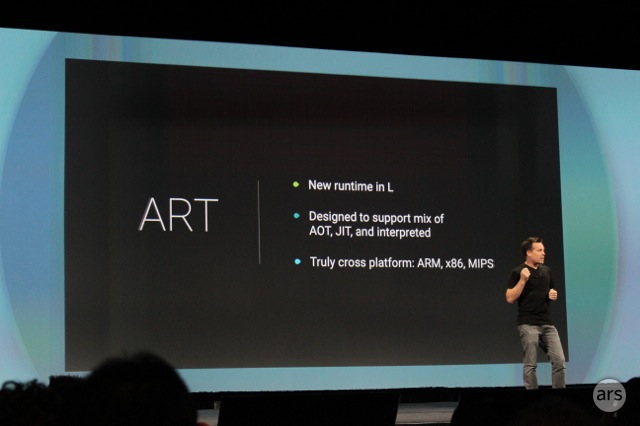
This is a big one, and since Google spent some time talking about it at the keynote there’s a good chance you know about it already. Google is replacing the old Dalvik application runtime with the Android Runtime (ART), which was introduced as an optional developer feature in version 4.4. Google has further improved ART in the L release, but in concept it remains the same as before.
Dalvik uses a just-in-time (JIT) complier, which means that bytecode is compiled into native code on-the-fly each time applications are launched—bytecode is small and portable, so this approach made sense on early space-constrained Android handsets. ART, on the other hand, largely uses an ahead-of-time (AOT) compiler, which compiles the bytecode to native code once when applications are installed and then doesn’t have to recompile them again. If you’ve already used ART in Android 4.4, you may have noticed that applications take longer to install from the Google Play store when you first download them—that’s because the code is being compiled up-front rather than at launch.



 Loading comments...