Panel discussion
 This past weekend, Ars writers Yun Xie and Kunio Sayanagi were invited to attend the pre-release events for the movie The Day The Earth Stood Still, a remake of the classic 1951 Sci-Fi film. The first event was held on the campus of California Institute of Technology on Friday, December 5th, where lead actor Keanu Reeves and the director Scott Derrickson held a panel discussion with scientists Maria Spiropulu, Sean Carroll and Joel Burdick. The discussion was followed by a screening of the film. In this article, Yun gives a recap of highlights from the discussion, and Kuneo gives his impression of film itself from the viewpoint of a professional scientist. The film is set for release on December 12th.
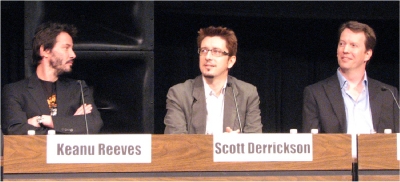
Hollywood actor Keanu Reeves isn't one of the stars you would normally expect to see at the California Institute of Technology, a world-renowned university and home to many stars of the science world. He and director Scott Derrickson took time away from the usual routine of promoting their upcoming sci-fi movie, The Day the Earth Stood Still, to attend a slightly different marketing event at Caltech's Beckman auditorium on Friday. Instead of focusing on the mechanics and entertainment values of the movie, they were there to discuss the relationship between art and science in a panel with three leading scientists. Ars was there to catch every moment of philosophical discourse, genuine humor, and awkwardness.
Joining Reeves and Derrickson on the panel were Caltech Astrophysicist Sean Carroll and Caltech Robotic Engineer Joel Burdick. The fifth panelist, CERN physicist Maria Spiropulu, acted as the host by directing the conversation and presenting audience members' questions, which were collected throughout the show on note cards. From the evening's discussion, the topics that involved the fusion of art, science, and religion stood out.
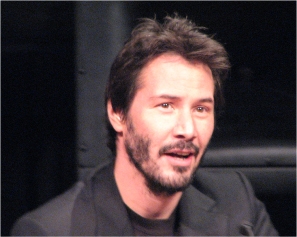
Photo Credit: Kunio Sayanagi.
Is science the antithesis of art?
Science can often appear cold and removed from humanity; data seems to reign supreme, and when it comes to the graphics that science uses to convey ideas, accuracy is far more important than aesthetic design. So, does that mean science is the antithesis of art?
Derrickson certainly doesn't think so. He finds the idea ridiculous. He believes that "we are all searching for some kind of truth," and that "takes different forms." Carroll agreed, pointing out that movies and art can often bring up questions that science might not be able to directly address. Things like morality are hard to quantify in science, but art can probe its depths in various forms. However, that doesn't mean science lacks morals. Researchers must have a great deal of moral integrity to produce trustworthy results and to avoid misusing the trust placed on them. Humanity is at the heart of science and art.
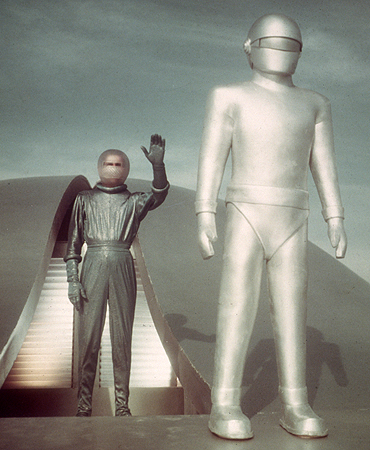
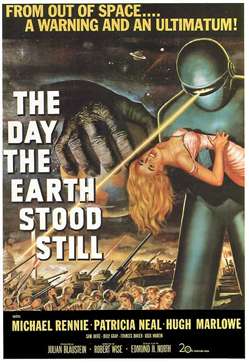
 Among its many small improvements, the new movie added realistic portrayals of women in science and politics, and it incorporated families of mixed race into the mesh of the main storyline, which is basically kept the same. And of course, it is rather rare that the scientists are portrayed as compassionate, conscientious beings in Hollywood films, and I am happy to see this aspect of the movie well-preserved and even improved.
 Loading comments...